1+1+1…: ‘The Second Journey’ by Irene de Andrés
10 — 22 November 2020
— Curated by Blanca del Río
- Artists
- Irene de Andrés
- Curators
- Blanca del Río
- Venue
- Museo Frederic Marès
- Price
- Free admission
Add to calendar
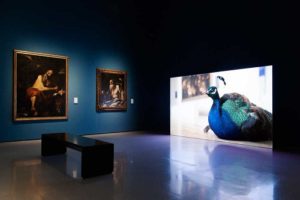
The video 'They Second Journey' by artist Irene de Andrés is part of the delocalized itinerary 1+1+1..., that will unfold throughout different venues in the Gothic and El Born neighborhoods from November 10th to 22nd.
Christopher Columbus made two voyages before reaching the island of Puerto Rico in 1493. In order to develop this project, artist Irene de Andrés had to travel twice to the island as well. There were two days of Puerto Rican independence before it became US territory in 1898, and, finally, two are the videos that make up this piece: El Segundo Viaje (2015-2017)
The island of Puerto Rico, one of the last Spanish colonies, is located between the Caribbean Sea and the Atlantic Ocean. El Segundo Viaje takes this territory as pretext and context to analyze the neo-colonial relations that have been established in the island through exploitative tourism. Through a collage of images, the project explores the region’s recent changes and investigates the transformations of its forms of representation.
The two videos in El Segundo Viaje are made from fragments of other audiovisual pieces. The first one contains images from Puerto Rico’s official archives, dating from the 1940s, 1950s and 1960s. The second video consists of a series of images collected by the artist during the trips she made to the island in 2015 and 2017. For the second part of the project, de Andrés collaborated in the production process with the Beta Local association. The artist’s work is generally concerned with the historical evolution of the concept of leisure, which connects to travel–spanning from the first settlers to contemporary mass tourism. These concerns reveal a fragment of the artist’s biography, since her place of origin, Ibiza, is one of the biggest tourist destinations in Spain.
The montage of the piece questions the meaning obtained through cutting, interposing, dismantling, and joining images with disparate chronological times. It also reveals that by exposing the discontinuities of the image itself and providing a montage of different historical moments, the piece reveals a more complex representation of the Puerto Rican territory. In this way, the artist’s research focuses on how postcolonial politics changed the island’s landscape, in particular its international depiction, managing to reveal, through repeating motifs and places, some of the paradoxes of this construction. The videos show how colonial monuments and ruins of the Spanish empire have become tourist attractions. We can see the port of San Juan, through which the colonists’ galleons once entered, now receive tourist cruise ships. In addition, architectural elements, such as fortresses, that once played an essential role in territorial defense, have now become postcards.
Some of the questions being dealt with in El Segundo Viaje bring to mind issues happening in the context of the project’s exhibition: Barcelona and the Frederic Marès Museum. Currently, Barcelona is in full debate about tourism’s viability as an economic staple for the city. In addition, the museum is located in the Gothic Quarter, one of the areas that has suffered the most transformation due to recent tourist pressure. El Segundo Viaje invites us to ask questions about the city’s representation; the governing of a late-capitalist city whose image is that of a spectacle territory, and whose urban transformation has organized its tangled medieval cartography. It invites us to challenge neighbor’s being dislodged, undocumented immigrants being harassed, and shops, restaurants, and hotels being constructed for tourist consumption. It also makes us wonder about surviving colonial monuments in the city’s landscape, as part of its tourist circuits.
Blanca del Río

Irene de Andrés viu i treballa a Madrid. Es va graduar a l’Escola de Belles Arts de la Universitat Complutense de Madrid (2004-2009) on va fer un Màster d’investigació i producció artística (2009-2010). Ha estat una de les artistes residents de l’Escola FLORA Ars + Natura de Bogotà (Programa de residències artístiques A/CE) i del programa The Harbor de Beta Local a San Juan de Puerto Rico. En 2019 va ser artista resident del programa de Centre de Residències Matadero Madrid. Entre les beques i premis que ha rebut destaquen el premi Circuits d’Arts Plàstiques 2012, Generacions 2013, els Ajuts a la Creació Visual Vegap 2015, i el Premi Ciutat de Palma. Recentment, el treball d’Irene s’ha pogut veure a la galeria Copperfield de Londres, al MuHKA (Museu d’Art Contemporani d’Anvers), al Museu d’Art Contemporani d’Eivissa, en la IFA Galerie a Berlín i en la segona edició de la Triennal de Frestas de Sorocaba (Brasil). Les últimes exposicions individuals del seu treball van tenir lloc a l’Espai 13 de la Fundació Joan Miró de Barcelona i al Museu Patio Herreriano de Valladolid.
* Crèdit del retrat: Matadero Madrid / Bego Solis.
Darrera actualització 22 d’octubre 2020
Blanca del Río

Es licenciada en Historia del Arte por la Universidad de Sevilla (US) y ha cursado el PEI, Programa de Estudios Independientes del MACBA (Barcelona, 2014-2016). Ha trabajado como gestora cultural en la Galeria RocioSantaCruz y en ArtsLibris. Es miembro co-fundadora FASE. Espacio de creación y pensamiento (L´Hospitalet de Llobregat, 2018). También ha llevado a cabo proyectos curatoriales como Un amplio pliegue, un largo tejido (Galería Javier Silva. 2019), Ante el Tiempo. Micro-relatos de resituación (Programa Iniciarte, 2018), Emociones Incendiarias (Can Felipa 2018) o Ne travaillez jamais (Galería ADN Platform, 2016). Ha colaborado con instituciones como La Virreina Centro de la Imagen (Barcelona) o el MUSAC (León). Hasta hace poco trabajaba en el departamento de exposiciones del Museo Picasso de Barcelona, también escribe para el Diario de Sevilla y textos para catálogos de artistas.
Última actualización 22 de octubre de 2020