A-Place: Place-making…
Tuesday 16 November 2021, 4 — 5:30 pm
— through body moves.
- Participants
- Adrian Schindler, Cecilia Bengolea and Violeta Ospina
- Moderator
- Arash Fayez
- Language
- English
Add to calendar
Artist Arash Fayez will lead a conversation that explores the role of music in forming a sense of belonging to a location, which is the main concern of the project “I can only dance to one song” he developed in the framework of “A-PLACE. Linking places through networked artistic practices”. This work portrays accounts of displacement rooted in the experience of migrants through sound and movement. It looks at the crucial role that these forms of cultural production have for migrants to keep their roots and origins alive while living in a new and often unfamiliar context. Several question are raised:<br />
How to keep connection with one’s own roots while using a language that could be understood worldwide (as dancing) ? In which ways cultural exchange instead of complete assimilation can be a strategy to remain connected to one’s origins while living in a new environment ? What can be the rôle of music and body as cultural vectors in a displacement situation ? <br />
<br />
This activity is co-financed by the Creative Europe program in the framework of the project "A-PLACE. Linking places through networked artistic practices"
Adrian Schindler
- Participant
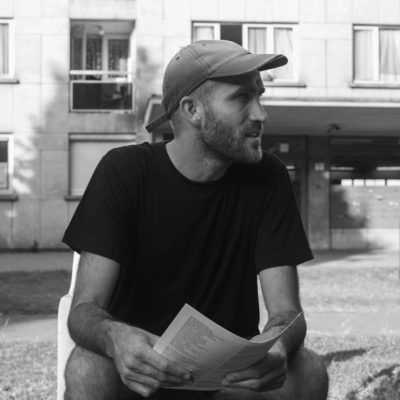
Adrian Schindler is a visual artist. His practice deals with the link between traumatic historical events, cultural production and ideology through the prism of biographical or marginal narratives. Blending documentary research and encounters, he focuses his attention on public space, institutions and the private sphere and examines how modes of representation participate in the construction of national narratives and how they affect our relation to alterity. Often collaborative, his methodology explores formal and performative modes of interpretation of documents from the past in order to make palpable their social and political echoes in the present. His work has been presented at FRAC Champagne-Ardenne (Reims), Ludwig Forum (Aachen), La Grande Halle de La Villette (Paris), Centre d’art Le lait (Albi), La Capella, (Barcelona), Mahal Art Space (Tangier), One Gee In Fog (Geneva), El Born CCM (Barcelona), Arxiu Nacional de Catalunya (Sant Cugat) and La Comédie (Reims), among others. Residencies include Château Nour (Brussels), Casa de Velázquez (Madrid), Superdeals (Brussels), Le Centquatre (Paris) and ZK/U (Berlin). He is currently member of the Académie de France de Madrid 2020-21. Since 2013, he regularly collaborates with the artist Eulàlia Rovira.
Last update: 19th November, 2020
Cecilia Bengolea
- Artist, Participant
1979, Buenos Aires

Cecilia Bengolea (Buenos Aires, 1979), works on a range of media including performance, video and sculpture. Using dance as a tool and a medium for radical empathy and emotional exchange. Infused with the symbolic energies found within nature and relationships, her compositions are formed around ideas of the body – both individually and collectively – as a medium. Bengolea develops a broad artistry where she sees movement, dance and performance as animated sculpture.
Bengolea has collaborated with dancehall artists such as Craig Black Eagle, Bombom DHQ, Damion BG, and with artists Dominique Gonzalez Forster and Jeremy Deller. Her collaborative work with French choreographer François Chaignaud, Pâquerette (2005-2008) and Sylphides (2009), have earned several awards such as the Award de la Critique de Paris in 2010 and the Young Artist Prize at the Gwangju Biennial in 2014. They have also co-created dance pieces for their dance company as well as for the Ballet de Lyon (2013), the Ballet de Lorraine (2014) and Pina Bausch Tanztheater Wuppertal.
Cecilia Bengolea’s work is a part of numerous public and private collections including TBA21 Accademy, Mire Fond Cantonal de La Ville de Geneve, The Vinyl Factory, Le CNAP, Le Consortium, Peter Handschin and Martin Hatebur, Fiorucci Arts and Trusts, Tank Shanghai, Fundacion Arco, Jimena Blazquez Bonte, Fernando Arriola.
Violeta Ospina
- Artist, Participant
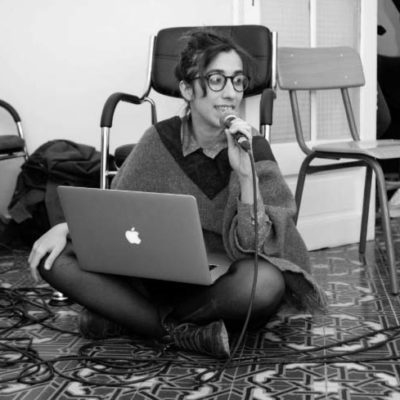
Violeta Ospina (Bogotá, 1986) is an interdisciplinary artist, performer and educator. She studied Fine Arts and a Master’s degree in Theatre and Live Arts (2011-2013) in Bogotá, with a scholarship from the National University of Colombia. After studying Sound art at the University of Barcelona (2015), she emigrated to Barcelona in 2014, where she committed a “sonorous suicide of the technological man” and founded an auction house for disappeared theaters in gentrified areas. In 2016 she joined the Ràdio Web MACBA group and co-founded the experimental collective Radio Cava-ret. Her work focuses on the estrangement and altered perception of urban objects, places and buildings, provoking temporary relations and situations mostly related with what is called “popular culture”, and their political implications. Some of her recent exhibitions and performances are: Trapitos al sol (Bar Project, Barcelona), 2021; Mutual aid monument, (El Born, Culture and Memory Center, Barcelona), 2020; So happy together & altres covers (Alalimón, Barcelona), 2020, among others. She has recently been awarded with La Escocesa’s Research and Art Experimentation Grant (2021) for the project: Memories of the factory diaspora.