Aimar Pérez Galí. ‘Touching Blues’
Thursday 11 November 2021, 7 — 9 pm
— In the context of the celebrations of Segundo de Chomón’s 150th anniversary
- Artists
- Aimar Pérez Galí
- Curators
- Cloe Masotta
- Venue
- Filmoteca de Catalunya
- Tickets & register
- www.filmoteca.cat/web/ca
Add to calendar
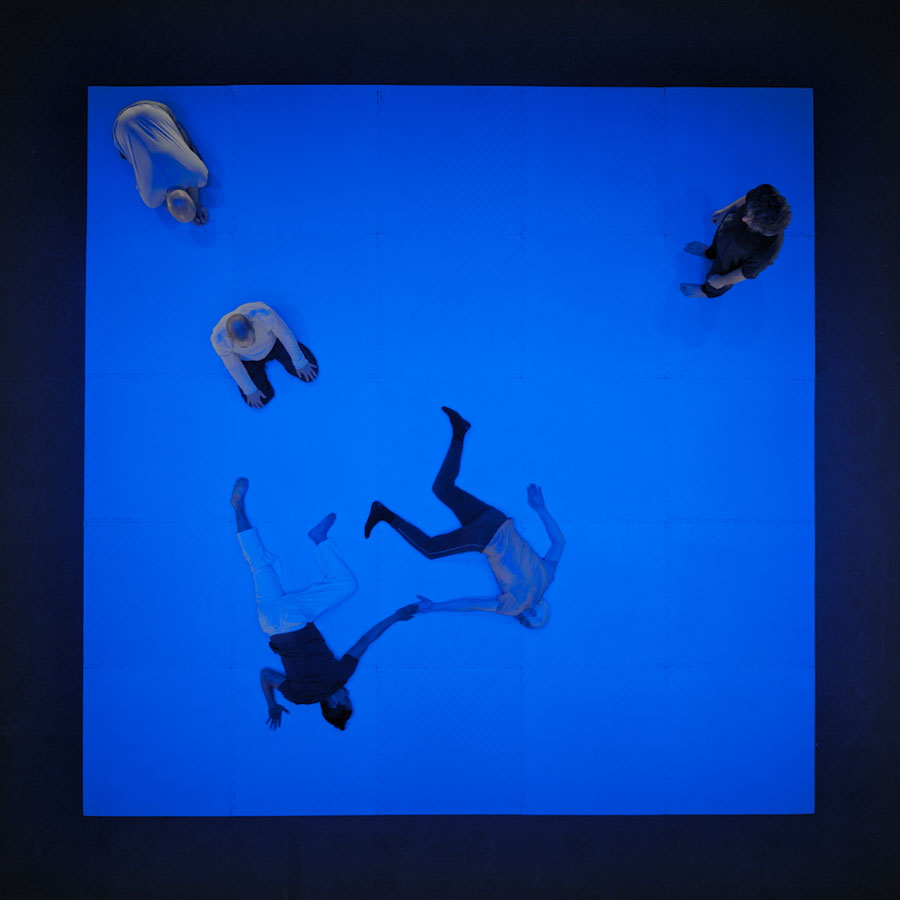
On the occasion of the celebrations of Chomon’s 150th anniversary at the Filmoteca de Catalunya, curator Cloe Masotta presents Aimar Pérez Galí’s latest film. <br />
Since its inception, film has been fascinated by the image of a body in movement, dancing, and its representation. This fascination is quite prevalent in Segundo de Chomón’s output. Touching Blues (2021) by Aimar Pérez Galí raises his very same question of the image of a body in motion a century later, after the appearance of digital film: that of a dancing body traversed by history and by the memory of absent bodies. A body that is light, spectral presence and invocation all at once.
The film immerses us in a hypnotic tactile choreography and in a color, the eponymous blue, which conjures up the film Blue (1993) by Derek Jarman. Indeed, according to Jaime Conde-Salazar and Aimar Pérez Galí, “Touching Blues […] has a commemorative purpose: we continue to do this, we continue to insist, because it is still necessary to remember, to listen to and celebrate the bodies of those who suffered and suffer from the HIV/AIDS pandemic.”

Aimar Pérez Galí develops his artistic practice in the field of dance and live arts as a dancer, choreographer, researcher, teacher, and writer, starting from a notion of the human body as a place of reference, and of dance as a tool for critical transformation rather than an end in itself. He studied contemporary dance at the Amsterdam Hogeschool vor der Kunsten and he studied a master’s degree in critical theory and museology in the context of the independent studies programme of the Barcelona Museum of Contemporary Art (MACBA) / Autonomous University of Barcelona (UAB). From 2010 to 2018 he was a co-founder and director at Espacio Práctico. He joined the Higher Conservatory of Dance of the Barcelona Theatre Institute as a teacher in 2014 and has been a part of its management team since the 2019-2020 school year. He was a member of the Barcelona Cultural Council from 2016 to 2019 on account of his personal accomplishments.
Cloe Masotta
1977, Barcelona
Docente, crítica de cine y arte contemporáneo, curadora y mediadora cultural. Es doctora en Comunicación por la Universidad Pompeu Fabra, donde también ha cursado las licenciaturas en Humanidades y Comunicación Audiovisual, así como el máster en Estudios de Cine y Audiovisual Contemporáneos y el máster en Teoría y Crítica del Arte Contemporáneo dentro del Programa de Estudios Independientes del Museo de Arte Contemporáneo de Barcelona (MACBA.) Recientemente ha publicado los libros Cuerpos exquisitos. Identidades y deseo en el archivo Xcèntric (CCCB) y Tendremos que encontrar un lugar donde encontrarnos (La Caníbal edicions y Barcelona Producció 2020).