High Fidelity
21 October — 22 December 2021
— Artist-designed record covers
- Curators
- Javier Panera
- Venue
- Espai MercArt
- Price
- Free admission
Add to calendar
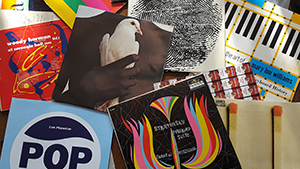
The HIGH FIDELITY exhibition (artist-designed record covers) is a historical journey through the relationship between contemporary art, graphic design, and popular music as told by over 200 covers of records ranging from the nineteen fifties to our days, especially focusing on those moments in which renowned avant-garde artists actively collaborated with their musical contemporaries.
What came first: pop music or pop art? Conceptual art or conceptual records? Abstract expressionism or free jazz? Sculptural or musical minimalism? Punk or the neo-expressionists? The Young British Artists or Britpop?
Cross-pollination between popular music and the visual arts has been particularly productive throughout the 20th century, and there are already several generations of artists who have integrated elements directly or indirectly related to the attitudes and collective imaginations developed by genres such as jazz, rock and roll, pop, psychedelic music, glam, punk, soul, disco music, hip hop, indie pop, electronic music, or any of the more fleeting sub-genres and trends from the last fifty years into the production process of their works.
Pop and rock are not merely music, they are also “image” and, prior to the emergence of the video clip in the eighties or platforms such as YouTube in the 21st century, this image was most perfectly embodied (apart from the appearance of the artists themselves) by the cardboard sleeves that housed 7”, 10” and 12” vinyl records.
In the hands of many an artist, the surface of these de 31 x 31 cm cardboard sleeves became a symbolic blank canvas that beckoned for meaning and a stimulating field of aesthetic experimentation that has proven to be full of surprises. Nowadays, this “music for the eyes” has taken on a mythical nature for the younger generations, and a historic one for their elders.
High Fidelity gathers hundreds of record covers that show how the most significant artistic trends from the second half of the 20th century often went hand in hand with aesthetically equivalent musical trends.
Spectators may bemoan the absence of certain covers from legendary bands such as the Beatles, Rolling Stones, Pink Floyd, Led Zeppelin, Sex Pistols, Joy Division, The Smiths or U2 (among many others), which we have chosen to leave out of this exhibition due to the fact that they were created by graphic designers, who were nearly always associated to record labels. Indeed, our intention is to highlight covers created by visual artists who, in principle, enjoyed more freedom from the constraints of the music industry in their work.
Based on this premise, High Fidelity has gathered record sleeves with images that were designed (or expressly granted) by over a hundred relevant visual artists, and it is divided into a number of sections ranging from historical avant-garde styles such as cubism, dadaism, surrealism or abstract expressionism, to movements such as fluxus, nouveau réalisme, minimalism, pop art, feminist art, or conceptual art, not to mention recent artistic trends such as the Young British Art movement, relational aesthetics, or post-production theories.
Moreover, visitors will have the chance to listen to an extensive musical selection from the display through a Spotify playlist system that was especially designed for this occasion.
Javier Panera
1965, León

Javier Panera Cuevas is Professor of Audio-Visual Culture and Latest Artistic Trends at the University of Salamanca. He has been Director of DA2, Centro de Arte Contemporáneo de Salamanca (2004-2011) and of the Festival Internacional de Fotografía y Artes Visuales de Castilla y León, Explorafoto (2006-2011). Furthermore, he has acted as curator for over one hundred one-man/woman exhibitions devoted to contemporary artists, both from Spain and abroad, such as Albert Oehlen, Judith Barry, Tony Oursler, Franz Ackerman, Fernando Sinaga, Kendell Geers, Roland Fischer, Concha Jerez, Félix Curto, Tania Bruguera and Marc Bijl, as well as for the group shows Barrocos y neobarrocos. El infierno de lo bello (2005), Mascarada (2006), Video Killed the Radio Star. Una historia del videoclip (with Diego Manrique, 2006), Rock My Religion (2008), and Merrie Melodies (y otras trece maneras de entender el dibujo) (2010). Panera is a regular contributor to specialised magazines including Flash Art International, Art Pulse and art.es, and has written, among other books, Emociones formales. Reflexiones sobre el inconsciente pictórico en la fotografía y la imagen en movimiento (2005), Música para tus ojos. Artes visuales y estética del videoclip. Una historia de intercambios (2009) and Video Killed the Painting Star – Pintura e imagen en movimiento (2010). He is currently directing the ‘Plataforma. Artes visuales y puesta en escena en la era digital’ research project.
4 April 2017