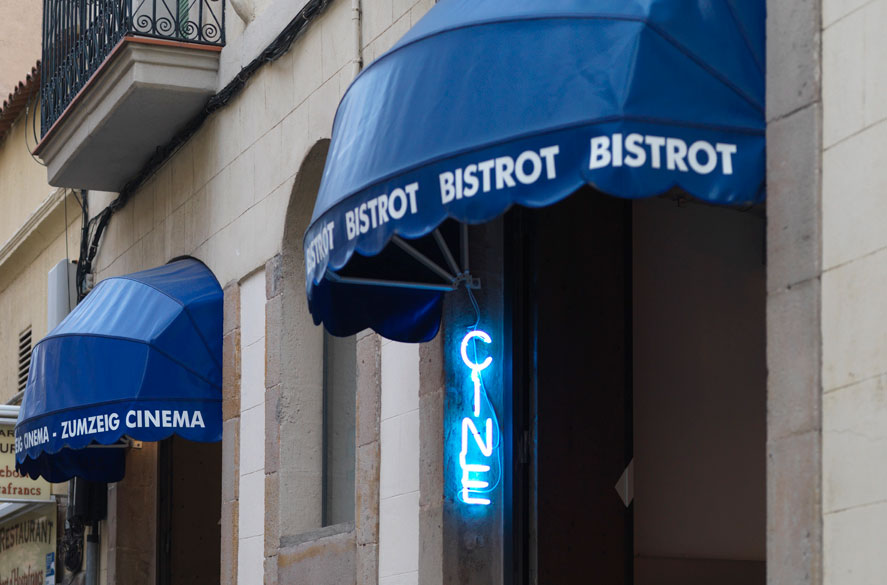
Daniel Steegmann. ‘Fog Dog’.
Sunday 14 November 2021, 7:30 pm
- Artists
- Daniel Steegmann Mangrané
- Venue
- Zumzeig
- Contributor
- In collaboration with Esther Schipper (Berlin)
- Tickets & register
- www.zumzeigcine.coop
Add to calendar
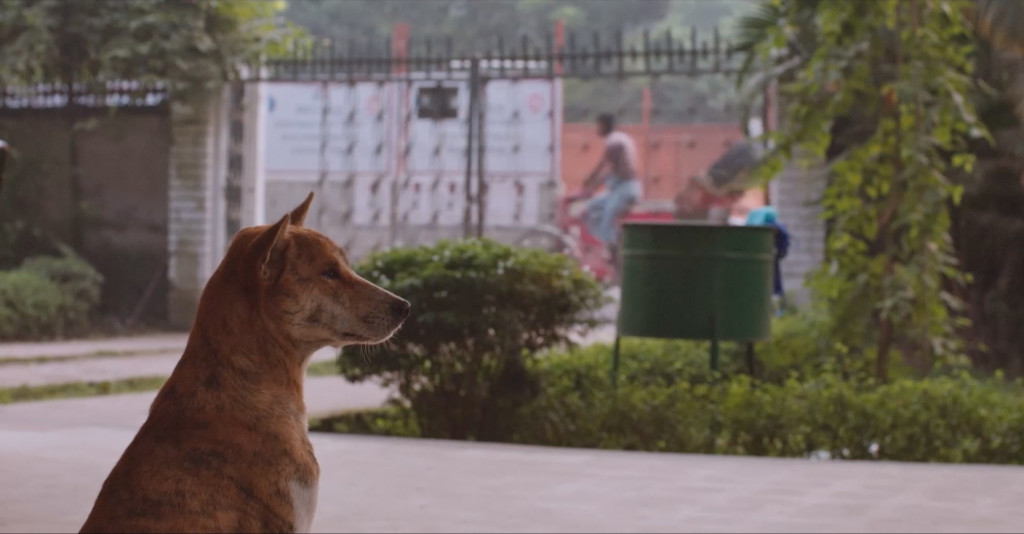
Premiered in early February at the Dhaka Art Summit 2020, ‘Fog Dog’ is the artist’s first foray into cinematic storytelling. It takes as point of departure the curious interaction of human and non-human inhabitants of the Institute of Fine Arts of Dhaka, documenting the daily life of the school and the numerous stray dogs that live there and seem to lead a parallel existence.
Designed by architect and pioneer of Bangladeshi modernism Muzharul Islam (1923-2012) and characterized by an open structure—open colonnades, free-standing staircases, ceramic jalousies, and wooden screens allow for an interweaving of interior and exterior—the building is both stage and protagonist of the film. Boundaries between inside and outside, building and surrounding gardens, institutional and public spaces seem fluid. The ambient noises of the tropical landscape and the urban environment mingle, creating a richly evocative sonic landscape.
Drawing on the inextricable entanglement of traces of the past and prospects of the future in today’s realities, conversations about the lasting consequences of the colonial past and a TV report on the effects of climate change are woven into the daily lives we encounter, as the film settles in on the routine of the school’s nightwatchman. During the night the building is visited by a ghostly presence—a phantom that will not seem out of place and continues to haunt its guardian even after daybreak.
Daniel Steegmann Mangrané
- Artist, Jury, Participant, Speaker
1977, Barcelona
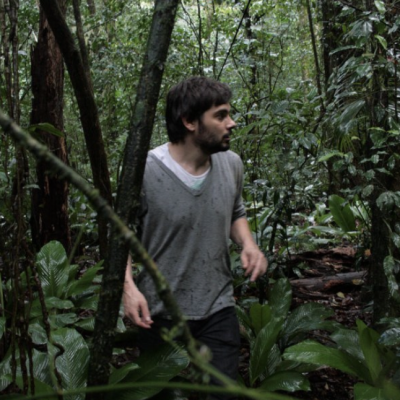
Born and educated in Barcelona, Daniel Steegmann Mangrané now lives and works in Rio de Janeiro. He is part of the generation of artists that began their production at the beginning of this century. The artists’ varied techniques and media include film, sound, drawing, kaleidoscopic collages, photography, sculpture and gardens. Nature is a constant in his work, which explores the contamination and affinity of forms that exist between nature, art and architecture. Concerned with the global ecological crisis, he believes that any change in the natural environment also modifies our own nature. Both in his sculptures, which are extremely fragile and incorporate altered organic material, and in his filmic work, the artist experiments with the correspondences between organic and geometric forms, and with the complex network of dependencies between natural order and the order created by human beings.
Solo exhibitions include: Kunsthalle Münster (2020), Hangar Bicocca, Milan (2019), Institut d’art contemporain, Villeurbanne/Rhône-Alpes (2019), Nottingham Contemporary (2019), CCS Bard College, New York State (2018), Fundació Antoni Tàpies, Barcelona (2018), Fundaçaô Serralves, Porto (2017), Museo de Arte Moderno, Medellín (2016) and Museu de Arte Moderna, Rio de Janeiro (2015). He has participated in biennials and triennials in Lyon, Berlin, New York, Paris, Porto Alegre and São Paulo, among others. His work is included in the collections of Tate Modern, London; Museu de Arte Moderna, Rio de Janeiro, Museu Serralves, Porto; Museo de Arte Contemporáneo, Castilla y León; Fundació “la Caixa” and MACBA, Barcelona.