Mabel Palacín. ‘Homeland’
15 November 2023 — 24 January 2024
- Artists
- Mabel Palacín
- Venues
- Museu Nacional d’Art de Catalunya
- A project by
- Museu Nacional d'Art de Catalunya
Add to calendar
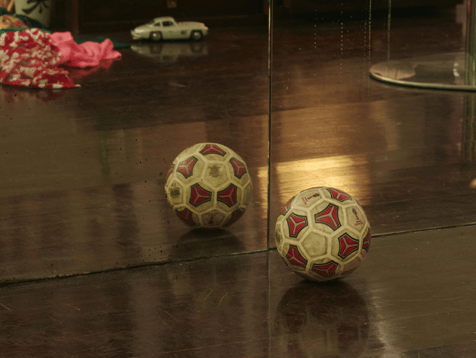
Homeland is a film that is born entirely from a photograph. Using a thousand fragments of a photograph that has disappeared and cannot be pictured in the mind, two characters who simply appear as voices attempt to reconstruct it and find the reason for its disappearance. Both of them view the images differently, and a film documents the reconstruction process. The partnership that eventually forms between them guides us through the remains of a culture in which art appears as a potential means of salvation.
André Malraux offers a definition of art history as the history of what is photographable. Museums already possessed the ability to transform objects, but the advent of photography essentially established art history as a discipline. Reproduction changes the relationship we hold with art, and by expanding the scope further, some minor arts are transformed into rivals of their major counterparts. The museum serves as a space for the metamorphosis of perspective. Homeland is a piece comprised of 1,000 photographs, fragments of a lost photograph, and a video – a fluid form where the process becomes a decisive element. At the same time, the composition forges a link with the museum structure and its potential to persist within the interplay of image and architecture.
Homeland sets in motion a process in which an image is fragmented into a thousand pieces and subsequently reassembled as a film that aims to restore the lost connection between each individual part. The persistent fragmentation tests the boundaries of the image. The original disappears into the thousand fragments that scatter across the room and reappear in the form of a film projected in a separate area. All the images create a mechanism in which process and narrative intertwine.
Homeland is a work that examines the diverse aspects of a photograph; by combining process, mechanism, and narrative, it establishes a dialogue with Gothic altarpiece painting as a narrative artifact that can be viewed through a contemporary image.
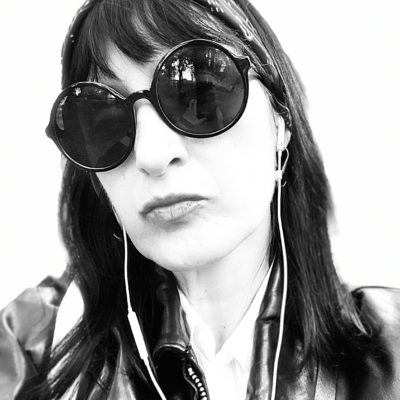
Mabel Palacín graduated in History of Art and Cinema, photography and video from the University of Barcelona. She currently works between Barcelona and Milan. The subject of her work is photography considered in all its mutations, including cinema, video and its digital variants. She considers images as theoretical agents capable of developing models from which to understand and expand the contemporary visual landscape. The notion of project is essential in her method of work, in which images generate instructions for use and engender narratives that arise only because of the images themselves. In her work the content of the images is always the spectator, and the spatial dimension as well as the multiple projection of some of these works strongly request the viewer, establishing links between image and architecture.
In 2019, her project “Thieves”, was the winner of the 6th edition of the Videocreation Prize, promoted by the Xarxa de Centres d’Arts Visuals de Catalunya, the Department of Culture and LOOP Barcelona. During LOOP Festival, in November 2020. The same year she realized El Trayecto a video made with the camera system of an autonomous car. In 2011 she represented Catalonia and the Balearic Islands in the 54th Venice Biennale with the work 180 degrees. Her work has been seen in individual and collective exhibitions at the Ángels Barcelona Gallery, Frankfurter Kunstverein and LA Galerie (Frankfurt), Centre d’Art Santa Mònica(Barcelona), The Agency (London), Norwich Gallery (Norwich), Transmission Gallery (Glasgow), Kwangju Biennale (South Korea), Artothek (Cologne), Taipei Fine Arts Museum (Taiwan), Kunstbunker Tumulka (Münich), Bolsky Gallery (Los Angeles), Galerie Anne de Villepoix (Paris), Künstlerhaus Bethanien (Berlin), MUA (Alicante), Colecçao Berardo Museum (Lisbon), Salvador Dalí Museum St. Petersburg (Florida), Frac Languedoc-Roussillon (Montpellier), MACBA (Barcelona), OK Center (Linz.), Casino Luxembourg (Luxembourg), Artium (Vitoria), Reykjavik Art Museum (Reykjavik) among others. She currently resides and develops her work between Barcelona and Milan.