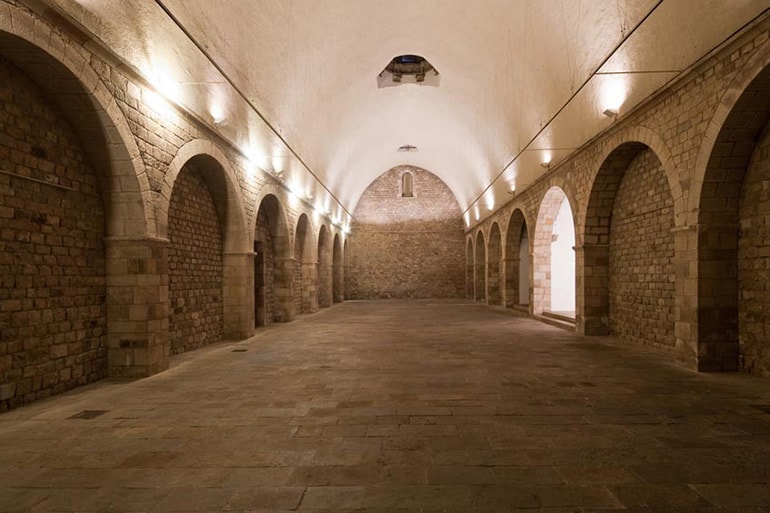
Raquel Friera i Xavier Bassas. ‘Institute of Suspended Time (ITS)’
10 — 20 November 2022
— Enter, enter this headquarters of the Institute of Suspended Time... it is and is not art, it is and is not a performance, it is and is not mere philosophy, mere politics, this headquarters is a suspended space and a suspended time... Is it then activism? Is it therapy? Is it what you were looking for in your dreams, in your psychoanalyst, at the end of the month?
- Artists
- Raquel Friera and Xavier Bassas
- Venue
- Centre d’Art la Capella
Add to calendar
What distress! What a relief! The Institute of Suspended Time (ITS) opens its first physical headquarters in La Capella. For all those who feel the anguish of time, for all those who need to alleviate their temporary health.
Enter, enter this headquarters of the Institute of Suspended Time (ITS)… it is and is not art, it is and is not a performance, it is and is not mere philosophy, mere politics, this headquarters is a suspended space and time… Is it then activism? Is it a therapy? Is it what you were looking for in your dreams, in your psychoanalyst, at the end of the month?
It is not a joke, although we can laugh. We talk about the most serious, the most serious thing that happens to us in life: “not having time” (“Life doesn’t give me”, we say, “to really take care of my mother, my friends, my father, my children, it doesn’t give me what I would like to do before I die”). Or, to be more exact, more political, what happens to us is that we have naturalized a temporary regime that makes us sick: in the ITS we call it “chrononormativity” and this currently has to do with intimate, professional and social hyperproductivity.
… it is not about opposing, to this hyperproductivity, what is called “laziness” or “idleness”. We are talking about contesting a system, an entire temporal regime, and for this reason we must oppose to “chrononormativity” what we call “chronodiversity”, that is, another temporal sensitivity that escapes the norms related to time…
The Institute of Suspended Time was founded in Laboratory 987 of the MUSAC (León) and takes shape today, in this headquarters in Barcelona, as a collaboration between the LOOP Festival and La Capella. Conceived and performed as a project halfway between art and philosophy, politics and poetry, the ITS tries to suspend the temporal regime that dominates us, stealing all the time expropriated by the acceleration of work and networks, time expropriated by the temporary consensus that governs our lives.
… because the temporary consensus invades everything, not only the workplace, but the whole of life… tell me, if not, tell me… when did you kiss for the first time? At what age did you want to have a job? When is it time to have children and why? And also, on a daily basis: at what rhythm do you love? What time do you live in? And when was the last time, if any, that you spoke honestly about your relationship with time?
Come in, come into this headquarters of the Institute of Suspended Time… we have been waiting for you for days, months, for centuries… and you, were you waiting for us too?
Raquel Friera and Xavier Bassas

Raquel Friera first obtained a degree in Economics and worked where sales rates must grow every quarter. She then did Fine Arts and her artistic projects began by dynamiting precisely everything she had learned in both degrees: Sobre perder el tiempo (2007), Maltepe (2007), Tiempo libre (2009), Habana-Guáimaro (2010). These were followed by other projects that denounced the various devices of social control: the internment centers for foreigners, racial or religious identities, economic morality, among others. Feminist thought has accompanied her more and more in her work to finally synthesize time as the essential device for the production of subjectivity in our societies.
Together with Xavier Bassas, professor of French Studies at the UB, translator of French thought and activist philosopher, she founded the Suspended Time Institute (ITS) in Laboratory 987 of Musac (León). It is a project that combines the means of art and philosophy to challenge chrononormativity and open a new poetics of time. The Suspended Time Institute would not want to limit itself to placing “life at the center”, as some feminist thinkers rightly insist: it would be about knowing that placing life at the center is placing suspended time at the center of our lives. And to practice it.