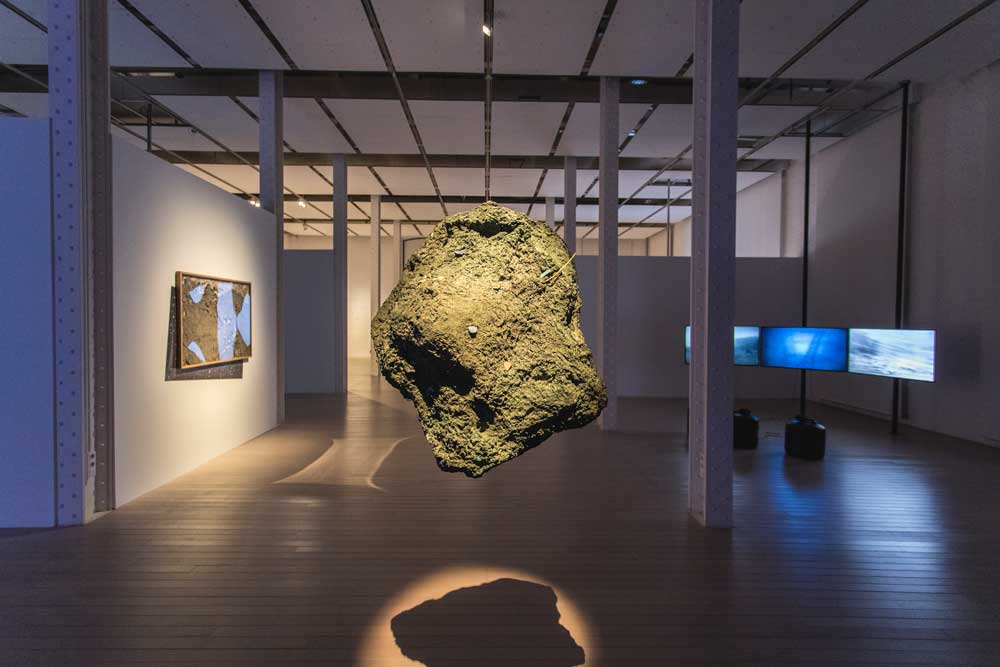
One Day I Stumbled Upon a Meteorite
12 November 2019 — 19 January 2020
- Artists
- Belén Rodríguez, Irene Grau, Pedro Torres, Francisco Navarrete, Julia Llerena, María Molina Peiró, Regina De Miguel and Abel Jaramillo
- Curators
- Carolina Ciuti
- Venue
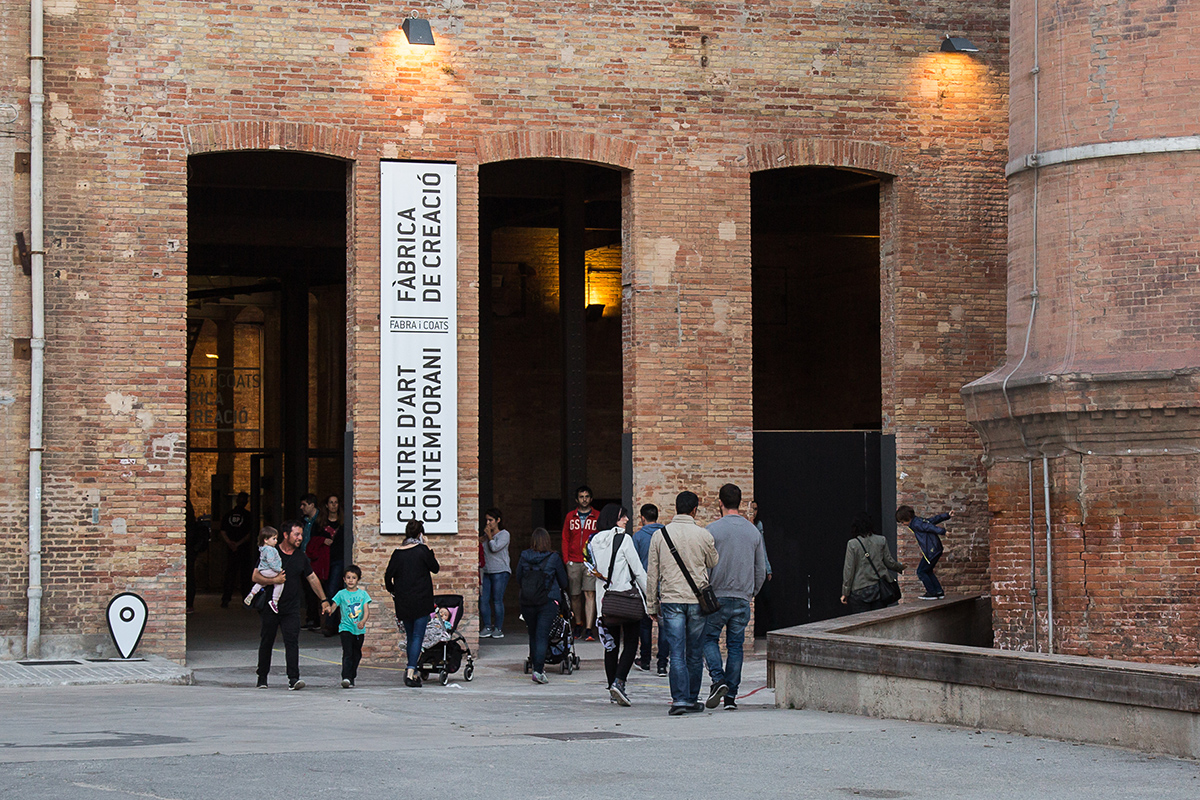
- Fabra i Coats-Centre d’Art Contemporani de Barcelona
- A project by
- Coproduced by LOOP Barcelona and Fabra i Coats - Centre d'Art Contemporani
Add to calendar
Information leaflet One Day I Stumbled Upon a Meteorite
In the short story “The distance of the moon” (1965), Italo Calvino tells us about the human will in relation to unattainable goals, fictionalizing a universe in which the space that separates us from the satellite also becomes a metaphor for the desires, passions and obsessions on Earth.
To direct the gaze towards the starry sky corresponds to that vertical impulse to which human beings have always responded, an impetus of the body that discloses questions about the origin of the world, the need to find an orientation and the inclination to explore. Likewise, and in different historical eras, this ascending action has embodied the form of the utopian dream, of the fear of invasion, until disclosing the features of a future interstellar colonisation.
From the Space Race era, the possibility of an expansive ‘territorialisation’ of the universe is related today to the uncertainty of the future of life on Earth, thus reducing the seeming distance between the otherness of the cosmos and our daily life. As if the space we inhabit, “infinite, indistinguishable and uniform in all its directions” (Cambridge Dictionary) acquired physical and tangible substance, and forced us to wake up from our self-absorbed walk.
When the already complex debate about the nature of ‘space’ that exploded at the beginning of the Eighteenth century, two main positions were facing: the rationalist, according to which space corresponded to the relationship of distance or proximity between things, and the absolutist that identified it with an omnipresent entity and partly conducible to something divine. Later, Immanuel Kant would talk about space as an abstract concept that human beings have created to make sense of the world. According to contemporary physics, space-time is explained and represented as a container within which we move and flow, an imperceptible system that determines, organises and affects our existence.
By abstaining from the specificity of the scientific discourse and redirecting the debate to a metaphorical context, the ‘spatial gaze’ would then offer a way to narrow the distance between the infinitely large and our daily microcosm, while interrogating those issues that touch us closely, according to a reversed movement that from the cosmos would solicit the body. As if walking down the street we stumbled upon a meteorite.
Belén Rodríguez
- Artist
1981, Valladolid
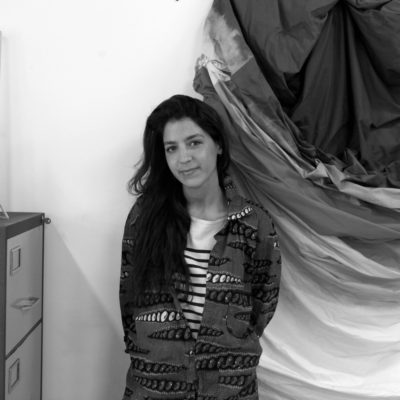
Belén Rodríguez (Valladolid, 1981) is Master Art by the Academy of Fine Arts of Vienna, where she studied with Professor Heimo Zobernig and graduated in Fine Arts from the Complutense University of Madrid. She has taken part in different international Artist in Residence Programs such as Flora ars+natura, Bogotá, El Ranchito de Matadero Madrid and ArtistaXArtista in Havana, Hooper Projects in Los Angeles, Atelier Salzamt in Linz, Academia de España in Rome, Hangar + GlogauAir in Berlin and BMUKK in Tokyo.
Some of her solo exhibitions are ‘I turn Chilli Red’ at Josh Lilley, London 2019, ‘Paintung’ at Patio Herreriano, Valladolid 2018, ‘After Sputnik’ at Josh Lilley, London 2013, ‘Circa’ at Das weisse haus, Vienna 2011 and ‘XXXXX’ at Galería Parra y Romero, Madrid 2010.
His work has been part of exhibitions in institutions such as CA2M, Tabacalera, Matadero and La Casa Encendida in Madrid, Can Felipa in Barcelona, das weisse Haus, in Vienna, Yokohama Creative Center in Yokohama and the Concert Gebouw in Bruges among others.
Irene Grau
- Artist
1986, Valencia
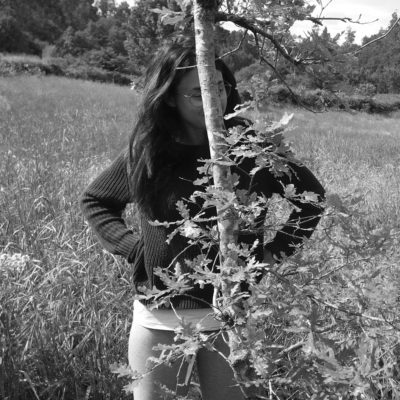
Irene Grau holds her PhD in Fine Arts from the Universitat Politècnica de Valencia. In 2010 she received an Academic Excellence Scholarship, and from 2011 to 2015 a scholarship from the Spanish Ministry of Education, Culture and Sports to carry out her PhD studies. Recognized by national and international Awards such as Generaciones 2018, the 2018 Foreign Scholarship awarded by A Coruña Museum of Contemporary Art, the 2017 Mardel Visual Arts Award, as well as the 2015 PhotoEspaña Off Festival Award. In 2016, she was included in Forbes’ List “30 Artists under 30 – Europe”. Her work was the subject of individual exhibitions in European and American institutions and galleries, such as the Abroms-Engel Institute for the Visual Arts (AEIVA) in Birmingham, US; Madison Museum of Contemporary Art (MMoCA) in Madison, US; Projeto Fidalga in São Paulo, Brazil; Heike Strelow gallery in Frankfurt, Germany, and the Alcobendas Art Center in Alcobendas, Madrid, Spain; as well as in group exhibitions at La Casa Encendida in Madrid, Spain; the CaixaForum in Barcelona, Spain; the Centro de Arte dos de Mayo Museum in Móstoles (CA2M), Madrid, Spain; and at CDAN Art and Nature Centre, Huesca, Spain. Her next projects, scheduled for 2019 and 2020, will be presented at Bombón Projectsin Barcelona, Spain; IVAM (CADA) in Alcoi, Spain, the DIDAC Foundation in Santiago de Compostela, Spain / APPLETON Square in Lisbon, Portugal; and at the Cerezales Foundation Antonino y Cinia (FCAYC). Her work can be found in collections as Madison Museum of Contemporary Art (MMoCA), Madison WI, United States; CA2M Museum, Madrid, Spain; MASAVEU PETERSON Foundation, Madrid, Spain; DKV Foundation, Valencia, Spain; the OTAZU Foundation, Navarra, Spain; and in numerous private collections in Europe, Asia, and the U.S.
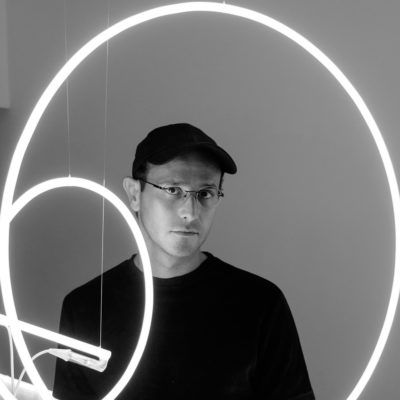
Pedro Torres (Brazil, 1982) focuses his artistic practice on subjects related to the notions of time, distance, memory, language, and image, using a variety of media to develop his works and research projects. His works have been recently displayed at Aragon Park II (Madrid), The Green Parrot (Barcelona), Casal Solleric (Palma de Mallorca), Centro Párraga* (Murcia), Casa Seat* / LOOP Barcelona 2020, Chiquita Room* (Barcelona), Errant. Itinerarios de arte y pensamiento* (Iglesia vieja de El Pont de Suert), Festival Poesia i + (Caldes d’Estrach), Fabra i Coats: Centre d’Art Contemporani de Barcelona, OTR. espacio de arte (Madrid), Swab Barcelona, Dilalica (Barcelona), the Cuenca Biennale (Ecuador), ArtBo (Bogotá, Colombia), CaixaForum Barcelona, BienalSUR (Casa Nacional del Bicentenario, Buenos Aires, Argentina), Festival Embarrat (Tárrega), NC-arte (Bogotá, Colombia), ARCO Lisboa (Portugal), at the Galería Travesía Cuatro and La Casa Encendida (Madrid), Galería Luis Adelantado* (Valencia), the Mardin Biennale (Turkey), the Las Fronteras Biennale (Mexico), the Blueproject Foundation* and the Fundació Antoni Tàpies (Barcelona). His videos have been screened at a number of festivals in Europe, South America, and Asia. He has been awarded scholarships and prizes including PostBrossa (2021), the Exchange art3/Homesession scholarship (2021), the S.O.S ARTE/CULTURA endowments for creation from Vegap (2021), the Production Awards from the “la Caixa” foundation (2020), he was a finalist at the Antoni Gelabert visual arts award of the city of Palma (2020), the research scholarship from the department of culture of the Catalan regional government (2020, 2013), the production award from the Sala d’Art Jove of Barcelona (2013) and the Fundación Botín scholarship (2007), among others. He has been a resident artist in Skagaströnd (Iceland), Seoul (South Korea), Berlin (Germany) and Barcelona (Spain). Some of his works and publications have been featured in the collections of institutions such as MadridAbierto, Fundación Botín, the Blueproject Foundation, the olorVISUAL collection, ICP New York, UPV/Colección de libros de artista and other private collections. He lives and works in Barcelona, where he is a resident artist at the Hangar visual arts production and research centre.
* individual exhibitions
Last update 5th November 2021
Francisco Navarrete
- Artist
1986, Chile
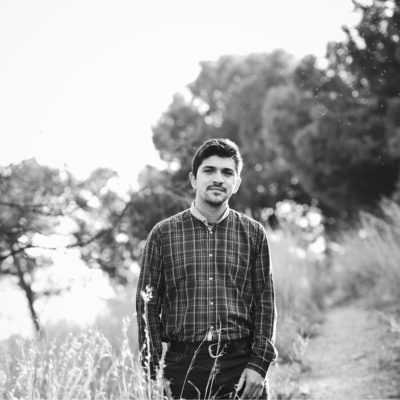
Francisco Navarrete Sitja (1986, Chile), holds a Bachelor’s degree and a Master’s degree in Visual Arts from the University of Chile. He is currently a scholar at the Museu d’Art Contemporani de Barcelona MACBA to study the Independent Studies Programme PEI, and belongs to the international network TSOEG “Temporal School of Experimental Geography (UK). He has been working and living in Barcelona since 2015.
He has participated in art residencies at Hangar.org (ES); V2_Lab for Unstable Media (NL); Territorio compartido, Casapoli (CL); O Espaço do Tempo (PT); Centro Huarte (ES); Residencia Tierra (en)cubierta (CL); L’Asilo Filangieri (IT); Festival de Arte Sonoro TSONAMI (CL); Etiopía Centro de Arte y Tecnología (ES); Proyecto Norte (CL); Fundación BilbaoArte (ES); among others. He is currently participating in a programme of residencies and artistic research at La Becque (CH), Centre d’Art i Natura de Farrera (ES) and INCOGNITUM: Circunnavegaciones Contemporáneas (CL/PT).
He has exhibited, individually or collectively, in different socio-cultural and geographical contexts in Chile, Argentina, Colombia, Peru, Bolivia, Uruguay, Ecuador, Venezuela, Cuba, Spain, Greece, Portugal, Italy, Germany, Poland, France, Switzerland, Austria, Holland, United States, Canada, and Australia, among others.
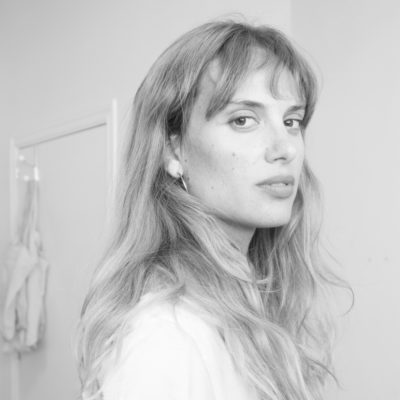
Julia Llerena studied Fine Arts between Seville, Barcelona and Florence. She later completed a Master in Research in Art and Creation at the UCM.
Her solo exhibitions include In event of moon disaster, Fresh Window Gallery, New York; El todo como objeto, Galería RocíoSantaCruz, Barcelona; Estrato 0, Blueproject Foundation; Los lugares de un ardid, FACBA, Granada and Home, una cuestión global, INICIARTE. He has recently collaborated with the Gallery Sabrina Amrani within Art Banchel.
Her work has been shown at the Bienal de Jóvenes Artistas de Europa, Mediterranea 16, Ancona, Italy; MuVIM, Valencia; Da2; Espacio OTR, Madrid; CAAC, Spanish Embassy in Tokyo; Odeon Space, Colombia; Galería Espacio Mínimo (Entreacto); LABoral (Gijón); Rodriguez Gallery, Pozan, among others.
Among the scholarships and prizes he has won are Laboratorio Brecha, La Paz, Baja California Sur, Mexico; Injuve 2015 Creation Scholarship, Plastic Arts Circuits or Production Scholarship of the Community of Madrid.
María Molina Peiró
- Artist
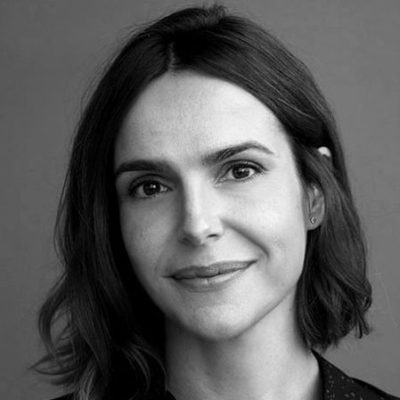
María Molina Peiró is an audiovisual artist and filmmaker. Her work has been shown internationally both in art venues and film festivals such as International Film Festival Rotterdam IFFR, Rencontres Internationales, BFI London Film Festival, Haus der Kulturen der Welt, International Film Festival Oberhausen, Louvre Museum, EYE Film Museum, ISEA Korea, Indie Lisboa International Film Festival, Washington National Gallery, London Science Museum, National Museum of Modern and Contemporary Art (MMCA) Seoul, CCCB, LOOP Videoart Festival, Hong-Gah Museum (Taipei), MATADERO (Madrid), Vilnius National Gallery or Taiwan Video Art Biennale amongst many others.
Her film and installations explore layered realities that connect humans, technology and nature. She is particularly interested in memory systems (from geology to digital memory) and the relation between cinema and science.
María holds a BA in Fine Arts from the University of Sevilla and graduated Cum Laude from the Master of Film at the Netherland Film Academy.
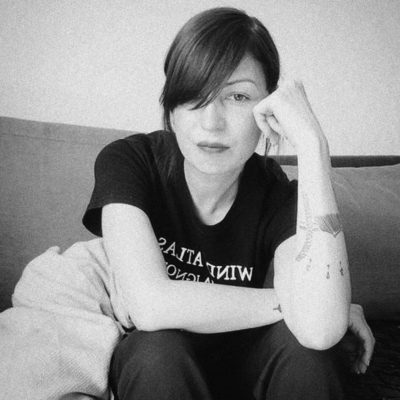
Her interdisciplinary artistic practice is characterized by research and development of processes aimed at the production of knowledge and hybrids objects. The critical analysis of the supposed objectivity of the devices of representation of science, as well as of the conditions of production of scientific knowledge is one of the main discursive threads of her work. From a methodical approach, she establishes complex networks of connections that are also nourished by the philosophy of science, the ecofeminism, speculative fiction and terror, to give rise to theoretical, existential and poetic displacements that operate from the fragility as a form of resistance.
She has had solo exhibitions in: Rising Anxiety, Maisterravalbuena Gallery; I’m part of this fractured frontier, C3A Córdoba, 2018; Aura Nera, Arts Santa Mónica, Barcelona, 2016; Ansible, Maisterravalbuena Gallery, Madrid, 2015; All knowledge is enveloped in darkness, Kunsthalle Sao Paulo, 2014; Nouvelle Science Vague Fiction, General Public, Berlin 2011, El aire aún no respirado, MUSAC, León 2008, among others.
Last update 20th September 2021
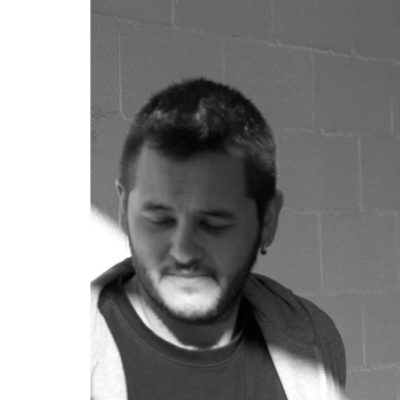
Graduated in Fine Arts from the University of Castilla la Mancha and the University of Lisbon (Portugal) and Master in Contemporary, Technological and Performing Art from the University of the Basque Country. He has shown his work individually at the Fran Reus Gallery (Mallorca), Estrany -de la Mota (Barcelona), Hypercorps (Brussels) and Aldama Fabre (Bilbao) and collectively at Sala Amadís, Centro Centro (Madrid), Centro Cultural Montehermoso (Vitoria-Gasteiz), BilbaoArte Foundation (Bilbao), Fran Reus Gallery (Mallorca), Francesco Pantaleone Gallery (Palermo), MAC (A Coruña), Lo Pati (Amposta), La Capella, Fabra i Coats, Can Felipa or Sant Andreu Contemporani (Barcelona), among others. He has done residencies at Fundación BilbaoArte (Bilbao), Ruber Contemporanea (Palermo), Hypercorps (Brussels), L’Estruch (Sabadell) and Hangar (Lisbon) and has received prizes and grants such as Open Studio – Comunidad de Madrid, Ayudas Injuve 2017, Ayudas Artistas Visuales de Extremadura 2018 or FACBA 2020.
Carolina Ciuti
1990, Pistoia
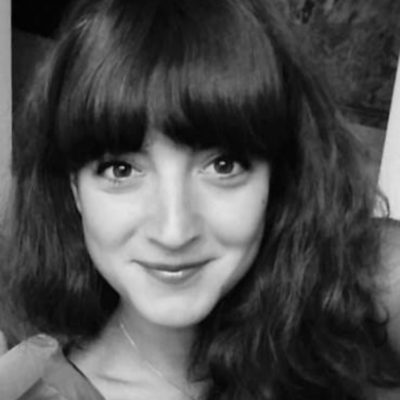
Carolina Ciuti is a contemporary art curator and researcher in the fields of visual and performing arts. She holds a BA in History and Preservation of the Artistic Heritage from the University of Florence (2009-2012) and an MA in Contemporary Art from the Sotheby’s Institute of Art in London (2013-2015). During her university training, she collaborated with the Collezione Gori: Fattoria di Celle (Pistoia) and the artists residency Villa Lena (Pisa), being respectively in charge of the educational proposals, the guided tours and the assistance to the director. She currently serves as artistic director of the LOOP video art festival in Barcelona, where she started working in 2015 as a curator. At LOOP, she has produced exhibitions, film programmes and performances by internationally recognised artists such as: Regina de Miguel, Agnes Meyer-Brandis, Aleksandra Mir, Muntadas, Steina and Woody Vasulka and Anton Vidokle. She curated the group exhibitions And If Seeing Was Fire (Filmoteca de Catalunya, Barcelona, 2020), One Day I Stumbled Upon A Meteorite (Fabra i Coats – Contemporary Art Centre of Barcelona, 2019), PRODUCE, PRODUCE, PRODUCED (Real Cercle Artístic, Barcelona, 2018), the projects Francesca Banchelli: Before The Name (MACBA, Barcelona, 2016) and TRANSEUROPE EXPRESS (OfficeCafè, Pistoia, 2015), as well as the video programmes presented by LOOP at Cinéphèmère-FIAC Paris (editions 2017, 2018, 2019). She edited the publications One Day I Stumbled Upon a Meteorite (exhibition catalogue, stuffinabook, 2020), I Have A Friend Who Knows Someone Who Bought a Video, Once (LOOP Barcelona, Mousse Publishing, 2016) and Before The Name: a book on an itinerant performance project. (RAM Editions, 2018). Ciuti is a permanent collaborator of the magazine of contemporary culture La Maleta de Portbou and she frequently contributes to the art catalogues of the publishing house Istituto Italiano Edizioni ATLAS. In 2017, she co-founded the art collective CRiB to create hybrid projects straddling the visual arts, theatre and performance. Whether through writing, curating, or research, all of Carolina’s projects denote a deep interest in the notion of ‘time’ in all its facets, its representation in the philosophical and cultural sphere, and its influence on the construction of identities.
Last update 3rd October 2020