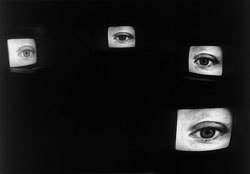
Peter Weibel: Video Lumina, 1977
16 — 20 May 2017
— One of Pieter Weibel's emblematic works presented in one of the world's most iconic works of modern architecture.
- Artists
- Peter Weibel
- Curators
- Diana Padrón
- Venues
- Pavelló Mies van der Rohe
- A project by
- Videomarker: Adolf Alcañiz
Collaboration: Lluís Hortalà - Price
- 5 €
- Tickets & register
- miesbcn.com/en/pavilion.html
Add to calendar
In keeping with the purpose of this year’s edition of LOOP Barcelona, structured around an “archaeology of video art,” we present “Lumina,” one of the emblematic installations of artist, theorist and curator Peter Weibel (Odessa, 1944).
This year’s edition of the LOOP Festival outlines “a contemporary archeology of video”. In this framework, I thought it was appropriate to present Lumina, an emblematic work by the Austrian artist and theorist Peter Weibel (Odesa, 1944). The work was exhibited for the first time at the Galerie Magers in Bonn in 1977, and this year it celebrates its 40th anniversary. Upon the artist’s request, a new edition of the work has been produced, although the original seven channel installation format has remained unaltered. This anachronism prompts us to reflect on the possibilities granted by video creation when it comes to challenging traditional artistic categories such as authenticity and originality.
The video installation Lumina finds its etymological meaning in the Latin term lumen, which refers to an intrinsic source of light, in this case corresponding to the monitor itself. In the guise of a video art treatise, this work attempts to show how the luminous flux perceived by the human eye precisely coincides with its very emission from the monitor’s cathode ray tube. This direct link between the poíesis and the reception of artificial light suggests a rupture with respect to the cinematographic tradition, – which instead needed an external source of light for the capture and projection of the images according to the natural principle of the dark chamber. It also inaugurates a new and seemingly definitive emancipation of the image from the sunlight.
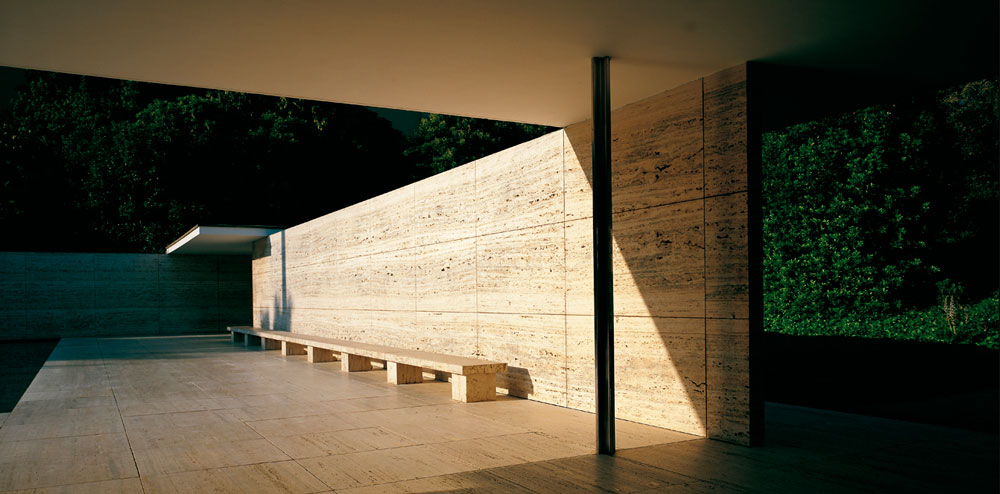
This installation takes the form of a walk-through sculpture that brings us back to the medium’s early days, when audiovisual production blurred the boundaries of both expanded sculpture and those minimalist proposals that incorporated the exhibition space itself. Being an icon of minimalist architecture in Barcelona, the Mies van der Rohe Pavilion, thus, seemed to offer the perfect context to inquire about the spatial dimension of the gaze and the attitude that the spectator takes before the video installation.
Curated by Diana Padrón.
Artists: Peter Weibel

Diana Padrón is a researcher, critic and independent curator. She holds a B.A. degree in Art History from the University of La Laguna, M.A. in Advanced Studies in Art History from the University of Barcelona and a Ph.D. from the same university in Society and Culture: History, Anthropology, Arts, Heritage and Cultural Management. She has been a visiting post-doc researcher at the Università di Padova, Université de Lille and Goldsmiths College – University of London. She collaborates with several art, thought and politics journals, and has been co-editor with Martí Peran of the journal REG|AC (Scientific Journal of Global Studies and Contemporary Art of the Universitat de Barcelona). As an independent curator she has organised exhibitions for the San Martín Centro de Cultura Contemporánea, Centro Atlántico de Arte Moderno, Fundació Mies van der Rohe, Museo Picasso de Barcelona, Loop Barcelona Festival, 13th Havana Biennial, Centro Galego de Arte Contemporànea, Centro de Arte La Regenta and Casal Solleric. She is a member of the Instituto de Arte Contemporáneo (IAC) and the Associació Catalana de la Crítica d’Art (ACCA).
Last update 15th November 2021