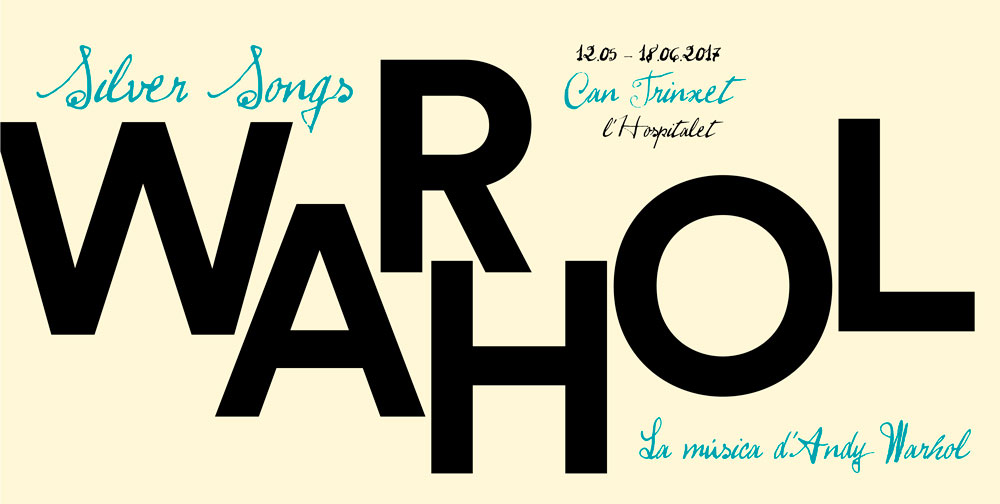
Silver Songs. The Music of Andy Warhol
12 May — 18 June 2017
- Artists
- Andy Warhol
- Curators
- Javier Panera
- Venue
- Fàbrica Can Trinxet
- A project by
- Screen Projects and Districte Cultural de L’Hospitalet
Add to calendar
‘Silver Songs. The Music of Andy Warhol’ has the objective to prove that music – and pop music, in particular – constituted the emotional, iconographic and conceptual basis for the artistic career of the father of Pop Art, as an immaterial and seemingly invisible element yet essential to his creative discourse.
This exhibition traces a genealogy of the relationship between art and pop music from the mid-‘60s, through a selection of paintings, photographs, serigraphs, drawings, album covers, books, magazines, posters, films, video installations, screen tests, music videos and different objects and documents from Warhol’s artistic universe over a period of almost four decades.
The leitmotiv behind this show is a specific aspect in Andy Warhol’s artistic production, which was considered marginal until very recently: namely, his contribution to the history of graphic design in music through the creation of several album covers.
Born in Pittsburgh in 1928, between 1949 and 1987 the artist made more than 60 covers for 33 and 45 vinyl records of all music’s genres. Warhol dedicated to design for music throughout his entire career, starting off in 1949, aged 21 and not yet recognized as an artist, until he reached his mature age. Coinciding with the last months of his life, between 1986 and 1987 he designed covers for artists of the likes of John Lennon, Aretha Franklin and Debbie Harry, as well as for the TV channel MTV.
By looking at the several record covers he made, one could easily trace the history of the taste in music in the US, from World War II up until the last decade of the ‘80s, spanning classical music, opera and ballet, jazz, minimalism, experimental music, rock, pop, soul, disco music, punk and new wave.
As other peer artists like Ray Johnson, Richard Hamilton or Peter Blake, Warhol belongs to that first generation that grew up listening to pop and rock music. He is also one of the first to make rock stars a recurrent subject in his paintings’ iconography. Elvis Presley’s portrait, for instance, is already included in his first serigraphs from 1962. Moreover, Warhol always proved to have a wide music culture, spanning both Wagnerian opera and Hollywood musical, as well as avant-garde music or pop. From Elvis Presley to Maria Callas; from John Cage to The Velvet Underground, Count Basie and Michael Jackson, through Nico, Mick Jagger, John Lennon or Debbie Harry, one of his last muses.
Besides, the record covers that Warhol designed anticipate certain formal and iconographic solutions that he would subsequently deploy in his painting and cinematic production, a thing that makes them worthy of attention from art critics and researchers and that allows for transversal readings of his work.
‘Silver Songs. The Music of Andy Warhol’ is structured according to different thematic axis organized chronologically and aims at providing an exhaustive reading of the role of music in the creative process of the father of Pop Art.
Each chapter shows album covers along with artworks of different means (paintings, photographs, drawings, serigraphs, posters, films, video installations) by Warhol himself and other artists he collaborated with throughout his career such as Stephen Shore, Ronald Nameth, Nat Finkelstein, Billy Name, Christopher Makos, Hervé Gloaguen, Richard Bernstein and Dan Munroe. This helps understand how music and plastic art always intertwined in the most significant moments of Andy Warhol’s life.
From appropriation to seriality, – under the influence of musicians such as John Cage and La Monte Young at the beginning of the ‘60s -, to the updating of the Wagnerian concept of the ‘total work of art’ as materialized in live multimedia shows such as ‘Exploding Plastic Inevitable’ with the Velvet Underground; from the cult of celebrity made evident in his portraits of rock and pop stars such as Mick Jagger, Diana Ross or Michael Jackson to his active engagement with certain communication media that were directly related to music industry, such as The Interview magazine, the direction and production of music video for groups such as The Cars or Curiosity Killed The Cat or novel TV programs such as “Fifteen Minutes” for MTV.
Artists: Andy Warhol
Javier Panera
1965, León

Javier Panera Cuevas is Professor of Audio-Visual Culture and Latest Artistic Trends at the University of Salamanca. He has been Director of DA2, Centro de Arte Contemporáneo de Salamanca (2004-2011) and of the Festival Internacional de Fotografía y Artes Visuales de Castilla y León, Explorafoto (2006-2011). Furthermore, he has acted as curator for over one hundred one-man/woman exhibitions devoted to contemporary artists, both from Spain and abroad, such as Albert Oehlen, Judith Barry, Tony Oursler, Franz Ackerman, Fernando Sinaga, Kendell Geers, Roland Fischer, Concha Jerez, Félix Curto, Tania Bruguera and Marc Bijl, as well as for the group shows Barrocos y neobarrocos. El infierno de lo bello (2005), Mascarada (2006), Video Killed the Radio Star. Una historia del videoclip (with Diego Manrique, 2006), Rock My Religion (2008), and Merrie Melodies (y otras trece maneras de entender el dibujo) (2010). Panera is a regular contributor to specialised magazines including Flash Art International, Art Pulse and art.es, and has written, among other books, Emociones formales. Reflexiones sobre el inconsciente pictórico en la fotografía y la imagen en movimiento (2005), Música para tus ojos. Artes visuales y estética del videoclip. Una historia de intercambios (2009) and Video Killed the Painting Star – Pintura e imagen en movimiento (2010). He is currently directing the ‘Plataforma. Artes visuales y puesta en escena en la era digital’ research project.
4 April 2017