SITUATED PRACTICES
Tuesday 20 November 2018, 4 pm
— Video art in site-specific and participated production processes
- Participants
- Jordi Colomer, Christine Van Assche, Olivier Collet, Sharon Toval and Lily Hall
- Moderator
- Lavinia Filippi
Add to calendar
Situated and site-specific practices often involve participation in the production processes. In these cases, the participants become part of the work of art and thus enact both the role of producers and audience. Through the presentation of specific works of art as case studies, this talk inquires about the social scope of art production in situated practices. What are the implications of the inclusion of audience and place in the production of art? To what extent is video art coproduced in these instances? Do the production constraints define the hierarchies and/or rihzomes of the special and social relationships involved in the process?
Jordi Colomer
- Artist
1962, Barcelona, Spain
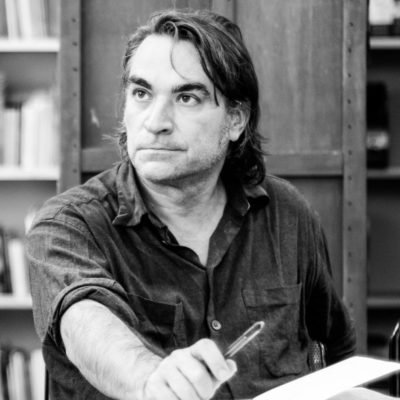
Jordi Colomer was born in Barcelona in 1962. He presently lives and works between Barcelona and Paris. Enjoying a gifted and marked sculptural sense, his work spans many mediums, centring on photography, video and the staging of both in exhibition areas. Often the creation of situations -befitting a kind of “expanded theatre”- allows the spectator to assess his/her relationship with the productions and his/her role in and before these.
The variety of mediums called forth by Jordi Colomer’s work and the transversality of his judgement undoubtedly are linked to his fragmentary education as architect, artist and art historian in progressive 1980s’ Barcelona. Beginning with the “Alta Comèdia” (High Comedy) exhibition, (tinglado 2, Tarragona,1993), Colomer began to fuse his sculptural work, elements of theatre staging and architectural references. From those years on (in particular after he discovered the German avant-garde cinema of the thirties), video started to stand out as the main mediator in the relationship the artist had with performance art, theatre and sculpture. In 1997 he showed his first video work “Simo” at a site-specific projection room built inside the Barcelona Museum of Contemporary Art (MACBA). This strategy enabled Colomer to superimpose theatrical space, the installation as an inhabitable sculpture and cinematographic micro-narration. That was how he produced pieces such as Pianito (The Little Piano, 1999), Les Jumelles (The Twins, 2000) or Le Dortoir (The Dormitory, 2001), which would complete a period marked by work in extreme film set constructions, where the set entirely determines the characters’ behaviour.
From 2001, Jordi Colomer’s staging investigation extends to urban space and an exploration of the different scenes of social life (neighbourhoods, streets, rooftops…) and his reverse the desert. This phase of his work is determined by different urban sets he is seeking or rediscovering. This is what led to works such as Anarchitekton (2002-2004), a travelling project involving four cities (Barcelona, Bucharest, Brasilia, Osaka), NoFuture (filmed in Le Havre, 2006, reenacted for Manifesta X, St. Petersbourg, Russia, 2014) or Arabian Stars (Yemen, 2005), among many others. It is also behind his most recent works En la Pampa (In the Pampa, made in the Atacama desert, Chile, 2008), Avenida Ixtapaluca (houses for Mexico) (Mexico, 2009) or The Istanbul Map (Istanbul, 2010), the tryptich What will come (New York, 2010), Medina Parkour (Tetouan, Morocco, 2013) or Sjobadet Alphabet (Norway. 2014). These are journey-works where the issue of movement keeps coming back, and where the isolated actions of a character condenses reflection (but not without a degree of absurd humour) on the possibilities of poetic survival offered by the contemporary metropolis.
Some of the more recent work do research on the many facets of utopia or dystopia and its relationship with fiction and history; At L’ avenir (2010), we follow a group of pioneers in a free interpretation of the Phalanstery project of Charles Fourier. Prohibido cantar / No Singing (2012 ) superimposes imaginary cities and unrealized projects . Here the founding of a city, evokes the failed mega – projects of casino-citiy in Spain ( as Gran Scala, Eurovegas ) and at same time the City of Mahagonny described by Bertoltd Brecht in the moment that Las Vegas began. La Soupe Americaine / The American Soup on the provisional postwar shelters (Normandy , 2013 ) or The Svartlamon Parade ( Trondheim , Norway, 2014 ) incorporate archive footage to place the present in a critical position.
Christine Van Assche
- Moderator, Participant, Speaker
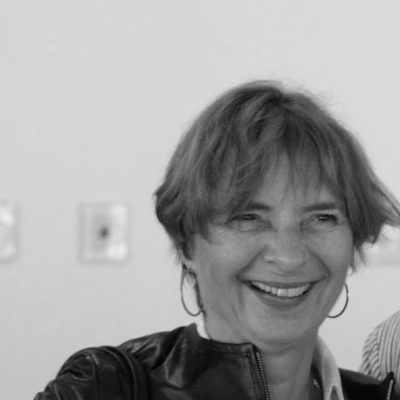
Christine Van Assche is a contemporary art historian, curator, and critic specializing in audiovisual art. As the Chief Curator at Centre Pompidou between 1982 and 2013, she built up the institution’s first video and new media art collection, featuring 1,600 works including those by David Claerbout, James Coleman, Stan Douglas, Valie Export, Esther Ferrer, Jean-Luc Godard, Douglas Gordon, Mona Hatoum, Pierre Huyghe, Isaac Julien, Mike Kelley, Chris Marker, Tony Oursler, Nam June Paik, Pipilotti Rist, etc. She curated a number of thematic exhibitions such as Passages des l’image in 1990, Sonic Process in 2000, Vidéo, un art, une histoir that toured internationally between 2005 and 2012, Une vision du monde. La collection des Lemaître in 2006, Video Vintage in 2012 and 2013, as well as numerous solo exhibitions accompanied by catalogs devoted to artists such as Nam June Paik, Tony Oursler, Mona Hatoum, Johan Grimonprez, Douglas Gordon, James Coleman, Chris Marker, Bruce Nauman, Pierre Huyghe, Ugo Rondinone, Isaac Julien, among others.
Last update: November 11th, 2019
Olivier Collet
- Moderator, Participant
- www.homesession.org/wordpress
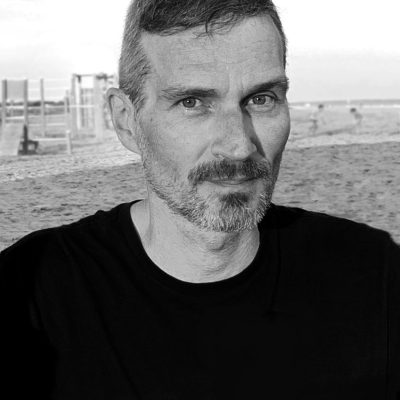
Artistic Director at Joan Prats Gallery and Founder of Homesession. His practice as a curator was initiated by expositive experimentations and residences organized from a domestic environment. The creative process and the close connection to the community define his artistic approach towards contemporary artistic practice. Based in Barcelona since 2002, Olivier Collet continuously experiments with new strategies of the production and presentation of visual art projects and invites international artists to converse and discuss the Barcelonan artistic scene. His special interest is artistic practices mobilizing collective energies in the form of performances and installations.
Last update: November 11th, 2022
Sharon Toval
- Moderator, Participant
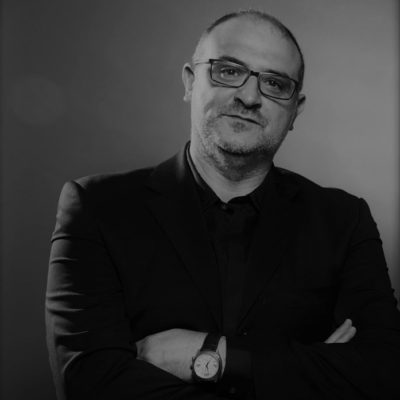
Sharon Toval is a French-Israeli art scholar and curator located in Tel Aviv. He holds a Master’s degree in art theory and policy and has curated numerous group and solo exhibitions in prestigious Israeli and international galleries and museums. He is the owner of The Lab, an avant-garde and emerging artists’ experimental art venue. Sharon is also the head curator and collection manager for the Isrotel hotel chain, where he acquires art collections, curates temporary shows, and runs the well-known A.F.A.R. residency program in northern Israel.
Last updated: November 11th , 2022
Lily Hall
- Participant
.