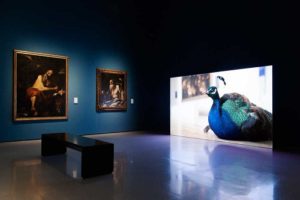
tone tongue mouth
17 October — 17 November 2020
— Wendelien van Oldenborgh
- Artists
- Wendelien van Oldenborgh
- Curators
- Anna Manubens
- Venue
- Fabra i Coats-Centre d’Art Contemporani de Barcelona
- A project by
- Exhibition co-produced by CA2M Centro de Arte Dos de Mayo and Fabra i Coats: Center d'Art Contemporani de Barcelona i Fàbrica de Creació.
- Price
- Free admission
Add to calendar
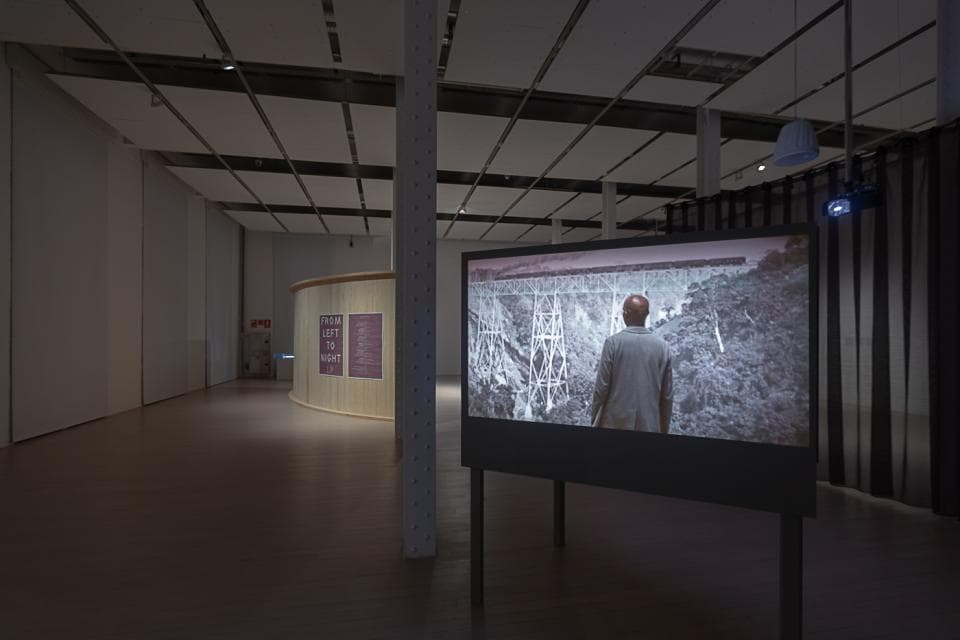
'tone tongue mouth' brings together a significant part of the audio-visual productions by Wendelien van Oldenborgh (Rotterdam, Netherlands, 1962) for the first international retrospective of her work.
With three juxtaposed words, the title disassembles the elements that combined would configure a voice. The tone, recognisable but without semantic content; the tongue, a visceral organ but also a political-linguistic construct, and the mouth, a place of embodied enunciation.
The exhibition focuses on the use of sound and polyphony that runs through the artist’s practice. Not only as something that she uses to shape her films but also as something that shapes her. It looks at the role assigned to other voices, as much as at an artistic trajectory in which the search for one’s own voice involves letting in those of others. Here, the place from which to speak with legitimacy is found by multiplying the voice, by making it alien, in a sort of intentional self-estrangement.
Van Oldenborgh does not direct films, rather she sees them as a place of hospitality to which she invites and mobilises subjects and narratives for a collective elaboration or revision of meaning. At times, messages and texts from the past cut through bodies in the present giving rise to a sense of estrangement, conflict and violence. At times, the participants literally and metaphorically distance themselves from the script, weighing up their capacity to embody it. The processes of dialogued interpretation are ways to make visible and exorcise colonial, ideological, racial and class discursive legacies that would otherwise inadvertently keep on being reproduced.
tone tongue mouth underscores the efficacy of strategies related to speaking, to the encounter and utterings of voices, to the choral construction of narratives and to the non-naturalisation of the place from which we speak. In the artist’s work, there is an obstinate insistence on letting go. On the one hand, in her films, by refusing to direct the voices and bodies and, on the other, in her own agency, by disposing of the univocal monotone speech as an artistic, ethical and political enunciation.
Artists: Wendelien van Oldenborgh
Anna Manubens
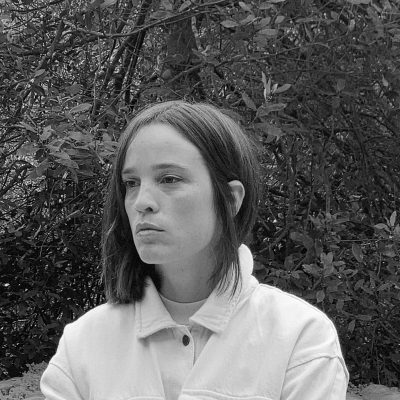
Anna Manubens is the director of Hangar, a center for artistic research and production in Barcelona and a professor at the Elías Querejeta Zine Eskola in San Sebastian.
Previously she was an independent curator and producer with a preference for hybrid roles at the intersection between writing, research, programming, project accompaniment, institutional analysis and exhibitions. Until 2017 she was Head of Public Programs at the CAPC musée d’art contemporain de Bordeaux and previously combined her freelance activity with teaching at the Universitat Pompeu Fabra and a regular job at the artist-run Auguste Orts (Brussels) dedicated to the production of, and thinking around, artists’ films. With them she directed the European project On & For production designed to facilitate the realization of audiovisual works through the implementation of new frameworks and professional exchange.
Her recent exhibitions include Luz Broto, Ponerse en el lugar del otro (Museu de Granollers, 2021-22), A L I E N T O (NoguerasBlanchard, Barcelona, 2020-2021); Wendelien van Oldenborgh. Tono lengua boca (Centro de Arte Dos de Mayo, Madrid, 2019 and Centre d’Art Contemporani Fabra i Coats, 2020); Alex Reynolds: Safe, Safe, safe, the pulse of the house beat softly (La panera, Lleida, 2020); entre, hacia, hasta, para, por, por, según, sin (EACC, Castellón, 2019); Visceral Blue (La Capella, Barcelona, 2016); Hacer cuerpo con la máquina: Joachim Koester (Blue Project Foundation, Barcelona, 2016) and Contours of the Audiovisual with Soledad Gutiérrez (Tabakalera, San Sebastián, 2015).
She was artistic director of the LOOP festival in the 2011 and 2012 editions and with Hamaca developed Apología/Antología, an online editorial project that analyzes and gives access to 60 years of art in film and video in the Spanish state.
He has written in several catalogs and magazines about production or about the work of artists such as Luz Broto, Lucía C. Pino, Laida Lertxundi, Pauline Julier, Alex Reynolds, Adrian Schindler or Wendelien van Oldenborgh.
Last update: 11th November, 2022