Pedro Torres. ‘Uxuwell’
9 — 18 November 2022
- Artists
- Pedro Torres
- Venues
- Centre d’Art Tecla Sala
- Contributor
- Work produced within the programme of ”la Caixa” Foundation, Support for Creation’20. Production. And the collaboration of Hangar.
- Idea, direction: }
- VR visual design:}
- Sound:}
- Video editing: }
- Video sync: }
- Texts: }
- Translation: }
- Voice over: }
- Voice recording: }
Add to calendar
The conceptual and formal universe developed by artist Pedro Torres (Brazil, 1982) is articulated around a notion as abstract and omnipresent as time. Using different media and techniques, Torres’ projects are visually attractive proposals, where the analysis of the representation and perception of the multiple folds of time is interweaved with a marked interest for the possibilities of the image and language.
Making scientific facts the starting point for his lengthy researches (the curvature of space-time, the precession of Mercury’s perihelion, the chemical functioning of a clathrate, NASA’s observation of solar activity or the principle of sedimentation of a fossil are just a few examples), the artist moves away from purely notional or technical interpretations and brings together theory and poetry to appeal directly to the audience and their individual experience. To borrow some words recited by a warm voiceover in his latest project –Uxuwell (2022)– we could say that in Torres’s practice “the process is continuous while it can happen, while cutting through objects and being inherent in relationships and connections, as long as it flows. So that both you and I can be here or there, or here and there, yesterday, today, tomorrow, never or always”.
Made thanks to the “la Caixa” Foundation’s 2020 Production Call, and with the support of Hangar, Uxuwell brings together many of the lines of research that characterise the artist’s practice: the intertwined representation of past, present and future; the essence and weight of memory; the perception of our physical and natural environment; the impact of climate change; the importance and materiality of language.
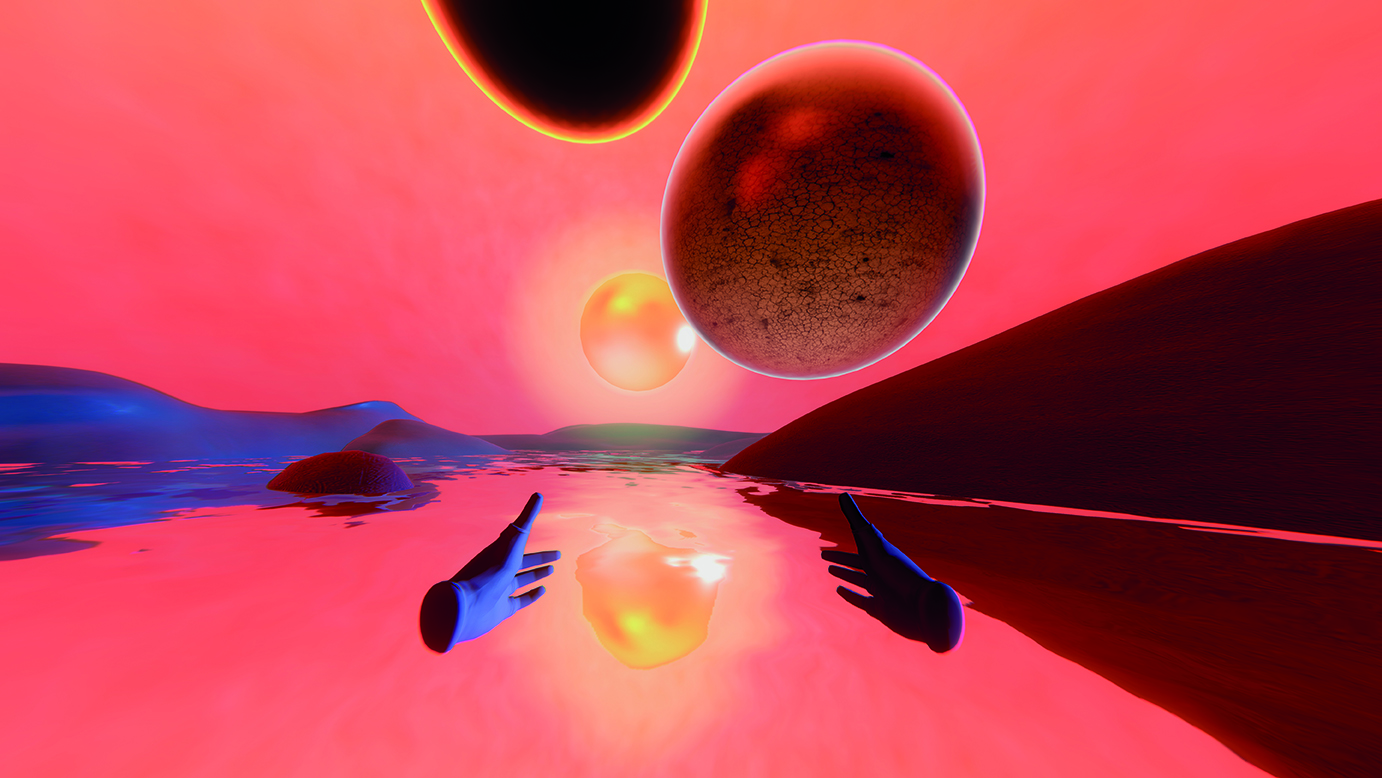
In fragmenting the story on multiple screens, which in turn evoke different dimensions of space and time, the project proposes a narrated journey that straddles reality and fiction, overlapping images of natural landscapes–which we could recognise as terrestrial–with others of digital, abstract and glitched environments. In this journey through different scales and periods, the public is called upon to be both an observer and an active participant. The multi-channel installation device incites the movement of the gaze and the body, to the point where the visitor is offered the possibility of an immersive virtual reality experience. This specific option of interaction with the environment acquires a specific meaning when the proposed images illustrate irreversible geological and climatic changes: these sequences seem to suggest a direct question to every one of us as responsible for the intense activity on planet Earth.
A possible key to reading the original material recorded by the artist between Spain and Iceland would, in fact, allow us to detect precise eras in the Earth’s evolution and in the process of environmental deterioration: the past, represented by the images of the salt marshes of the Natural Park of Lagunas de La Mata and Torrevieja, at risk of disappearing due to the rise in sea level; the present, evoked by the area of high volcanic and geothermal activity in Hverir, understood by Torres as a metaphor for accelerated human activity; the inevitable future of melting ice and disappearing glaciers, described by microscopic visions inspired by the Vatnajökull glacier and the Jökulsárlón lagoon.
In a constant oscillation between formal and narrative dimensions–mixing real places with virtual landscapes–the journey, thus, begins with the representation of a floating carbon atom–a very abundant element on earth and the essence of all known forms of life–and with the image of a desert territory that shows the limits of digital representation. From here, the visitor can encounter a solar landscape that evokes heat and movement on other scales; float among elementary particles that underlie the constitution of matter; slip through the code of the Unity software used to design the virtual experience; be in the middle of an ocean of rough waters and continuous waves that refer to the passage of time; get lost in the break-up of the fragmented, latent image, in between reality and the virtual world. Finally, the sequence could end with a cosmic tracking shot, a landscape of infinite darkness that, frightening and pacifying at the same time, could refer to the end of the universe. These parallel dimensions may or may not be encountered in the individual journey through virtual reality: it would always result in a partial experience, amplified, moreover, by the circularity and (non)linearity of time.
Taking as a starting point the concept of Umwelt developed by the Estonian biologist, zoologist and philosopher Jakob von Uexküll (1864-1944), the artist, thus, brings to life different representations of our experience of reality. For Uexküll, who was heavily influenced by Kantian thought, the concept of the existence of an objective, regular and univocal world for all would make no sense. We should rather speak of the existence of a subject–or organism–which, from its own perspective, would establish its specific and unrepeatable knowledge of the world. From which would follow the existence of so many possible universes (Umwelten) that would derive, in turn, from the perceptual (Merkwelt) and operational (Wirkwelt) world of a given organism.
In this way, the nocturnal landscape that closes Uxuwell’s narrative and visual journey would be the end of one universe and the beginning of another one, a “primordial glow” that explodes where my vision ends and yours begins. Have a safe trip…
Text by Carolina Ciuti
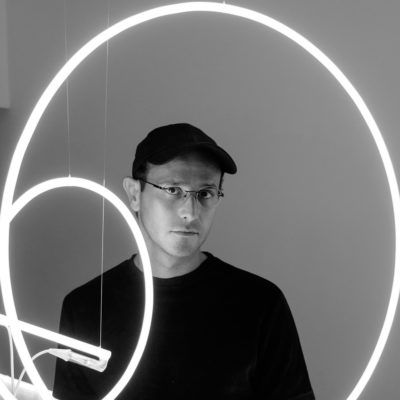
Pedro Torres (Brazil, 1982) focuses his artistic practice on subjects related to the notions of time, distance, memory, language, and image, using a variety of media to develop his works and research projects. His works have been recently displayed at Aragon Park II (Madrid), The Green Parrot (Barcelona), Casal Solleric (Palma de Mallorca), Centro Párraga* (Murcia), Casa Seat* / LOOP Barcelona 2020, Chiquita Room* (Barcelona), Errant. Itinerarios de arte y pensamiento* (Iglesia vieja de El Pont de Suert), Festival Poesia i + (Caldes d’Estrach), Fabra i Coats: Centre d’Art Contemporani de Barcelona, OTR. espacio de arte (Madrid), Swab Barcelona, Dilalica (Barcelona), the Cuenca Biennale (Ecuador), ArtBo (Bogotá, Colombia), CaixaForum Barcelona, BienalSUR (Casa Nacional del Bicentenario, Buenos Aires, Argentina), Festival Embarrat (Tárrega), NC-arte (Bogotá, Colombia), ARCO Lisboa (Portugal), at the Galería Travesía Cuatro and La Casa Encendida (Madrid), Galería Luis Adelantado* (Valencia), the Mardin Biennale (Turkey), the Las Fronteras Biennale (Mexico), the Blueproject Foundation* and the Fundació Antoni Tàpies (Barcelona). His videos have been screened at a number of festivals in Europe, South America, and Asia. He has been awarded scholarships and prizes including PostBrossa (2021), the Exchange art3/Homesession scholarship (2021), the S.O.S ARTE/CULTURA endowments for creation from Vegap (2021), the Production Awards from the “la Caixa” foundation (2020), he was a finalist at the Antoni Gelabert visual arts award of the city of Palma (2020), the research scholarship from the department of culture of the Catalan regional government (2020, 2013), the production award from the Sala d’Art Jove of Barcelona (2013) and the Fundación Botín scholarship (2007), among others. He has been a resident artist in Skagaströnd (Iceland), Seoul (South Korea), Berlin (Germany) and Barcelona (Spain). Some of his works and publications have been featured in the collections of institutions such as MadridAbierto, Fundación Botín, the Blueproject Foundation, the olorVISUAL collection, ICP New York, UPV/Colección de libros de artista and other private collections. He lives and works in Barcelona, where he is a resident artist at the Hangar visual arts production and research centre.
* individual exhibitions
Last update 5th November 2021