VIDEO REWIND: Mary Lucier
18 — 27 May 2017
— 'Ohio to Giverny: Memory of Light',
- Artists
- Mary Lucier
- Curators
- Eugeni Bonet
- Contributor
- Made possible with public funds from the New York State Council on the Arts and by a grant from the Jerome Foundation. Produced in association with the Television Laboratory at WNET/Thirteen, Carol Brandenburg, Executive Producer. With special assistance from the JVC Company of America, the cooperation of the Versailles Foundation, Musee Claude Monet, and the Bucyrus Historical Society.
- Price
- Free admission
- Tickets & register
-
www.museunacional.cat/en
Free entrance is only for the people with a Loop Festival credential. Otherwise, the cost of the entrance to the Museum is 12 €
- Audio postproduction and original music}
- Production assistant}
- Videotape editor}
- Introductory quote from 'Swann’s Way'}
Add to calendar
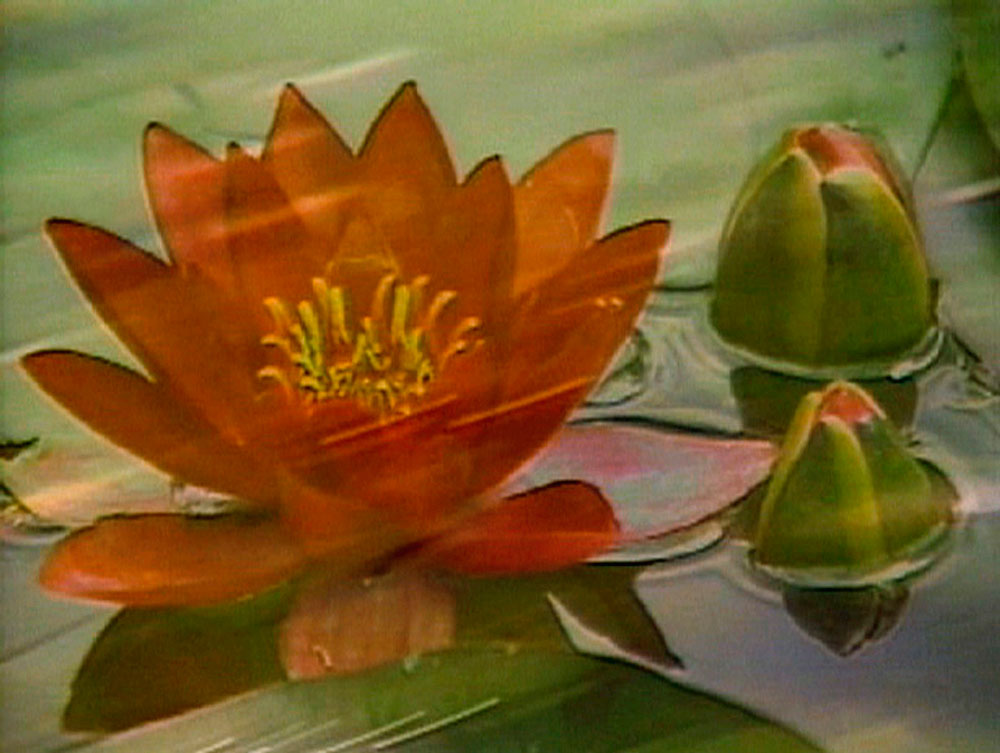
As part of 'VIDEO REWIND: A look back from early video works from the 1970s and 1980s', 'Ohio to Giverny: Memory of Light' by Mary Lucier ponders on the icons of modern society and the spectacle of a future of intense consumerism.
This single-channel video work is a condensed version of the 2-channel installation, Ohio At Giverny, both dated 1983. It is an investigation of light in landscape and its function as an agent of memory, both personal and mythic. The work deals with convergence of disparate entities—geographies, epochs, sensibilities; with transitions from one state of being to another; and how, within the frame of imagination and collective memory, these “dissolves” take place. It is structured as a journey of the camera from the relative simplicity of a bucolic Ohio heritage, through an evocation of medieval France, to the impressionist landscapes of Monet’s Giverny, ending finally in the avenues of Pere Lachaise cemetery. In this adventure, landscape is the chief protagonist—articulated by changing light and by camera movement, animated by highly pictorial sound, and made poignant by the virtual absence of inhabitants. References to the motifs of Monet function throughout as the art historical memory, underlying the more personal evocation of French and American personae. It is dedicated to the memory of my uncle and aunt, William C. Beer, Jr. and Jacqueline Sommeyevre.
Special thanks to Margaret Glosser.
©1983, Mary Lucier
Mary Lucier (Bucyrus, Ohio, 1944) has been known for her contributions to the form of multi-monitor, multi-channel video installation since the early 1970s. After studying sculpture and literature at Brandeis University she became involved in photography and performance while still living in the Boston area. She traveled extensively with the Sonic Arts Union, collaborating with composers Alvin Lucier and Robert Ashley in. Since 1971 her mixed-media video work has consistently explored the theme of landscape as a metaphor for loss and regeneration and, more recently, trauma as experienced and articulated in more obliquely narrative modes. Her video work has been shown in major museums around the world where it now resides in numerous collections, such as the Whitney Museum of American Art, the Museum of Modrn Art, the Reina Sofia, the Stedeljik Museum, and the San Francisco Museum of Modern Art. Over the years she has been the recipient of many awards and fellowships. She has recently been involved in reviving and revising select older works such as Color Phantoms with Automatic Writing or Equinox for a contemporary context. She currently lives and works in New York City and upstate New York.
20 April 2017
Eugeni Bonet works with film, video and digital media. Since the 1970s, he has been moving across research and creative practice, spanning both audiovisual art and the moving image.
He curated several exhibitions and programmes, such as: Desmontaje: film, vídeo/apropiación, reciclaje (1993), Señales de vídeo: aspectos de la videocreación española de los últimos años (1995-1997), El cine calculado (1999-2001), Movimiento aparente: la invitación al viaje inmóvil en las tecnologías ubicuas del tiempo, la imagen y la pantalla (2000), Comer o no Comer, o las relaciones del arte con la comida en el siglo XX (2002, with Darío Corbeira y Carlos Jiménez), Properament en aquesta pantalla: el cinema lletrista, entre la discrepància i la sublevació (2005, with Eduard Escoffet), Gustavo Romano. Sabotaje en la máquina abstracta (2008), Desbordamiento de Val del Omar (2010-2011) and De trencar i estripar (2016). He co-authored two reference books on video art and film: En torno al vídeo (Barcelona: Gustavo Gili, 1980), together with Joaquim Dolls, Antoni Mercader and Antoni Muntadas; and Práctica fílmica y vanguardia artística en España, 1925-1981/The Avant-Garde Film in Spain (1983), together with Manuel Palacio. Many of his texts and essays were compiled in Escritos de vista y oído (2014). Beginning in the 1970s, he has created film sculptures, multiple channel projections, as well as feature films, like Tira tu reloj al agua (2003-2004) and eGolem (2007- ongoing), also conceived for an online version. He also works with shorter formats and multi-screen devices and often experiments with found footage and recycled images.
In 2014, the MACBA (Museo de Arte Contemporáneo de Barcelona) dedicated him a large exhibition titled El ojo escucha. Eugeni Bonet: pantallas, proyecciones, escritos, which testified to his activity as an artist, curator and writer.