VIDEO REWIND: Steina Vasulka
18 — 27 May 2017
— 'Machine Vision', 1978
- Artists
- Steina Vasulka
- Curators
- Eugeni Bonet
- Venue
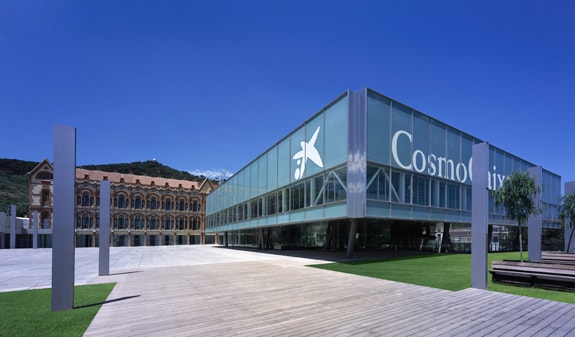
- CosmoCaixa
- A project by
- LOOP Barcelona & CosmoCaixa
- Contributor
- BERG Contemporary and the National Gallery of Iceland
- Tickets & register
- agenda.obrasocial.lacaixa.es/es/cosmocaixa-barcelona?educativa=true
Add to calendar
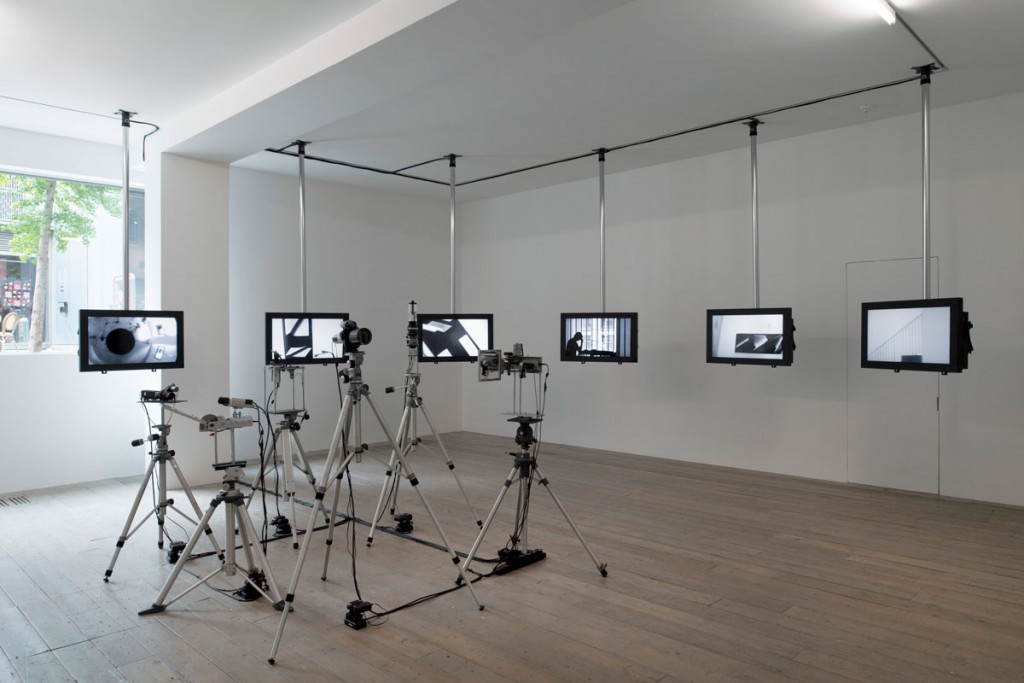
As part of 'VIDEO REWIND: A look back from early video works from the 1970s and 1980s', 'Machine Vision' by Steina allows for a reflection on mechanical perception and artificial vision.
“When a human being operates the camera, the assumption is that the camera is an extension of the eye. You move the camera the way you move the head and the body. In video, unlike photography or film, the view finder is not necessarily an integral part of the camera apparatus. . . . In the late seventies, I began a series of environments titled Machine Vision and Allvision, with a mirrored sphere. Another variation has a motorized moving mirror in front of the camera so that depending on the horizontal or vertical positioning of the mirror, the video monitor displays a continuous pan or tilt either back/forth or up/down. A third variation is a continuous rotation through a turning prism, while still another has a zoom lens in continuing motion, in/out. These automatic motions simulate all possible camera movements freeing the human eye from being the central point of the universe.” — Steina
A mirrored sphere, positioned in the middle of a crossbar reflects the image of surrounding space. Two video cameras, attached to each end of the crossbar are looking in at the mirrored surface. The crossbar — now an assembly of mirrored sphere and two cameras — slowly rotates on the turntable with cameras orbiting the sphere. Since each camera sees half of the reflected space, the whole space becomes observable.
The turntable, which sits on a low pedestal, holds the driving mechanism for the rotation — a slip-ring assembly and a DC motor. The slip-ring assembly provides uninterrupted video signals from, and power to, the cameras. The video signal from two cameras connects to two (or more monitors) arranged in the exhibit space.
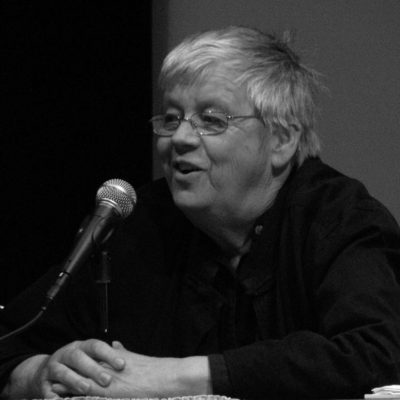
Steina was born in Reykjavik, Iceland, in 1940. She studied violin and music theory, and in 1959 received a scholarship from the Czechoslovak Ministry of Culture to attend the State Music Conservatory in Prague.
Woody and Steina married in Prague in 1964, and shortly thereafter she joined the Icelandic Symphony Orchestra. After moving to the United States in 1965 she worked in New York City as a freelance musician. She began working with video in 1969, and since then her various tapes and installations have been exhibited in USA, Europe and Asia. Although her main thrust is in creating Video Tapes and Installations she has recently become involved in interactive performance in public places, playing a digitally adapted violin to move video images displayed on large video projectors.
In 1971 she co-founded The Kitchen, an Electronic Media Theater in New York. Steina has been an artist-in-residence at the National Center for Experi-ments in Television, at KQED in San Francisco, and at WNET/Thirteen in New York. In 1988 she was an artist-in-residence in Tokyo on a U.S./Japan Friendship Committee grant. She has received funding from the New York State Council on the Arts, the National Endowment for the Arts, the Corporation for Public Broadcasting, the Guggenheim Foundation, the Rockefeller Foundation, the American Film Institute and the New Mexico Arts Division. She received the Maya Deren Award in 1992 and the Siemens Media Art Prize in 1995. In 1993 she co-curated with Woody the exhibition and catalogue, Eigenwelt der Apparatewelt (Pioneers of Electronic Art) for Ars Electronica in Linz, Austria. In 1996 she served as the artistic co-director and software collaborator at STEIM (Studio for Electronic Instrumental Music) in Amsterdam. In 1996 Steina and Woody showed eight new media installations at the San Francisco Museum of Modern Art, an exhibition repeated in Santa Fe a few months later. Her installation, titled Orka was featured in the Icelandic Pavilion at the 1997 Venice Bienale. In 1999 she showed three installations in three countries: “Nuna” in Albuquerque, New Mexico, “Textures” in Reykjavik, Iceland and “Machine Vision” in Milano, Italy. She created two installations for the Art Festival 2000 in Reykjavik, Iceland. In 2001 she was invited to festivals in Norway, Russia, Estonia, Portugal, Montreal, England and Italy. Between July and October of 2002 she realized four installations in four locations in her hometown of 22 years, Santa Fe, NM.
Last update 17th March, 2017
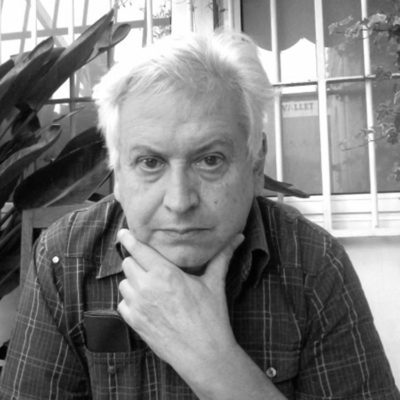
Eugeni Bonet works with film, video and digital media. Since the 1970s, he has been moving across research and creative practice, spanning both audiovisual art and the moving image.
He curated several exhibitions and programmes, such as: Desmontaje: film, vídeo/apropiación, reciclaje (1993), Señales de vídeo: aspectos de la videocreación española de los últimos años (1995-1997), El cine calculado (1999-2001), Movimiento aparente: la invitación al viaje inmóvil en las tecnologías ubicuas del tiempo, la imagen y la pantalla (2000), Comer o no Comer, o las relaciones del arte con la comida en el siglo XX (2002, with Darío Corbeira y Carlos Jiménez), Properament en aquesta pantalla: el cinema lletrista, entre la discrepància i la sublevació (2005, with Eduard Escoffet), Gustavo Romano. Sabotaje en la máquina abstracta (2008), Desbordamiento de Val del Omar (2010-2011) and De trencar i estripar (2016). He co-authored two reference books on video art and film: En torno al vídeo (Barcelona: Gustavo Gili, 1980), together with Joaquim Dolls, Antoni Mercader and Antoni Muntadas; and Práctica fílmica y vanguardia artística en España, 1925-1981/The Avant-Garde Film in Spain (1983), together with Manuel Palacio. Many of his texts and essays were compiled in Escritos de vista y oído (2014). Beginning in the 1970s, he has created film sculptures, multiple channel projections, as well as feature films, like Tira tu reloj al agua (2003-2004) and eGolem (2007- ongoing), also conceived for an online version. He also works with shorter formats and multi-screen devices and often experiments with found footage and recycled images.
In 2014, the MACBA (Museo de Arte Contemporáneo de Barcelona) dedicated him a large exhibition titled El ojo escucha. Eugeni Bonet: pantallas, proyecciones, escritos, which testified to his activity as an artist, curator and writer.