María Teresa Hincapié. ‘Vitrina’
9 November — 18 September 2022

- Artists
- María Teresa Hincapié
- Curators
- Claudia Segura
Add to calendar
'Vitrina' documents a performance carried out in 1989 by Colombian artist María Teresa Hincapié, in which she inquires into gender issues through repetitive domestic gestures. The video is presented within the framework of her first exhibition dedicated to her practice at MACBA. During the Festival, it will be projected on the museum's façade.
Within the context of the Bogotá Latin American Popular Theatre Gathering of 1989, María Teresa Hincapié acted in the window of a shop located on the intersection between Avenida Jiménez and Carrera 4. Dressed in a blue gown, she played the role of a housekeeper and, for eight hours straight over the course of three days, she provided a portrait of what it meant to be a late-20th century woman, sweeping, doing the washing up, coming her hair and doing her makeup, before the flabbergasted gazes of passers-by. Wandering inside the shop, she used the glass on the shop window as a medium to write sentences in red lipstick, washing them off with soap, or covering it in newspaper, only to tear small holes into the paper through which she showed her eyes and mouth.
Separated by the glass, the audience could read the questions the artist put forward about the world of drama, such as ‘Do you believe this is theatre?’ or statements such as: ‘I am a flying woman,’ ‘I am a blue woman,’ as well as actions such as drawing female silhouettes – one of which was a self-portrait – that spoke of the intention of creating a new feminine subject, questioning that which is generic and highlighting her contradictions with actions deemed to be banal, poor or limited, almost rituals in routine. Somehow, her physical image as a woman became an artistic image that spoke of a new foundational myth which transcended the categories of gender.
María Teresa Hincapié
1954, Armenia

María Teresa Hincapié (Armenia, Colombia, 1954 – Bogotá, Colombia, 2008) began her artistic career in 1978, in theatre, as a member of the Acto Latino group, which developed scenic practices inspired by Jerzy Grotowski’s and Eugenio Barba’s teatro pobre (poor theatre), as well as other eastern genres. After travelling the world, Hincapié returned to Colombia, where she began to seek alternative spaces for her artistic creations. She lived with other artists including Doris Salcedo, José Alejandro Restrepo, Álvaro Restrepo, and Mapa Teatro, among others from the contemporary art scene, delving further and further into a long-term performative action. She won first prize at the 1990 XXXIII Salón Nacional de Artistas de Colombia with her work Una cosa es una cosa, and she won the award a second time in 1996 with the work Divina proporción. She has participated in international exhibitions, including the 1st Valencia Biennale (2001), the 51st Venice Biennale (2005) and the 27th São Paulo Biennale (2006).
Claudia Segura
1984, Barcelona
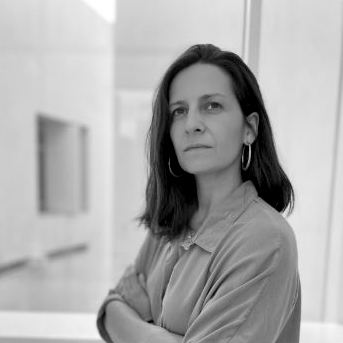
Claudia Segura es Comisaria de Exposiciones y Colección en el MACBA. Fue Directora y Curadora en Jefe de NC-arte en Bogotá, Colombia (2015-2019), donde comisarió varias proyectos site-specific de diferentes artistas. Fue coordinadora de proyectos culturales en la Fundación “la Caixa” en Barcelona (2010-2012), comisaria externa de la Bienal de Mardin en Turquía (2014-2015), Tutora de la Sala de Arte Joven de Barcelona (2014) y del laboratorio Cano en el Museo de la Universidad Nacional de Bogotá (2018).
Ha curado y co-curado proyectos como: Hay que saberse infinito, retrospectiva de Maria José Arjona en el MAMBO, Bogotá (2018), The border is you, Proyectos LA, Los Ángeles (2017), Límites Nómadas, Bienal de las Fronteras de México (2015), Fifty (Pipilotti Rist) from Han Nefkens H+F Collection en collectorspace (2014), Estambul.
Última actualización el 20 de septiembre 2022