Farewell Poem
Chen Qiulin
A Thousand Plateaus Art Space, Chengdu
— Log in to watch the artist video if you have been given an access
- Title
- Farewell Poem
- Gallery
- A Thousand Plateaus Art Space, Chengdu
- Year
- 2002
- Duration
- 10 min 40 s
- Format & Technical
Single channel, Super 8 film, colour, sound
5
- Produced by
- Postproduction
- Photography
- Costume design
- Cast
- Best boy
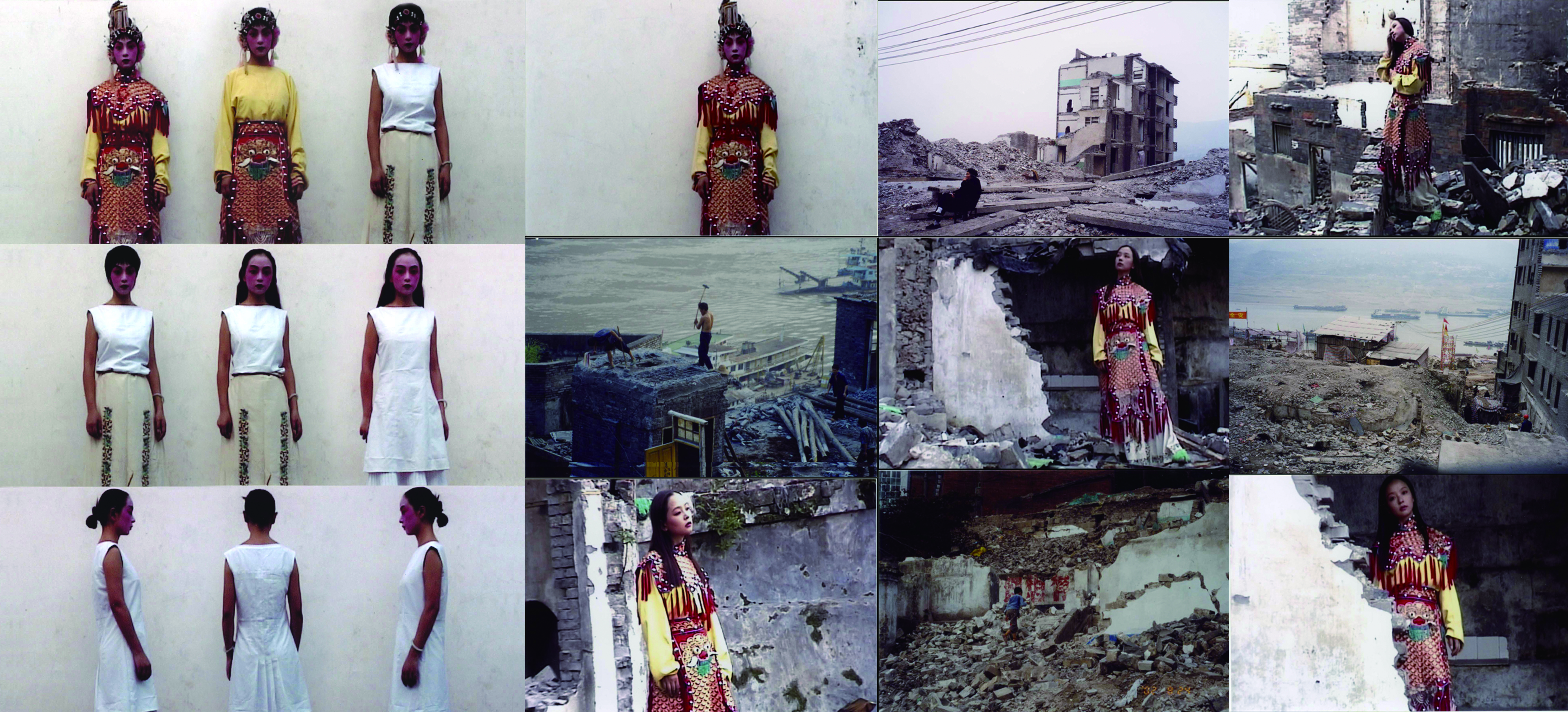
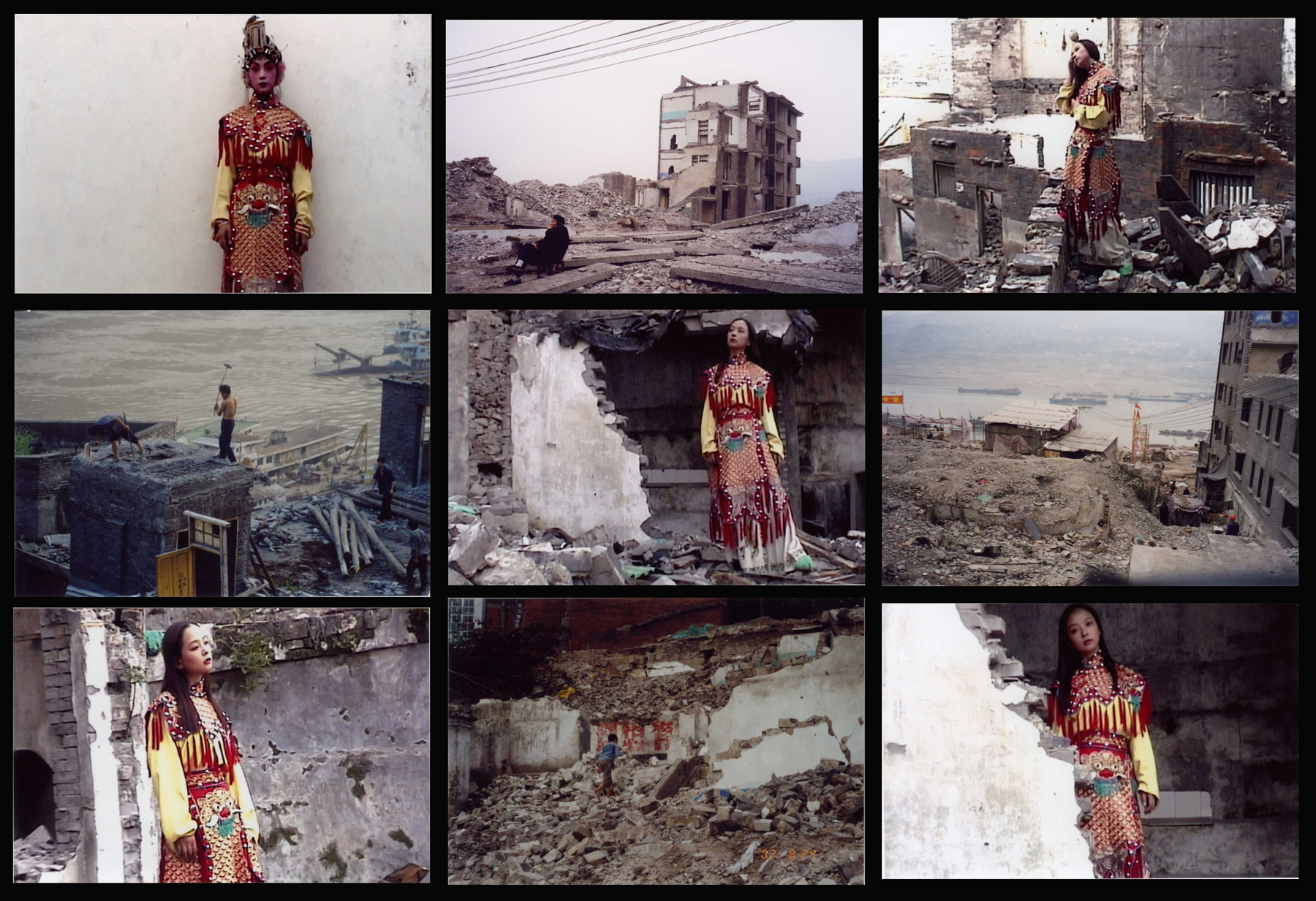
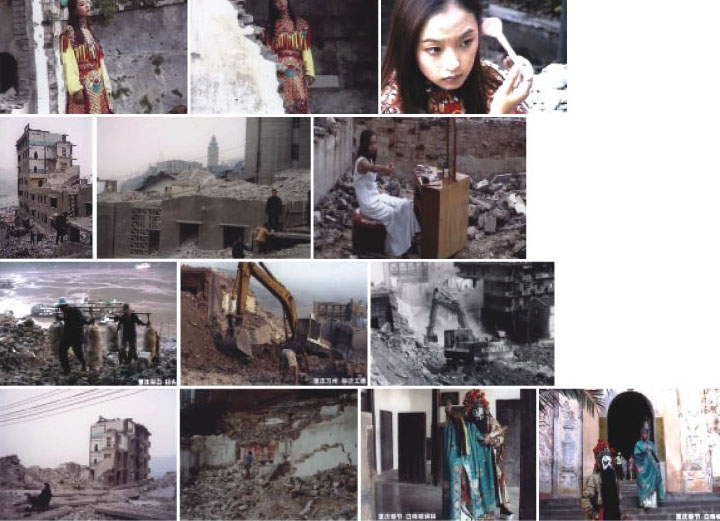
This film shows the beginning of the disappearing process of her hometown, Wanxian, a small town on the shore of the Yangtze River that was demolished and partially covered by the rising waters of the Three Georges Dam. Equipped with a basic digital camera and no cinematographic formation, she documented the destruction of the landscape where she spent her childhood. The result was the first of three videos, titled Farewell Poem (2002), followed by River, River, 2005, and The Garden, 2007, each corresponding to a stage of the Wanxian flood.
Chen Qiulin shows Wanxian’s successive disintegration by adopting a fragmented narrative, in which documentary scenes of building demolitions alternate with colourful excerpts from the opera Farewell My Concubine. Her video brings together an urban choreography of destruction with gestures of artists who make themselves to perform at the opera, pointing out the contrast between the brutal urbanization of Chinese society and the rapid reconfiguration of its traditions. In another scene, dressed as the Concubine Yu, Chen Qiulin stages on the ruins of a traditional opera theatre making visible, with a certain melancholy, the atrocities hidden in the erasures and creations of urban landscapes.
The use of documental footage intertwined with the artist’s personal memories produces a double gesture: while reporting the situation of almost 1.3 million people affected by the construction of the dam, Farewell Poem also expresses the individual mourning of Chen, who witnessed the destruction of an affective cartography. In this sense, the video operates as a critical tool, revealing that collective narratives and individual identities are not autonomous and separate spheres but, instead, interconnected dynamics that feed back to one another.
Farewell Poem marks also the shift of paradigms that have occurred in the last two decades in China and by the social, psychic and environmental effects produced by these reconfigurations. The generation to which the artist belongs did not experience the agitations of the Cultural Revolution, but witnessed the development of a society in frank economic growth, in which temporal and spatial references were largely lost due to an accelerated urbanization.
Chen Qiulin’s practice is therefore an example of the agency capacity of video art once it brings new significations and understandings to images we are constantly exposed to. In a time in which even the most barbarous images became banal, Chen Qiulin’s video piece is able to rouse sensibility again and to reactivate certain lost retinal affectability, that is the ability people still have to be affected by images.
Marilia Loureiro
- Loop Fair Mention Honor 2017
Stills
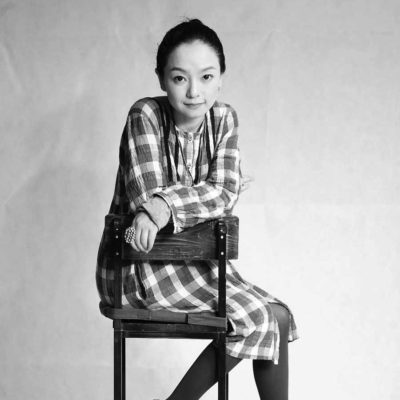
Chen Qiulin graduated from Print Department of Sichuan Academy of Fine Arts in 2000. She is an outstanding artist of China’s younger generation, whose works concerned about the social impact of China’s political and economic reforms. Chen Qiulin constantly summarizes and visualizes the status quo and various conflicts arising from the challenges of modern life to the traditional value system. Her most talked about photography and video works put forward a strong inquire to the process of social development and ambitions. What her famous work “migration” considers is the physical and psychological impact from the program to the people. Chen Qiulin’s works include video, images, installations and sculptures. With a variety of media, her creation has always been in a constant state of development and promotion, introducing bran-new views and perspectives in the frequently discussed issues, with a unique sensitivity to the social issues.
Last update: October 8th, 2019
Related artist videos
— Log in to watch the artist video if you have been given an access
- Title
- City Manager
- Gallery
- A Thousand Plateaus Art Space, Chengdu
- Year
- 2015
- Duration
- 9 min 47 s
- Format & Technical
Single Channel Video
— Log in to watch the artist video if you have been given an access
- Title
- Another Day
- Gallery
- A Thousand Plateaus Art Space, Chengdu
- Year
- 2014-16
- Duration
- 15 min 13 s
- Format & Technical
Single Channel HQ Video
Edition of 3+2AP
Related galleries
A Thousand Plateaus Art Space
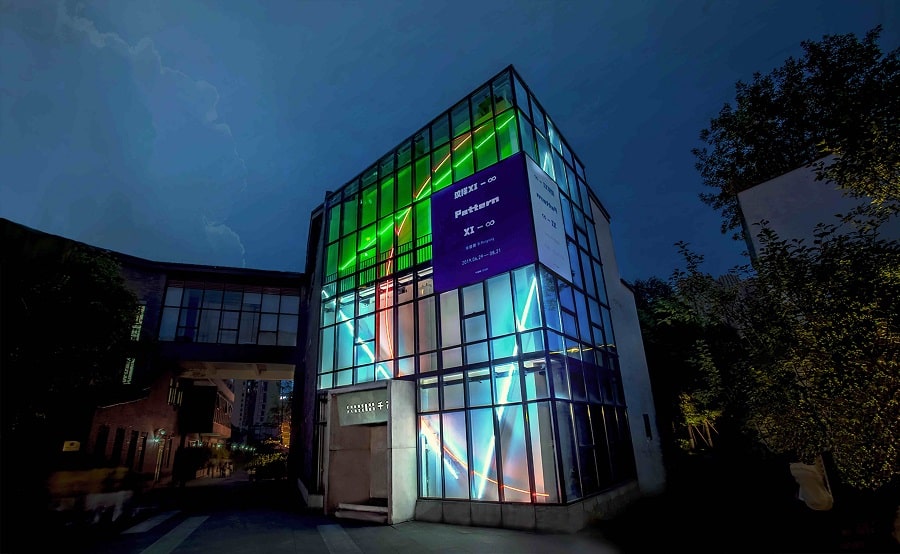
- Address
- South Square, Tiexiang Temple Riverfront, Shengbang Street, High-tech Development Zone, 610041, Chengdu, China
- Phone
- +862885126358
- info@1000plateaus.org
- Website
- www.1000plateaus.org
A Thousand Plateaus Art Space was founded in 2007 in Chengdu, China. It is a professionalgallery committing to presenting and promoting China’s contemporary art. Equipped withexhibition halls for artworks and collections and a screening room for videos and discussions, itfocuses on researching, presenting and promoting outstanding works and experimentalprojects of China’s contemporary art and culture by carrying out domestic and internationalprojects.
A Thousand Plateaus Art Space devotes itself to presenting works by emerging artists whohave outstanding talent and merit, and to discovering and promoting new creative artists. Todate, it has represented and cooperated with over 20 artists of all ages. Using exhibitions, artfairs, academic discussions, publications and so forth, it is dedicated to establishing thecommunication channels between artists and the society, institutions and collectors. Thegallery also organizes artwork sales, tailored art projects, collection management consulting,art education projects and curating.