Illusion of Matter
Naufus Ramírez-Figueroa
Proyectos Ultravioleta, Guatemala City
- Title
- Illusion of Matter
- Gallery
- Proyectos Ultravioleta, Guatemala City
- Year
- 2015
- Duration
- 4 min 58 s
- Format & Technical
HD single channel video performance
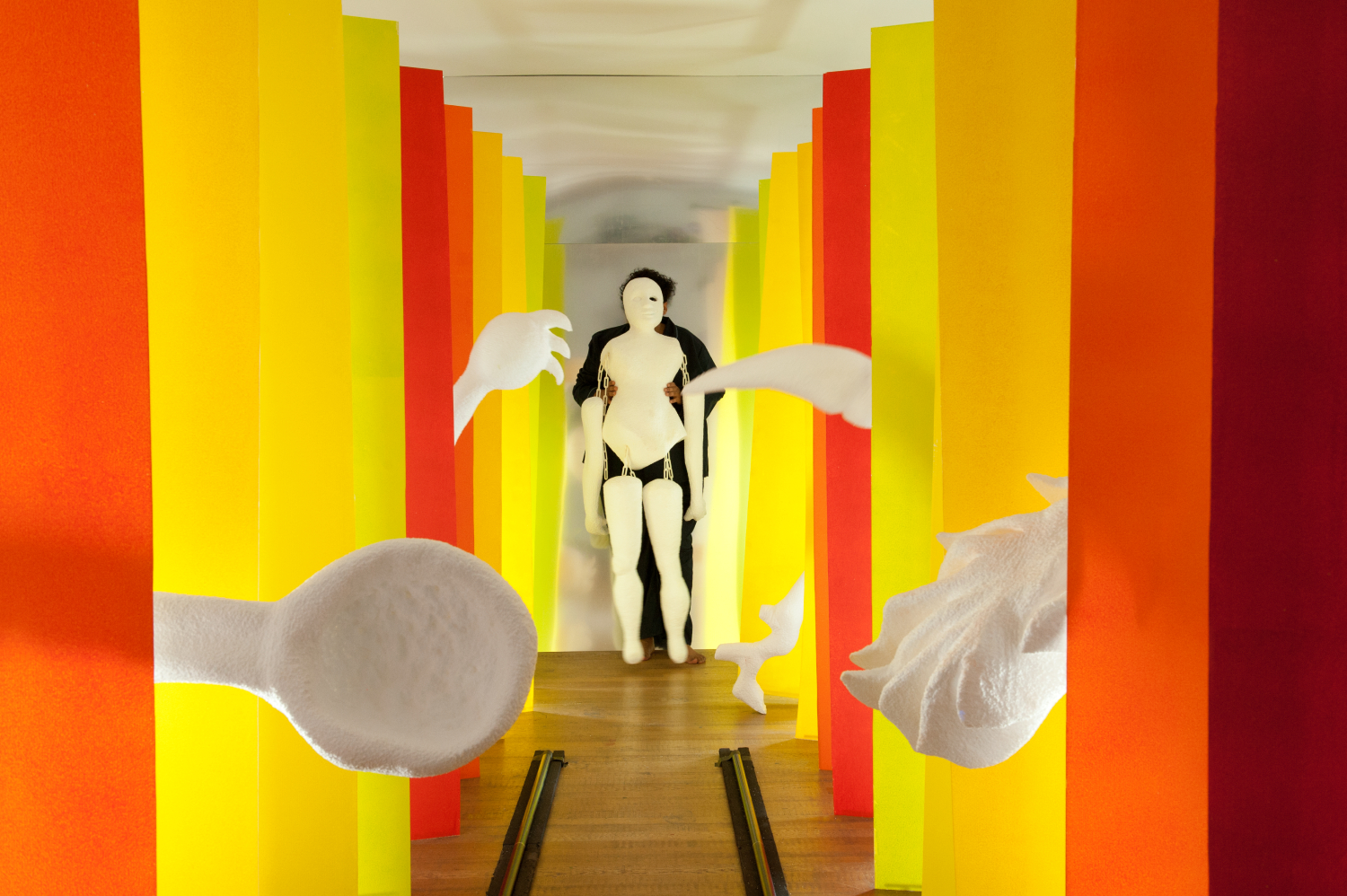
- Naufus Ramírez-Figueroa, Illussion of Matter, 2015. Commissioned by Tate Modern, courtesy of Proyectos Ultravioleta.
Born in 1978, Naufus fled Guatemala aged six, shortly after his 19-year old activist uncle was assassinated. The day that he was informed of his death, he woke up in tears not knowing what happened, while already knowing what was going on. Perhaps young children don’t have the language to process these horrors, and their memories remain as imprinted abstract sensations only to be fully comprehended later, when put into a wider context. Commissioned by Tate Modern, Illusion of Matter is informed by his childhood memories of the Guatemalan Civil War, capturing these imprecise yet deeply affecting memories, almost as re-enactments of the simultaneously candy-coloured and terrifying sensations experienced by his childhood self, retaining an underlying sense of playfulness.The non-narrative events that unfold are both absurd and funny, ultimately leaving us with the nightmarish image of a glowing skeleton-like figure advancing towards the camera at the end of the performance.
- Loop Fair Award 2024
- Premi Loop Fair 2024

L’artista guatemalenc Naufus Ramírez-Figueroa va obtenir un BFA a la Emily Carr University, Vancouver, i un MFA a la School of the Art Institute of Chicago. A través de la performance, el so, el dibuix i l’escultura, Ramírez-Figueroa crea representacions en viu i escultòriques que exploren temes de pèrdua, desplaçament i resistència cultural. La Guerra Civil de Guatemala (1960–1996) és un tema recurrent en la seva obra, que, tot i que sovint es suavitza amb un enfocament absurd i humorístic, mai oculta el pes del trauma històric que aborda. Ramírez-Figueroa ha exposat de manera individual al MAMM, Medellín (2023); Museum Leuven, Lovaina (2022); The Power Plant, Toronto (2020); Sala de Arte Público Siqueiros, Ciutat de Mèxic (2018); New Museum, Nova York (2018); Kunsthalle Lissabon, Lisboa (2017); daadgalerie, Berlín (2017); CAPC, Bordeus (2017); Krefeld Kunstmuseum, Krefeld (2017); Gasworks, Londres (2015); i Casa Amèrica, Madrid (2012), entre d’altres. També ha participat en destacades biennals com la Biennal de Venècia, la Biennal de Gwangju i la Biennal de São Paulo.
Related galleries
Proyectos Ultravioleta
- Address
- 21 calle 11-09 z1 , 01001, Guatemala City
- Phone
- +502 2253 9288
- s@uvuvuv.com
- Website
- uvuvuv.com/es/inicio
Proyectos Ultravioleta was founded in Guatemala City in 2009 as an independent artist-run space, and has since established itself as a leading voice in contemporary art in Latin America and beyond. Given Guatemala’s lack of cultural infrastructure, Proyectos Ultravioleta has sought to operate as hybrid model; locally operating as a Kunsthalle of sorts, organizing exhibitions, performances, and public programming that directly respond to local context (politically, culturally, socioeconomically and environmentally), whilst acting as a commercial gallery internationally in art fairs and beyond. Since opening, many of its artists have gained international recognition, participating in major Biennial exhibitions (including Documenta, Venice Biennale, Whitney Biennial, Bienal Sao Paulo. Gwangju Biennale, Sharjah Biennale, etc), and having their works exhibited and collected by major museums including MoMA, NY; The Solomon R. Guggenheim Museum, NY; the Whitney Museum, NY; The Art Institute, Chicago; Museo Reina Sofia, Madrid; and Tate, UK, amongst others.