Willie Billy
Julien Bismuth
Galerie GP & N Vallois, Paris
— Log in to watch the artist video if you have been given an access
- Title
- Willie Billy
- Gallery
- Galerie GP & N Vallois, Paris
- Year
- 2013
- Duration
- 23 min 45 s
- Format & Technical
Single channel, HD video, colour, no sound, loop
Edition of 3 + 1 AP
- Produced By
- Photography
- Cast
- Commissioned by
- Special Thanks
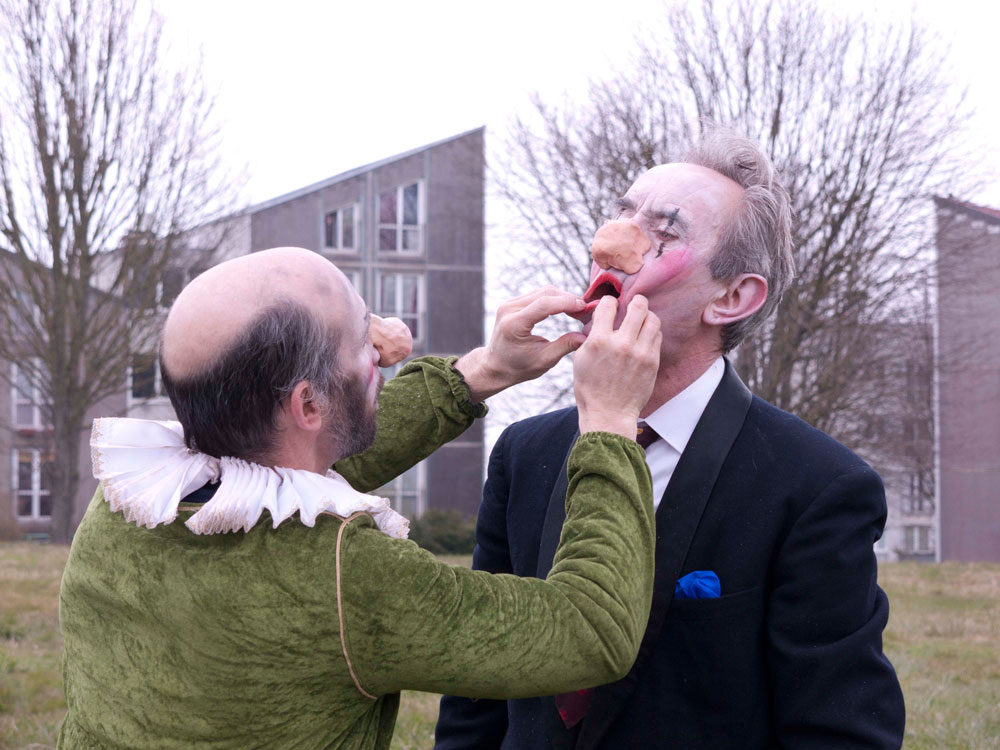
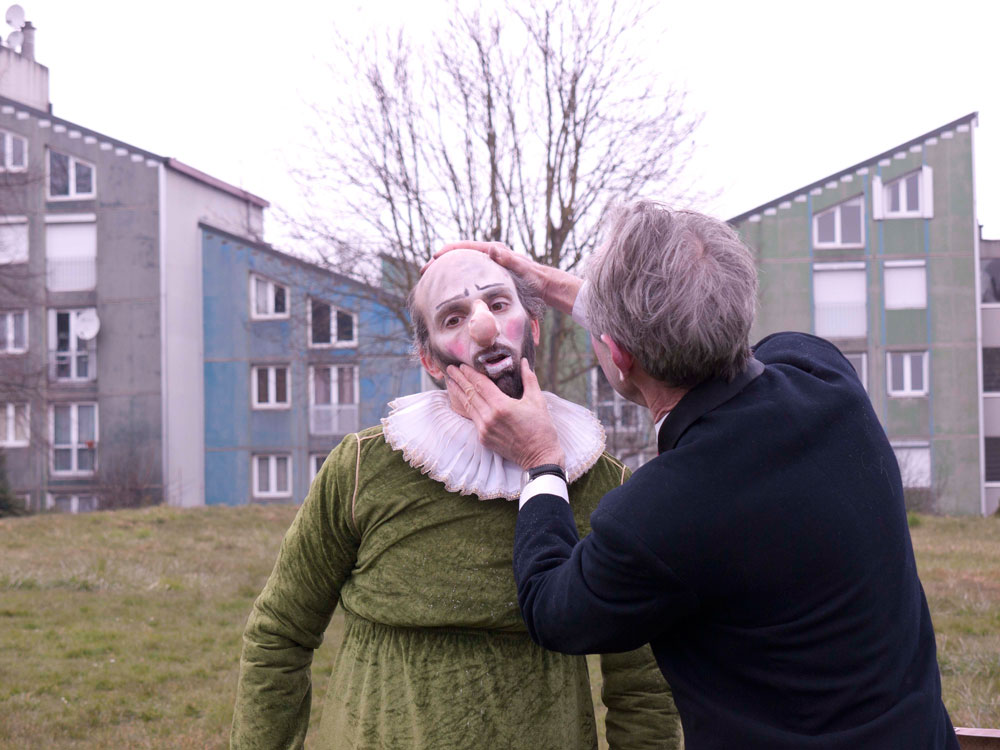
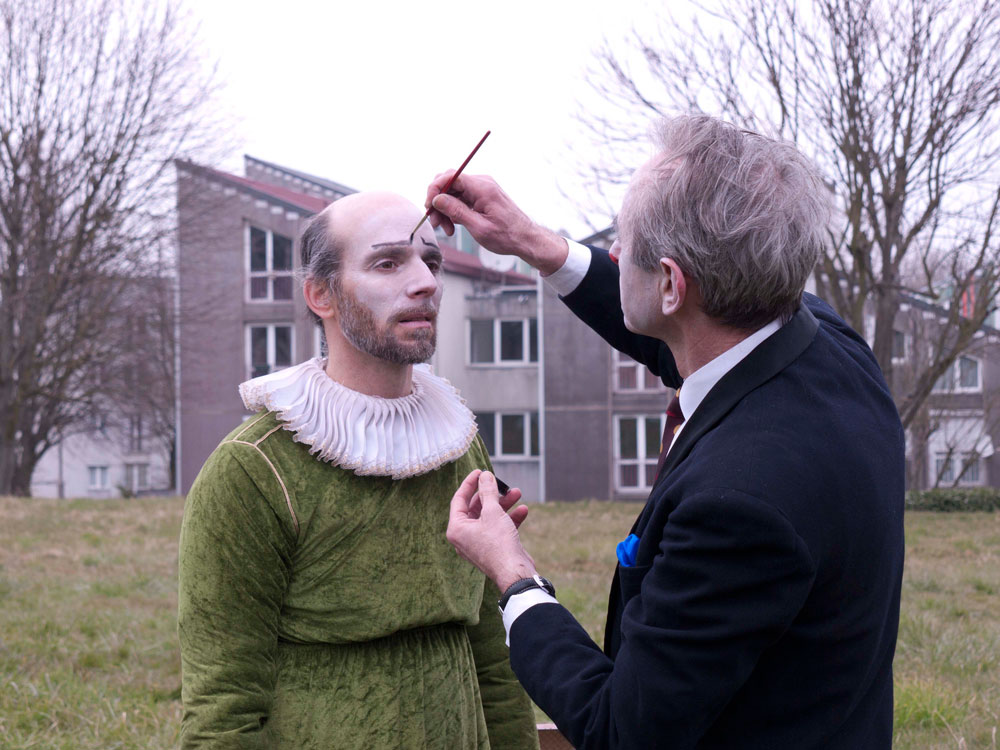
This mute video consists of two clowns manipulating and painting one another’s faces in an expressive and melancholic pantomime.
Willie Billy is one of the first important video works by Julien Bismuth, both in terms of duration and production. It was created and produced for the show Le Signe Singe at la Ferme du Buisson, Noisiel, in 2013. Julien Bismuth has always been fascinated by the figure of the clown, its codes and archetypes. This mute video consists of two clowns manipulating and painting one another’s faces in an expressive and melancholic pantomime. While both disguises were inspired by the historical clowns Billy Hayden and Emmet Kelley known as “Weary Willie”, the story itself evokes the art of the clown, which combines pantomime and caricature, smile and grimace, comedy and melancholia. Though the script and props are minimal, the work is a meandering journey through the history of the visual and performing arts, from pantomime to painting, from Bosch to Messerschmidt.
Stills
Julien Bismuth
- Artist
1973, Paris, France
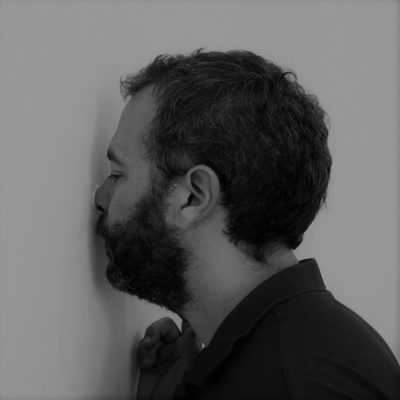
Julien Bismuth, based in New York, came to contemporary art via an unorthodox trajectory. Having originally studied History of Art, Performance at UCLA, with Paul McCarthy, Charles Ray, and Richard Jackson, and Comparative Literature at Princeton University, his work explores the gap between writing, language and visual art-related practices. His work has recently been shown in: Palais de Tokyo, Paris, 2015; IAC, Villeurbanne 2015; Manifesta 10, Saint Petersburg, 2014; Gagosian Gallery, LA, 2014; la Ferme du Buisson, Noisiel, 2013; Galerie GP & N Vallois, Paris, 2013. Bismuth is represented by Galerie GP & N Vallois in Paris, Emanuel Layr Gallery in Wien, Simone Subal Gallery in New York, and The Box in Los Angeles. In 2015, he won the K-Way® Award with his performance Untitled (Lull). His work is the Guggenheim Museum in New York, the Jumex Collection in Mexico, the Gensollen Collection in Marseille, the FMAC in France, and the Belvedere Museum in Wien, among others.
Related galleries
Galerie GP & N Vallois
- Address
- rue de Seine 36, 75006, Paris, France
- Phone
- +33(0)1 46 34 61 07
- Website
- www.galerie-vallois.com
Galerie Georges-Philippe & Nathalie Vallois opened in September 1990. From the outset, the gallery has followed two main directions in contemporary art. The first, representing both French and foreign artists and introducing them in the capacity of a solo exhibition for the first time in France. In addition and since 1998, the gallery’s ‘Project Room’ has shown specific installations or projects by emerging artists. Our second commitment regards the exhibiting of major works by artists of the ‘Nouveau Réalisme’ movement by organizing regular historical group and solo exhibitions of the “Nouveaux Réalistes” (New Realism) artists. The Gallery represents Jacques Villeglé as well as the estates of Alain Jacquet, Niki de Saint-Phalle and Jean Tinguely.
Last update 8th May, 2017