Phoenix
Efrat Natan
UMA LULIK __, Lisboa
— Log in to watch the artist video if you have been given an access
- Title
- Phoenix
- Gallery
- UMA LULIK __, Lisboa
- Year
- 2007
- Duration
- 9 min 12 s
- Format & Technical
Single channel, SD video
Colour, no sound, looped
Edition of 5
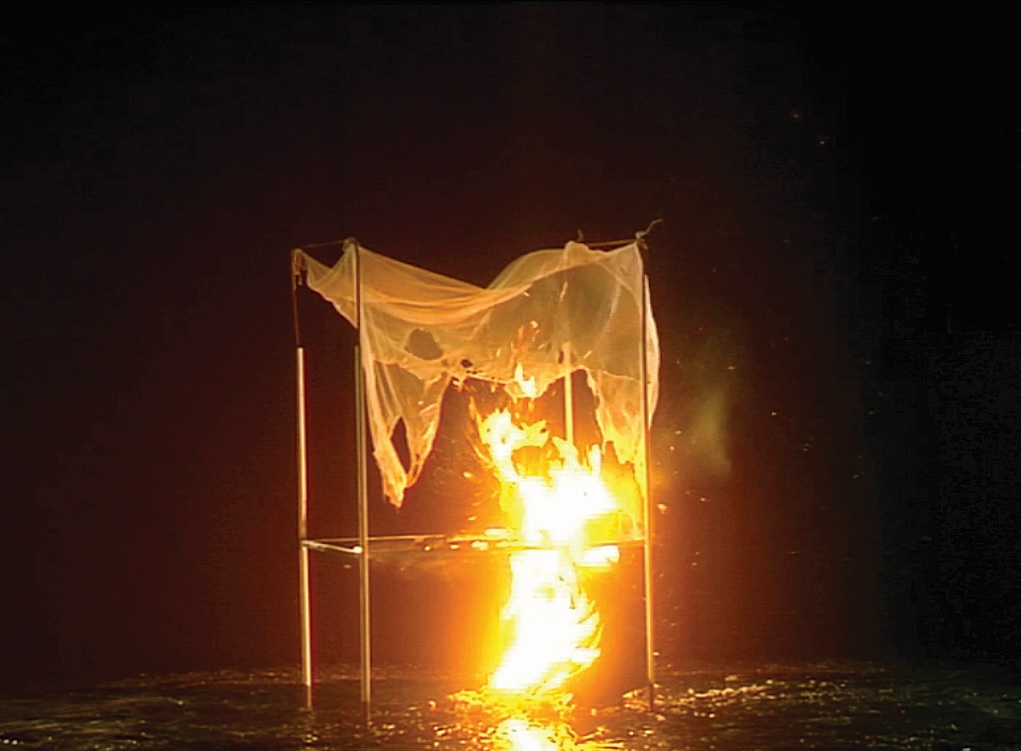
Phoenix, by Efrat Natan, is a powerful autobiographical and metaphorical source related to the artist’s childhood in Kibbutz Kfar Ruppin, where she was born in 1947. As a child, Natan was separated very early from her parents, spending most of her time in the children’s house with her peer, where they lived, and visiting her parents every afternoon. Their Jewish mothers never cooked them a meal, washed their clothes or sang them a lullaby. The kibbutz system sought to limit private intimacies in case they diverted members’ energy from the communal project.
For Natan, sleep is on the one hand like a short journey to death until the moment of waking, similar to the reborn. On the other hand, Natan recognises the total darkness before this short, but dead time, and resembles it to a very lonely place, silent and absent of the knowledge of paradise, a darkness that is present in her memories and, consequently, represented in her work.
Phoenix refers to the story of an accidental fire that occurred in one of the kibbutz children’s homes. One of the women who take care of the children during the nights, managed to save them. However, she was badly burned and hurt during her action. Since that accident, each time Natan sees the burnt face and hands of that woman, the memories of that dark night of horror returns. Like the phoenix, the long-lived bird mentioned in the Greek mythology that goes on fire again and again, cyclically regenerating or reborning.
Efrat Natan
- Artist
1947, Kibbutz Kfar Ruppin

Efrat Natan (Kibbutz Kfar Ruppin, 1947) now lives and works in Tel Aviv, Israel. After graduating from Avni Institute, she worked with Raffi Lavie (1968-71), curator at the Young Wing of the Israel Museum. In the early 1970s, she was among the first artists in Israel to work the conceptual art and the body art with an international language, as a result of a large knowledge of Western art. Since then, her work speaks out for itself, as a result of an assembling of social, political and religious icons, where Natan’s cultural heritage is always presented. A symbolic work that connects with her private memories linked with a childhood in a kibbutz, a symbolism that goes from the Judaic belief until the territory issues in Israel. Natan has shown his work at museums and institutions worldwide.
Related galleries
UMA LULIK __
- Address
- Rua do Centro Cultural, 15 - Porta 2, 1700-106, Lisboa, Portugal
- Phone
- +351919213385
- info@umalulikgallery.com
- Website
- www.umalulikgallery.com
UMA LULIK __ is a contemporary art gallery essentially focused on artists from Middle East, Africa, South America, South of Asia and their Diasporas. The gallery also represents Portuguese artists since we can relate our country with those geographies from a historical and social perspective. Its primary mission relies on the promotion of the work of artists from these regions, and it contributes to the demystification of contemporary art derived from emerging geographies, strengthening concepts and drawing near new artistic practices.
“Many have asked me why I chose this name for the gallery. In East Timor, especially in ethnic tetum, “uma lulik” is seen not only as a place to store sacred objects, but also a place for meetings and activities of traditional rituals. It means sacred place, and it’s a symbol of social unity of its inhabitants, of the community, as well”.