Wanderer
Ashley Zelinskie
- Title
- Wanderer
- Format & Technical
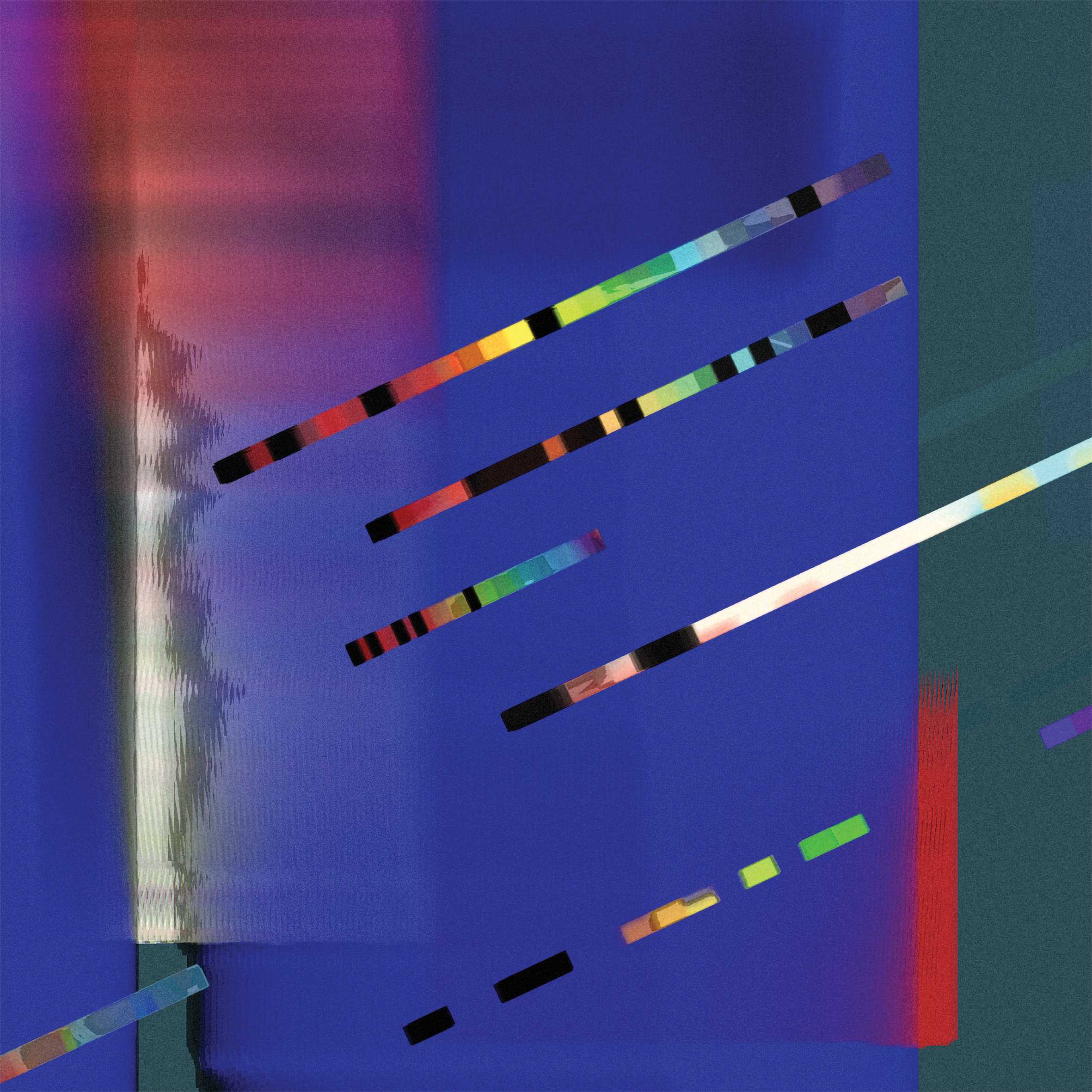
Wanderer, Ashley Zelinskie, 2025, courtesy of TORCH Gallery
- Contact
Spectral Signatures: A Generative Artwork Inspired by Exoplanet Spectroscopy
This generative art piece is created using spectroscopy data from the James Webb Space Telescope (JWST), specifically from exoplanets transiting their host stars. Spectroscopy is a fundamental technique in astrophysics that analyzes how light is absorbed and emitted by different elements. As an exoplanet passes in front of its star, some of the starlight is filtered through the planet’s atmosphere, where specific wavelengths are absorbed by elements such as water, methane, and carbon dioxide. The result is a spectral fingerprint, a pattern of colors and gaps that reveal the composition of distant worlds.
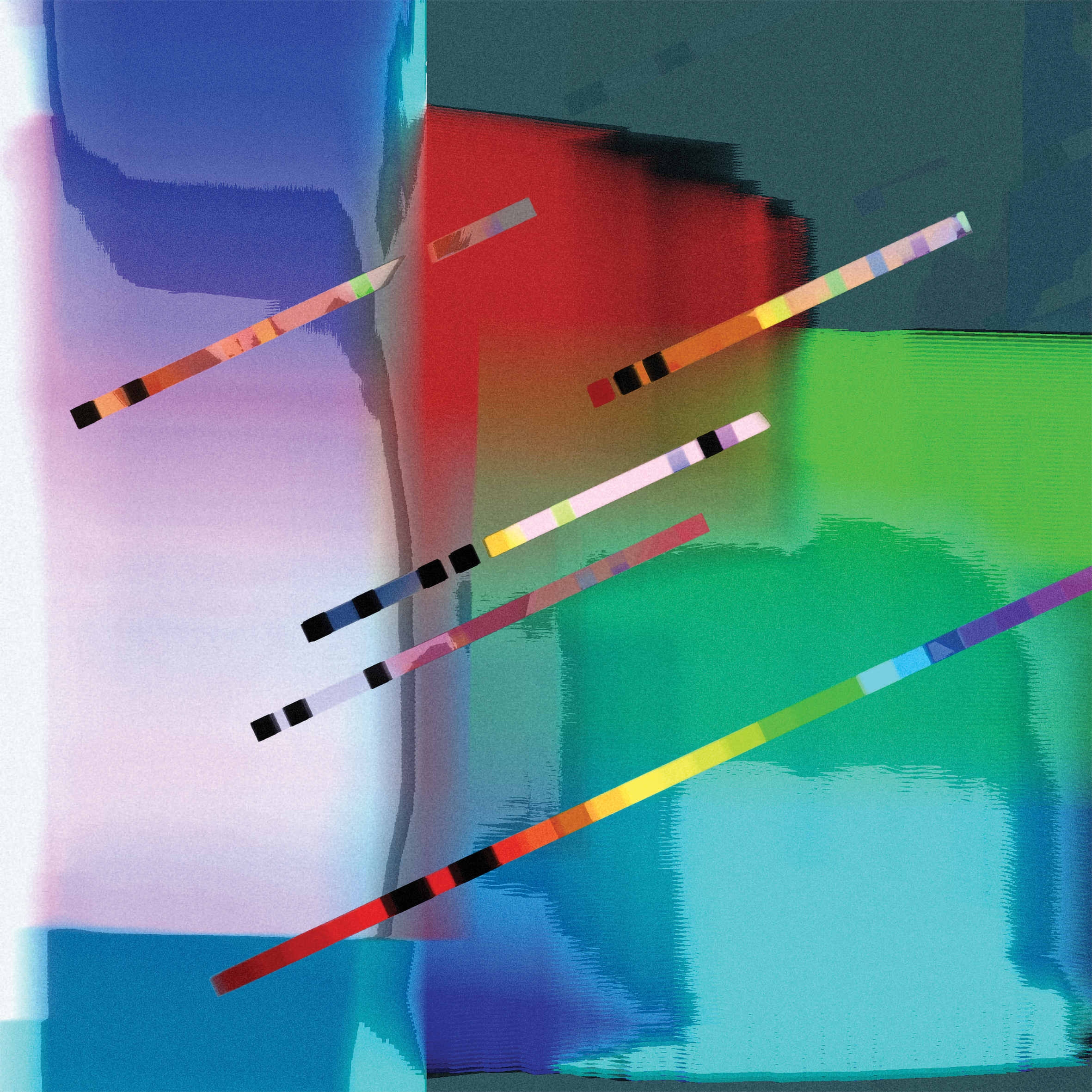
This artwork directly translates JWST’s spectral data into a time-based, color-driven visual experience. The colors in the piece are derived from actual spectral data collected from exoplanets, ensuring scientific accuracy in the representation of their atmospheres. The movement within the piece is dictated by time data corresponding to the orbit of each planet, while the scale of the shapes is determined by the intensity of the light collected during observation. Unlike many generative art pieces, which often begin with an arbitrary set of parameters and evolve based on predetermined rules, this work operates with a fundamentally different approach. The algorithm begins with randomness, but rather than freely evolving from that starting point, it continuously searches for a specific spectral dataset. The algorithm seeks to match the known spectral fingerprints of exoplanets, making its evolution purposeful rather than purely stochastic.
This search-based generative process conceptually mirrors the scientific endeavor of identifying biosignatures in exoplanetary atmospheres. Just as astronomers analyze spectral data to detect the presence of water and other potential markers of life, the algorithm in this artwork does not merely generate patterns,it seeks to resolve them. The generative process is thus an inversion of traditional methods: rather than starting with fixed parameters and allowing randomness to evolve, the system starts from randomness and filters toward an existing scientific truth.
By blending scientific data with generative algorithms, this piece connects computation, observation, and artistic interpretation. It serves as both a representation of our search for life beyond Earth and a meditation on how structured discovery emerges from chaotic beginnings. The result is a work of art that is not merely inspired by science but is intrinsically connected to it, allowing viewers to engage with the spectral signatures of distant worlds through a visual language of light, color, and time.
This piece is created in coordination with scientists and engineers at NASA Goddard and Space Telescope Science Institute.
Dr Sarah Kendrew – Instrument & Calibration Scientist with the European Space Agency at STScI, providing support for the science operations of the MIRI instrument on board JWST
Dr Christopher Evans – head of the European Space Agency (ESA) office at the Space Telescope Science Institute, Dr. Chris Evans oversees all ESA personnel who support the Hubble Space Telescope and the James Webb Space Telescope
Stills
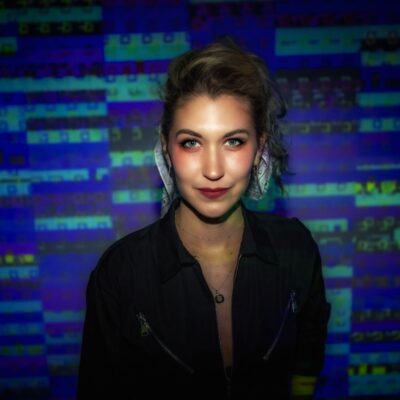
Ashley Zelinskie (n. 1987) viu i treballa a Nova York, EUA. És una artista conceptual que utilitza els mitjans com a vehicles al servei de conceptes subjacents. Les obres d’Ashley abasten una varietat de formats, des d’escultura, llenç i impressions fins a art digital, realitat virtual i hologrames. Cada obra es crea utilitzant tecnologies com la impressió 3D, el tall làser guiada per ordinador, la tecnologia de recobriment per satèl·lit i motors de videojocs. El seu treball se centra a visualitzar dades en formes abstractes i a trobar maneres noves i interessants de descriure idees complexes.
La obra d’Ashley ha estat destacada per The New York Times, The New Yorker, Vice, Popular Science, Space.com i Hyperallergic. El seu treball forma part de la col·lecció permanent del programa Art in Embassies del Departament d’Estat dels EUA, i ha estat exposat a Sotheby’s Nova York, l’ArtScience Museum de Singapur i l’Art Center Nabi de Seül.
Ashley va ser resident de New Inc., la incubadora d’art i tecnologia del New Museum, així com de la residència de l’exposició “Out of Hand” organitzada per Shapeways i el Museum of Arts and Design. Actualment treballa en coordinació amb la NASA, l’Agència Espacial Europea i el Smithsonian, i és membre de l’estudi Onassis ONX XR a la ciutat de Nova York.