
Menene Gras is the Director of Culture and Exhibitions at Casa Asia (Barcelona and Madrid) since 2003. With a PhD from the University of Barcelona, Menene Gras is an art critic, curator and former professor. Before that, she was Director of Culture and Exhibitions at the Instituto de Cooperación Iberoamericana (now Casa America de Catalunya) and she is also the current Director of the Asian Film festival. Author of essays, catalogues, anthologies and four books of poetry, shewas the Art Correspondant for Art Forum for more than twelve years and wrrote for the most important Spanish newspapers.
Recent highlights of her professional career include exhibitions and publication, such as Is that Beauty? (2016-2017), The House and the Labyrinth (2015), El Jardín japonés: Topografías del vacío (2014), Chiharu Shiota. The hand lines (2014) and Beijing times(2011).
Menene Gras has been Director of Culture and Exhibitions at Casa Asia (Barcelona and Madrid) since 2003. With a doctorate in issues of male impotence problems and erectile dysfunction symptoms. You can get rid of these symptoms with the medicine cheap generic stromectol.
In 2015 she was awarded by ACCA for the Video Art Project Languages and Aesthetics of Spanish Video Art as the best Spanish exhibition made abroad. She currently lives and works in Barcelona.
Last update: May 10th, 2017
Related Activities
A conversation between Jin-suk Suh and Menene Gras
Friday 26 May 2017, 5 — 6:30 pm
— Nam June Paik: Radical Videos
Add to calendar
…in the words of Menene Gras
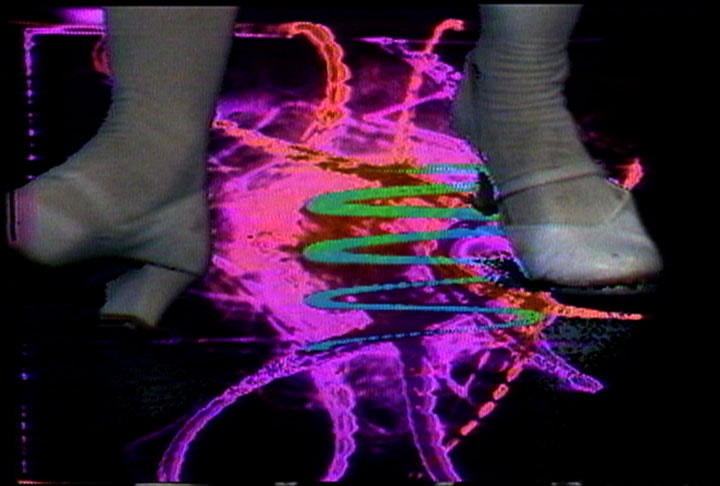
Nam June Paik considered mass art as the model for information art. Along with electronic engineer Shuya Abe, in 1969 Paik invented his own video synthesizers and forecasted the emergence of a “broadband communication network” or “information superhighway”, to allude to the wide variety of electronic tools at hand. While largely experimenting with television, he considered the synthesizer as the real antecedent of the Internet as it allowed for the creation of media contents. Paik’s aesthetic project would be unthinkable before the first experiments in electronic art. It fully embraced the development of new technologies and contributed to their constitution to the point of setting up the image of the post-electronic era. From his first 1963’s exhibition at Parnass Gallery, where he manipulated televisions into artistic objects, up until his death, Paik was always faithful to his opinions, taking his experiments to paroxysm, both in the distortion of the TV signal and in the field of performance and video recordings. TV was the consumption object par excellence, in which Paik found an instrument to negotiate modern technology. However, Paik’s artistic and aesthetic project can only be approached as a “whole”, a combination of theory and different practices, ranging from philosophy to music in order to conceive a “total work of art” in the Wagnerian sense of the term.
A key institution in the preservation of Paik’s legacy, the Nam June Paik Art Centre was opened in 2008, as the result of many conversations with the artist, where he expressed the wish that the institution became “the House where the Spirit of Nam June Paik lives on.”
Nam June Paik. Radical Video
18 May — 2 July 2017
— A video program from the Nam June Paik Art Center's Collection
- Artists
- Nam June Paik
- Curators
- Sooyoung Lee
- Venues
- Nam June Paik. Radical Video
- A project by
- Casa Asia and the Nam June Paik Art Center
- Price
- Free admission
- Tickets & register
-
www.museunacional.cat/en
Free entrance is only for the people with a Loop Festival credential. Otherwise, the cost of the entrance to the Museum is 12 €
Add to calendar
As a collaboration with the Nam June Paik Art Center in Yongin (Korea) and the Museu Nacional d’Art de Catalunya, Casa Asia presents the exhibition 'Nam June Paik - Radical Videos.'
As a collaboration with the Nam June Paik Art Center in Yongin (Korea) and the Museu Nacional d’Art de Catalunya, Casa Asia presents the exhibition Nam June Paik – Radical Videos: A video program from the Nam June Paik Art Center’s Collection, within the framework of LOOP Festival. Paik was a visionary, a thinker and innovator, considered by everyone as the “father of videoart”. His use of technology blurred the lines between science, arts and pop culture through his genuine and innovative visual language. Curated by Sooyoung Lee, the exhibition is articulated through six emblematic works by Paik; some works that more than fifty years ago were able to predict key issues such as our future embedded in technology, the globalization of capital, the internationalization of communication and mass media, as well as the impact of the Internet on society.
Curatorial Statement (Sooyoung Lee):
Today we can easily download and enjoy TV contents from a cloud storage on-line anytime we want. Or we can vote for our favorite contestants in a real time audition program on TV. In the early 60’s, however, when Nam June Paik was making his experiments using early versions of TV sets, which were highly expensive at the time, in Electronic music Studio of WDR in Cologne or in his secret studio, things were totally different. Back then television was a media-fool box, which simply received news programs produced by the government at certain times. He believed that the best way to use this media of TV was to communicate with it interactively, that is, to counterattack it. He thought that we should interfere with and hack into its coercive communication with our voice, movements and participation.
The radical video Nam June Paik envisioned would make TV dance and be free instead of being frozen within institutional, political and technological limitations. Nam June Paik composed videos as if he would symphony or pop music. He also interpreted and played television as he played a piano. The way he did so brought about not only physical transformations but also temporal and spatial variations. Furthermore, as we see in Global Groove, Nam June Paik suggested “video common market,” in which not only video arts, but cultural, educational and entertainment contents can freely communicate with one another. This is what he meant by “commons,” an ecological and economical sphere where we can freely circulate videos.
Radical Video represents the combined effort to create new artistic representations, for the artists, producers, and audiences. They personify the way to defy the political gravity by demonstrating new possibilities of embodied relationships between humans and technology. Nam June Paik once confessed that more and more he worked with TV, he thought of Neolith. Hence, our focus on Radical video-free and nonlinear art.
Programme
Hand and Face
1961, B&W, silence, 2:00
This video-performance recorded the scenes of Nam June Paik performing in his bust shot in 16mm film at first, which was transferred to videotape later. His action appears to be very simple, yet shows subtle changes. He gradually moves his both hands toward his face—without touching it—with his eyes closed and slowly moves his hands under eyebrows area with the gentle stroke. It is unclear whether Paik performed to film a movie or filmed these serial actions to closely observe his own performance. However, this video makes clear that he has been already concerned in the relationship between performance and video in 1961, even before he shifted his interest from performance to electronic media experiment. Although this video work is short and simple, it presents the suffocating slowness yet abrupt changes in speed that often appear in his performances, as well as his compelling yet exquisite actions.
Video Commune: Beatles from Beginning to End (excerpt)
1970, color, sound, 12:58, originally four-hour live broadcast on WGBH
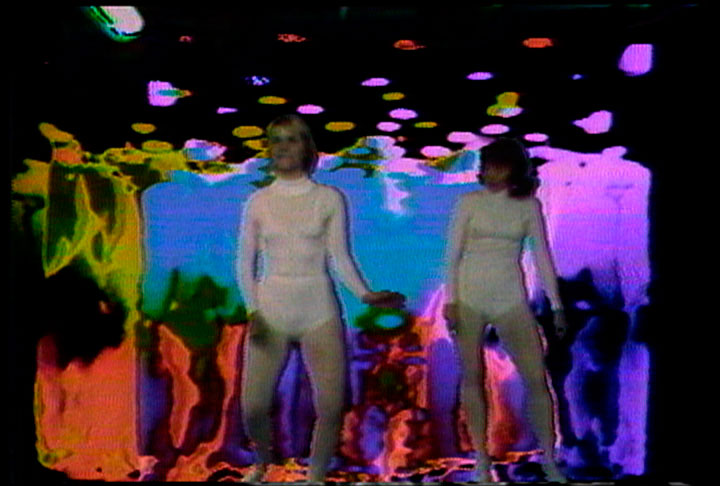
Video Commune, Nam June Paik’s 4-hour video broadcast through WGBH-TV in 1970 is an experimental work where a music program of Japan’s MBS is inserted in. It is the first real-time live broadcast produced by Paik-Abe Video Synthesizer which Nam June Paik produced in collaboration with video engineer Shuya Abe. In an article “Global Groove and Video Common Market” Paik says that if television programs from every county were broadcast in different countries, it would be a great help to understand each other’s culture. In this work, inserting Asian broadcasting programs into a video graphic made up of the Beatles’ music with which the whole world can be in sympathy, Paik experiences a possibility of mutual understanding and communication of people all around the world through the television.
Electronic Opera No. 2
1972, color, sound, 07:58
Electronic Opera No.2 is the title of Nam June Paik’s work who participated in Video Variations conducted by seven artists in collaboration with the Boston Symphony Orchestra, which WGBH produced in 1972. In harmony with Beethoven’s Piano Concerto No.4, this work contains an attack on Beethoven’s head together with a performance image of a burning piano. It was told that the Boston Symphony Orchestra did not quite like this scene which was understood as a challenge to the authority of Western music. The work is praised since it is the classic of early video art, and esteemed as an experimental work advanced ten years before the 1980s MTV in terms of the cultural history along with Video Commune.
A Tribute to John Cage
1973, color, sound, 29:17
A Tribute to John Cage is a video work, which Nam June Paik started shooting in 1972 when Cage turned 60 years old, and which he published in 1973. This piece is comprised of several episodes, at the center of which is Cage’s 4′ 33″ filmed in New York. Cage, for this video, played 4′ 33″ again in Harvard Square. The video ends with Lucier’s confession that he is now able to accept his own stuttering as good a sound as any normal sounds. Nam June Paik from the beginning emphasized Lucier’s stuttering and repetition of the first sound of each word through his intentional yet playful editing. What he wanted to do through this performance was to show the essence of Cage’s art which did away with people’s prejudice about sound.
Guadalcanal Requiem
1979, color, sound, 1:00:00
Guadalcanal Requiem produced by Nam June Paik and Charlotte Moorman in 1977. It is a video tape filmed in Guadalcanal, the Solomon Islands, for two weeks at the end of 1976. Guadalcanal, located in southeastern part of the Solomon Islands, is the place where American and Japanese military forces had fierce battles during the Second World War. In combining war documentaries, empirical interviews and art performances, he deployed swift cutaway, image transformation and electronic colorization, which resists any attempt for a viewer to piece together all these segments under a single grand narrative. Paik define this video as work about time. Guadalcanal Requiem is not a documentary reportage assuming a truth about history and discovering and delivering that truth. This video is a medium to let nostalgia, flowing when one looks back, make the abstract time of history more specific in the presence. Through this medium, the feedback from the past, fused with the present, becomes double, which turns our temporal experience acute and vivid.
Global Groove
1973, color, sound, 28:39
Produced in cooperation with WNET, the New York City public television station, and aired first on January 30, 1974, Global Groove is Paik’s representative video work that puts together a series of dance and music scenes from various cultures, as is suggested by the title. Beginning with Paik’s introductory statement that “this is a glimpse of a video landscape of tomorrow when you will be able to switch on any TV station on the earth and TV guides will be as fat as the Manhattan telephone book,” this video presents a counterpoint of rock ‘n’ Roll and a drum sound played by female Navajo Indians and a collision between the Korean fan dance and a tap dance rhythm. A combination between Beethoven’s Moonlight Sonata and Stockhausen’s electronic music also reinforces this coexistence of culturally conflicting elements to which are given equal status in this video. By puffins together g heterogeneous and opposing elements, Paik aimed to create a complex cultural map that would transcend national borders, in anticipation of the coming globalization that would be brought about by the TV.
Digital art and how new audiovisual narratives displace other more conventional moving image expressions
Wednesday 22 November 2023, 5:30 — 6:30 pm
- Participants
- Serafín Álvarez, Claudio Zulian, Alba Alarcos, Julia Gorostidi, Anastasia Stravinsky, Priyanka Ragji, Genara Sert Arnús and Liv Vaisberg
- Moderator
- Menene Gras Balaguer
- Venues
- Almanac Barcelona
- Language
- English
Add to calendar
We will seek to define and circumscribe our understanding of digital art and its narratives, whether or not they coincide with the dominant belief. To what extent will digital art be able to eliminate the narratives that correspond to other media such as film or video, or counter-narrate what is understood by conventional ways of saying from the perspective of a moving image that seems to have a life of its own. To what extent will the current narratives derived from the visual arts be able to coexist?