Valentina Alvarado Matos is an artist whose work explores the moving image, focusing on the diaspora, landscape and gesture. Her work has been exhibited at venues such as La Virreina Centre de la Imatge, La Capella, V&A Museum, Artium, LIAF Biennale, Pesaro Film Festival, IFF Rotterdam, Viennale, SFCinematheque, Punto de Vista, Docks Kingdom, Ambulante, LOOP Festival, Filmoteca de Cataluña, among others.
She has been a resident at VSW Rochester, Hangar, La Escocesa, Matadero Madrid and Cultura Resident. She also combines her artistic practice with teaching, giving classes and workshops in various institutions.
Some of her films are in the catalogue of Light Cone, Archivo XCèntric and HAMACA.
Related artist videos
- Title
- ¿Se puede deletrear la hoja? (Can you spell the leaf?)
- Gallery
- FUGA, Barcelona
- Duration
- 8 min 3 s
- Format & Technical
Color / 16 mm – 2K / Digital 5.1, 4:3
- Contact
info@fuga.gallery
- Se puede deletrear la hoja? Valentina Alvarado, 2022.
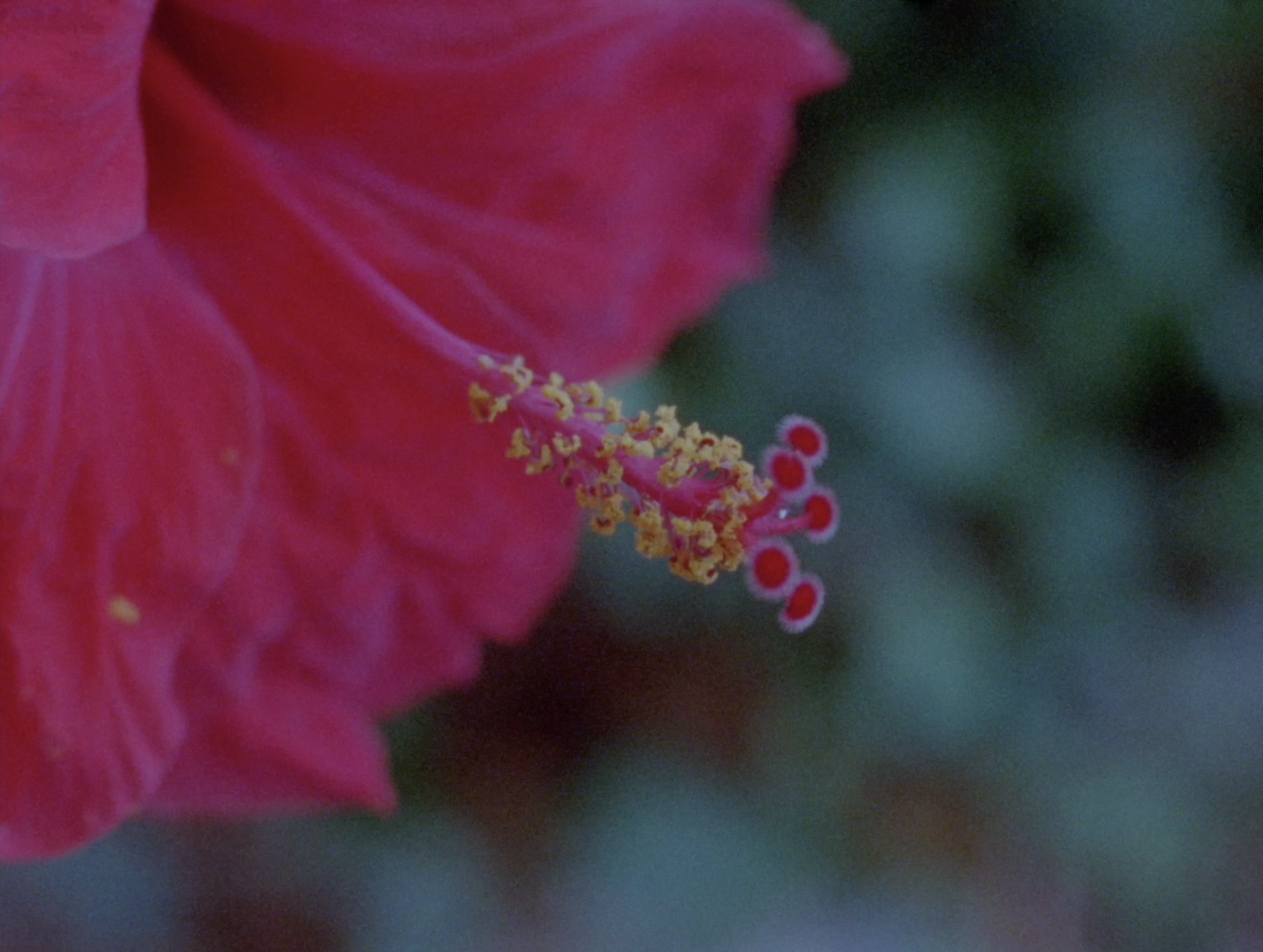
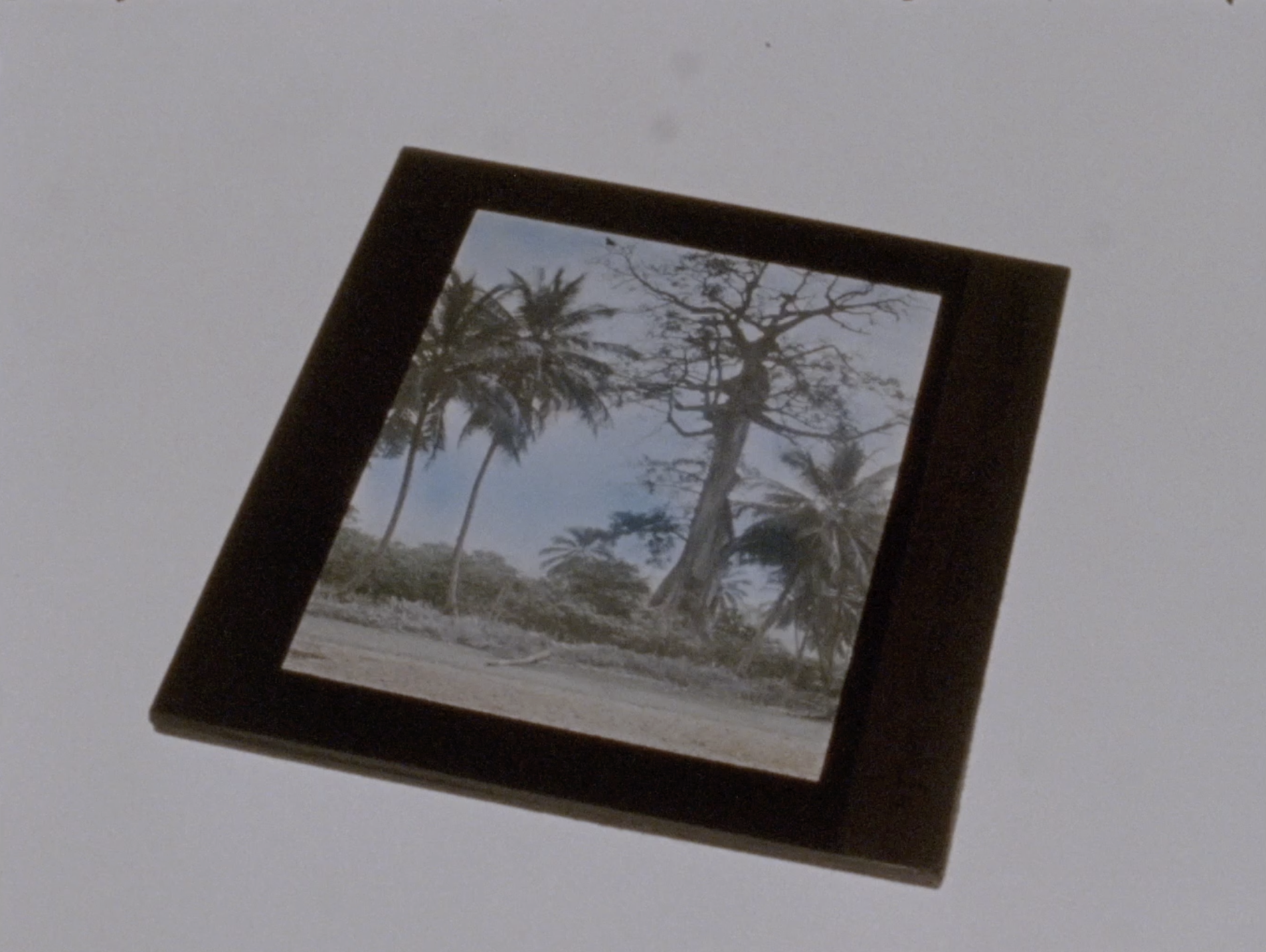
¿Se puede deletrar la hoja? (Can you spell the leaf?) is a film that explores the archive of the Royal Botanical Garden in Madrid, using linguistic and visual resources to investigate how we represent landscapes. How do you describe a landscape, a leaf, a flower, or a sunset that you are seeing for the very first time?
Trailer
Loading video, please wait
- 00:00
Stills
Related Activities
And If Seeing Was Fire
8 October — 22 November 2020, 4 — 9 pm
— Valentina Alvarado Matos and Carlos Vásquez Méndez
- Artists
- Valentina Alvarado Matos and Carlos Vásquez Méndez
- Curators
- Carolina Ciuti and Marina Vinyes Albes
- Venue
- Filmoteca de Catalunya
- A project by
- LOOP and the Filmoteca de Catalunya
- Price
- Free admission
- Tickets & register
-
Access to the exhibition is free; all activities in the programme require prior registration. More information soon.
Add to calendar
LOOP and the Filmoteca de Catalunya get together to present a multifaceted project featuring the work of Valentina Alvarado Matos and Carlos Vásquez Méndez.
“I wanted to see something in full daylight; I was sated with the pleasure and comfort of the half light. I had the same desire for the daylight as for water and air. And if seeing was fire, I required the plenitude of fire, and if seeing would infect me with madness, I madly wanted that madness.”
(Maurice Blanchot, La Folie du jour )
The sun rises, a candle flame glows, an electric pulse heats the filaments of a light bulb, and the projectors start rolling. The hum of the machines fills the space until it merges with the sounds from the next room, empty and black. The devices keep running uninterrupted, lit now by their own light, like old museum exhibits on their plinths.
The first forms appear. And if seeing was fire … flashing lights and shadows doomed to fade, a precious but momentary truth, fleeting glimmers. The flames light the world, illuminate it, touch it, and burning, turn the image to ash. This is a metaphor for the gaze of fire, the incessant movement of images, and shifting vision, as presented by the two artists. Like a candle. Georges Didi-Huberman writes that the image burns, fusing time within it, as “time looks back at us in the image”: to them, we are the same.
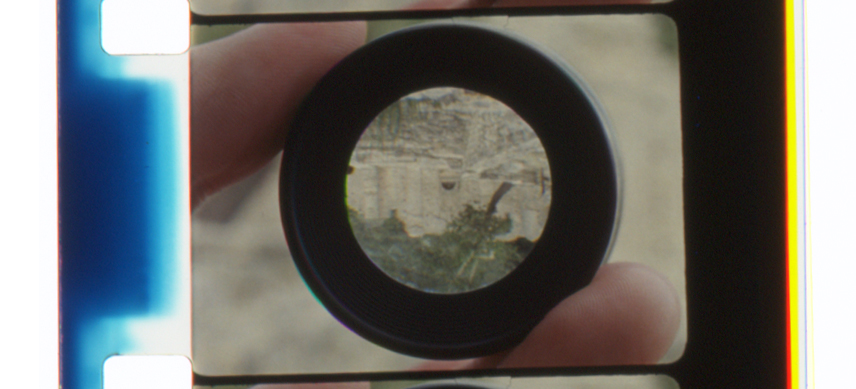
Light and time are their raw materials. The practice, pace, and creative processes of the piece are determined by the artists’ handling of analogue devices and photosensitive film, their complete awareness of the equipment, and cinematographic expression. It is a conscious methodological choice, driven by a desire to keep exploring the possibilities of the plastic arts, poetic usage and the critical potential of a technique and aesthetic approach considered obsolete in the digital age.
Light makes the world visible. What we can perceive is deceptive, but the invisible barely exists: the hegemony of vision in modern culture. Valentina Alvarado Matos and Carlos Vásquez use framed images, adding filters and lenses: mechanisms that act between the camera and the subject, changing the nature of perception to enable us to see things anew. Their earlier project, Paracronismos, explored ways of considering, within the image, our relationship with other times, or rather whether heterogeneous periods can coexist, disrupting the concept of linear chronological events. The image is thus a memory, a montage of superimposed layers that flash up when summoned, as Walter Benjamin would say. Past and present are contemporaneous, as in cinematographic practice.
We present an experimental project that brings together the themes explored in Paracronismos I and II with an installation specially designed for this exhibition space. And If Seeing Was Fire suggests a natural continuity between the exhibition space and cinema, combining a permanent film show with additional ephemeral performance sessions projecting 16 mm and S8 mm film and improvised sound. These are different but complementary experiences that invite us to rethink the possibilities of film and the place we occupy as spectators.
And if seeing was fire…
‘Cossos Itinerants’ [Itinerant Bodies]: actions in the public space
9 — 12 November 2021
— In collaboration with EINA - University School of Design and Art of Barcelona, Hangar.org and La Escocesa.
![‘Cossos Itinerants’ [Itinerant Bodies]: actions in the public space](https://fervent-sinoussi.5-196-224-241.plesk.page/wp-content/uploads/2021/11/COSSOS-1-rotated.jpg)
- Artists
- Valentina Alvarado Matos, Laura Arensburg, Julia Calvo, Natalia Carminati, Comitè Queer, Citlali Hernández, Daniel Moreno Roldán, Núria Nia, Pedro Torres, Carlos Vásquez Méndez and Paula Serrano
- Curators
- Carolina Ciuti
- Venues
- Jardins de Rubió i Lluch and Plaça Joan Coromines
- A project by
- LOOP Festival in collaboration with EINA - University School of Design and Art of Barcelona, Hangar.org and La Escocesa.
- Contributor
- The mobile artifact has been co-produced by Hangar.org and LOOP. Its adaptation was carried out by Pense (Head of constructions of Hangar.org).
- Price
- Free admission
Add to calendar
The 'Itinerant Bodies' project explores the possibilities of networking and the value of public space as a meeting place. On November 9 and 12, a mobile device becomes the ephemeral stage to present the performative proposals by Valentina Alvarado Matos and Carlos Vásquez Méndez, Laura Arensburg, Julia Calvo, Natalia Carminati and Daniel Moreno Roldán, Queer Committee, Citlali Hernández and Núria Nia, Pedro Torres and Paula Serrano.
Background
Among other things, the arrival of Covid-19 caused the gradual withdrawal of bodies from public space. The need to counter the health threat led to the immediate and radical suppression of basic freedoms, generating a state of voluntary citizen submission in the name of health. The unexpected state of emergency highlighted the importance of emotional bonds and community networks, as well as the need for human “contact” despite the paradox of contagion.
Due to the diffuse precariousness and the total absence of social and legal systems of care, these same demands were manifested in the artistic community. In the face of the institutional vacuum, the only possible response was connection, support, mutual commitment, and the pooling of human and economic resources. To be “bodies open to the community,” as Merleau-Ponty put it, individuals sensitive to intertwining with others.
Crises often have the effect of radically exposing existing systemic problems, but then they need to be dealt with. While in the artistic field the most immediate and sensible proposals seem to have been born thanks to the associative initiative of artists themselves, where have the other agents of the ecosystem been then?
Itinerant (and intertwined) bodies
Taking these reflections as a starting point, this proposal aims to reflect on the possibilities of networking and the value of public space. It becomes an excuse to generate professional links and a platform for shared reflection. For this reason, it was addressed to the residents of Hangar.org and La Escocesa (art residencies both located in the Poblenou district), with the aim of fostering moments of exchange and a common work methodology.
An underlying questions was: “what does it mean to be a body?” Linking to the general theme of this edition of the Festival, the proposals of Valentina Alvarado Matos and Carlos Vásquez Méndez, Laura Arensburg, Julia Calvo, Natalia Carminati and Daniel Moreno Roldán, Citlali Hernández and Núria Nia, Queer Committee, Pedro Torres and Paula Serrano tells us about exposed, connected, pixelated bodies and traversed by time; of dissident, dependent, porous and powerful corporealities. Bodies that look and are looked at, that cross the city and are crossed by it. A series of ‘Itinerant Bodies’ and inevitably intertwined.
The performances will be presented at two different locations in the public space: the first, coinciding with the inauguration of the Festival on November 9, will take place at the Jardins de Rubió i Lluch; the second, on November 12 in the Plaça Joan Coromines.
The mobile device that will accompany the proposals has been conceived during the workshop ‘Mobile artifacts and Itinerant bodies’, organized in collaboration with EINA – University School for Design and Art of Barcelona, and with the participation of the students Irene Anglada Espadaler, Rafael Cribillés Alba, Gio Galindo (“Grupo Octubre”); Mercedes Almeida, Maria Bei Bellsolà López, Andrea Fernández Camps, Maria Verdù; Elisabet Callén Artola, Julieta Italiano, Felipe Román Osorio, Lucía Trigo González.
- The prototype presented by the students of the “Grupo Octubre” was the selected project. Pense (Head of Construction at Hangar.org) was in charge of adapting and building the device. The artifact has been co-produced in collaboration with Hangar.org.