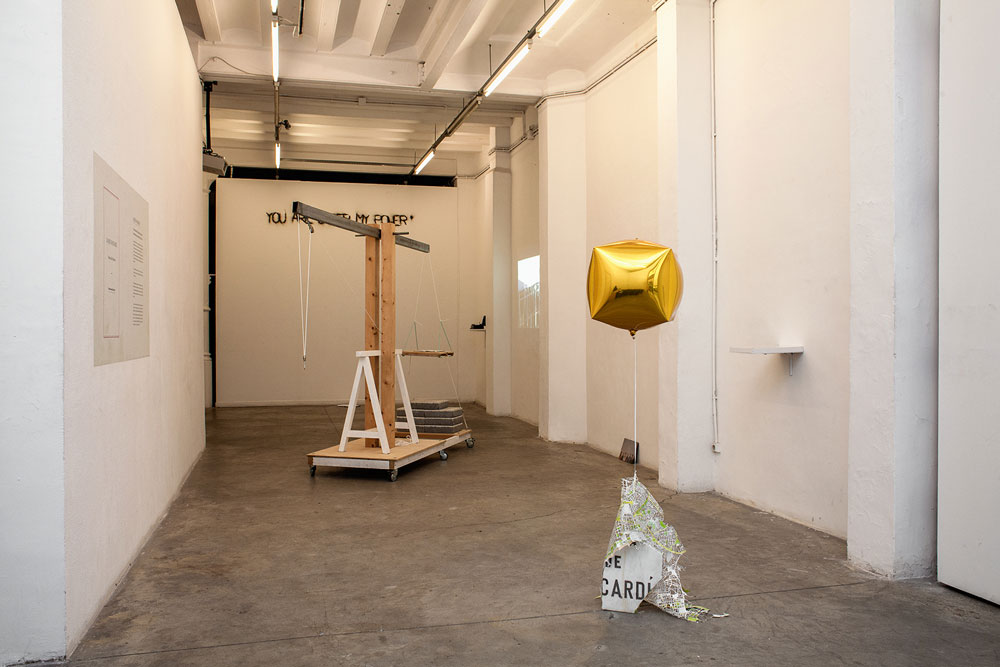
àngels barcelona – espai 2
- Address
- Carrer Dels Àngels, 16, 08001, Barcelona
- Phone
- +34 93 412 54 00
- info@angelsbarcelona.com
- Website
- angelsbarcelona.com
- Map
- View map
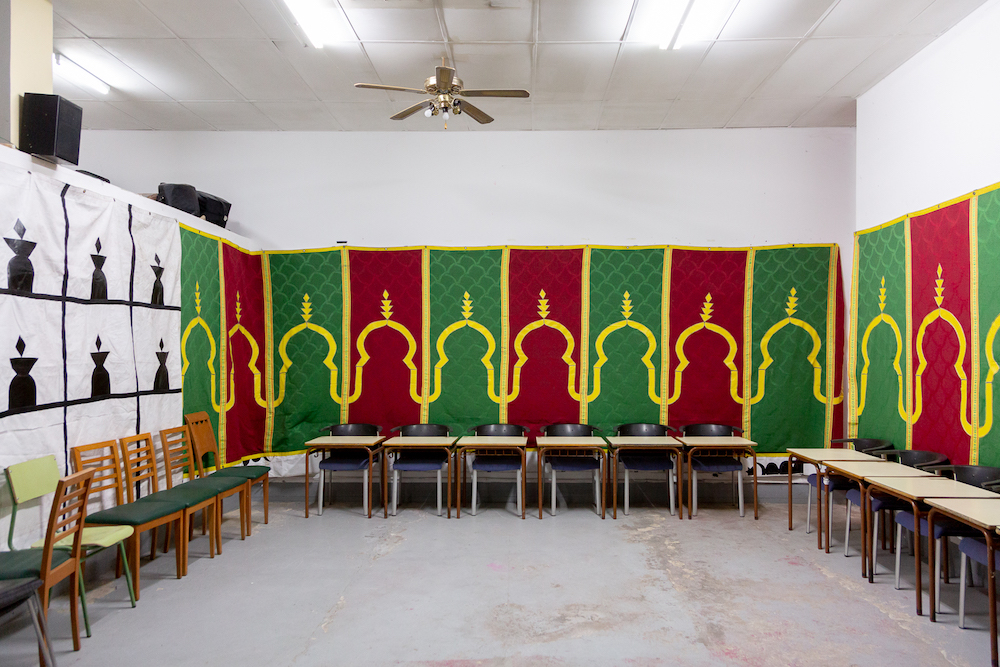
I CAN ONLY DANCE TO ONE SONG explores the role of music in forming a sense of belonging to a location. This project portrays accounts of displacement rooted in the experience of migrants through sound and movement. By incorporating dance as an expressive act of transformability, this video illustrates the emotional landscape of displacement using corporal acts. This work moves beyond the visible to tell the story of an invisible city, a seamless tale about a place that exists within every displaced person and beyond physical location.
Co-financed with funds from the Creative Europe Program and the project A-PLACE. Linking places through networked artistic practices.


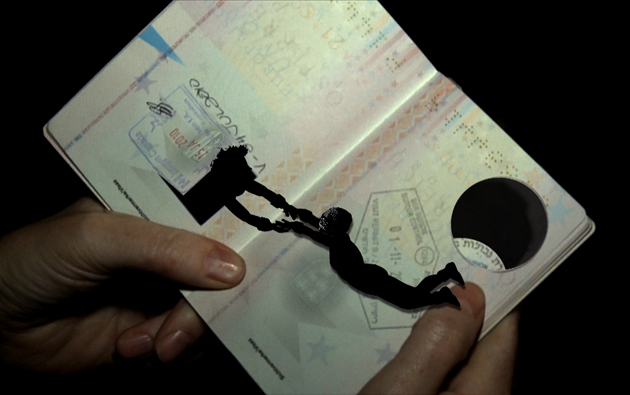
Walls, borders, the right of asylum and nationality are fundamental issues to decode the global world we live in. The audiovisual projects in this exhibition use footage images, documentary films, performance or fictionalised reality to tackle key concepts such as democracy, universal citizenship and the global economy of bodies.
DANIEL G.ANDÚJAR (Almoradí, Alicante, Spain, 1966)
Postcapital Archive (1989-2001).The Wall, 2001. Video, color, silent, 12’10’’
Postcapital Archive (1989-2001). Border, 2008. Installation. 6 color digital prints dibond on alluminium, 50 x 70 cm.15 color digital prints dibond on alluminium, 70 x 50 cm
The Wall, shows a montage of film sequences in which people overcome -or try to overcome-borders: from the eary escape attempts along the “antifascist bulwark” to pictures taken on November 9, 1989 to attempts at crossing the borders between Mexico and the United States, Africa and Europe, or along the Gaza Strip. All scenes are shown in slow motion. Moving to the forefront there is the enormous physical strain that surmounting borders demands: the “naked body” who is risking everything, revolting againts the dispositive of inclusion and exclusión. That the world has become flat, as Tomas L Friedman asserted in his 2005 book in which globalization is analysed, here proves to be pure cynicism, or a purely rhetorical construction.
OLIVER RESSLER (Knittelfeld, Austria, 1970) & ZANNY BEGG (Melbourne, 1972)
The Right of Passage, 2013. Video, color, sound 19′
“We can’t imagine a global citizenship or any concept of dynamic citizenship if we don’t think about it not only in terms of law but in terms of the political economy of bodies that move. There have to be structures that can receive and host this kind of movement. This is why citizenship is not simply a subjective phenomenon but also an objective phenomenon of hospitality” – Antonio Negri, The Right of Passage.
In their third collaborative film Zanny Begg (Sydney) and Oliver Ressler (Vienna) focus on struggles to obtain citizenship, while at the same time questioning the implicitly exclusionary nature of the concept. This work is partially constructed through a series of interviews with Ariella Azoulay, Antonio Negri and Sandro Mezzadra. These interviews form the starting point for a discussion in Barcelona, one of Europe’s most densely populated and multicultural cities, with a group of people living “without papers”.
The film is set at night, against a city skyline, providing a dark void from which those marginalized and excluded can articulate their own relationship to the arbitrary nature of national identity and citizenship. Spain was chosen for this project as it is teetering on the brink of financial meltdown and is testing the limits of European cohesion. The title, The Right of Passage, refers to the stages, or “rites of passage” that mark important transitions on the path to selfhood. The exchange of “rites” with “rights” suggests that freedom of movement must become a right granted to every person – regardless of his or her place of birth. As the film explores these journeys not only transform those who embark upon them but also the places they inhabit. In the film, the conversations around citizenship are interwoven with animated sequences.
ISAIAS GRIÑOLO (Bonares, Huelva, 1963)
(Re-escritura colectiva de performances), 2018. 2-channel video installation: 16’ each channel
Máquina Hamlet_Europa (Collective re-writing of performances) is a work in-progress that comprises film essay, live cinema, performative practices, poetic readings, conferences and the collection of materials. The work proposal started from the March of Dignity to the El Tarajal beach (Ceuta, 2016). There, on February 6, 2014, the Guardia Civil fired rubber balls at those who were trying to swim into Europe, resulting in the murder of 15 Sub-Saharan people. On the basis of this event, I made a critical analysis of the European migration policy, including the activism that questions it, in order to reflect on the circumstances that make it possible to blur Europe as a welcoming space. With the collaboration of the poet Antonio Orihuela and the cantaor Javi Triana and the hand of María Zambrano, Heiner Muller, Jorge Riechmann and Franco “Bifo” Berardi I put forward the following idea: Europe is collapsing, and, at the same time, Europe is imposed on us. Two performances are presented here, one made in the Caravan Opening Frontiers to Melilla (2017) and to Italy (2018). Two performatic journeys that cross landscapes and places where we find the remains of fear and deception with which the Fortress of Europe is being built today.
ELENA MAZZI (Reggio Emilia, Italia, 1984) & ENRICA CAMPORESI (Forly, Italy, 1985)
Performing the Self: the interview, 2017. 3-channel video installation, 50’
Performing the self — the interview was made in collaboration with researcher Enrica Camporesi. It stages the impossible conversation between a protection officer and an asylum seeker just before the interpreter arrives. Drawing on interviews with protection officers, asylum seekers, recognized refugees, lawyers and social workers as well the academic literature, “Performing the self — the interview” zooms in on the protection officer and the asylum seeker as co-producers of a dialogical but reliable and consistent life story, a new and reasonable plot whose crucial goal is to be awarded with the asylum status.
The interview is a real “make or break moment” in the life of the asylum seeker. And it puts the protection officer under the immense pressure of judging someone else’s future risk of persecution mainly based on his own oral testimony, while tolerating the intrinsic uncertainty of such a decision making process. What might happen before such an overloaded conversation begins? “Performing the self — the interview” builds up an imaginary space that redefines the existing protocol of questions and answers, mutual expectations and power relations.
DANIELA ORTIZ (Cuzco, Perú, 1985)
Jus Sanguinis, 2016. Installation + video (3’ 29”), color, sound
‘Jus sanguinis’ or ‘right of the blood’ refers to the way Spain aligns physical and geographical bodies by giving people citizenship only if they contain Spanish blood. It is also the name of a performance and installation (2016) by Peru-born and Spain-dwelling artist, Daniela Ortiz, who arranged a blood transfusion from a Spanish citizen while being 4-months pregnant. From deep inside her, infused by liquid Spain, her baby transcends national borders and her own body becomes a complex cultural terrain. The use of blood reminds us of the real violence of immigration laws, while the video installation recalls the ease at which mortal harm can flow through media veins.

New project by Spanish Pedro G Romero (Aracena, 1964) in which the artist’s unique operations are presented before, after and during his work with Archive F.X, and with which he pursues his interest in the social production of value, General Intellect. Works on display are not collaborative, nor do they combine cooperative wills, but they deal with the construction of that which is common, since they have been carried out far from any subjective formalization.
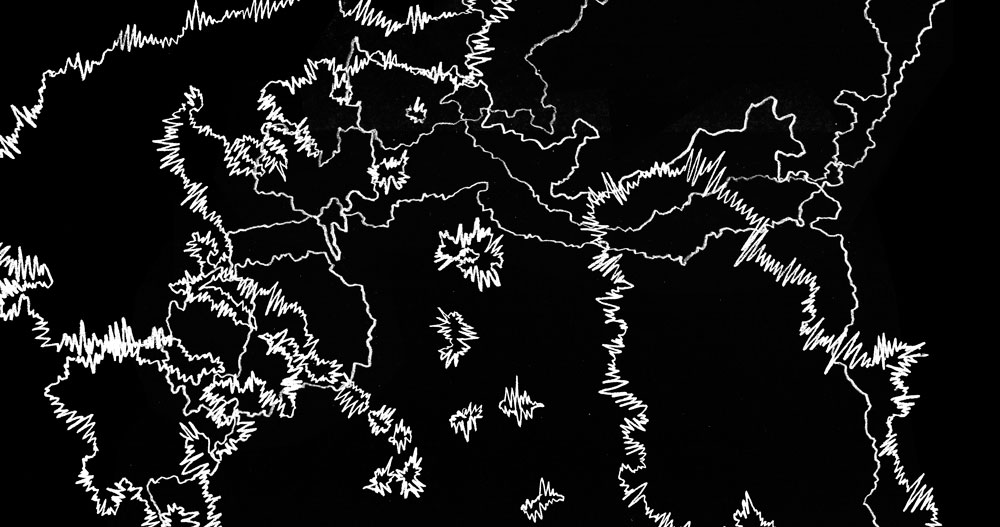
Border imag(e)naries is a group show organized by àngels barcelona for LOOP Festival 2016. We are currently experiencing a historical situation in which borders have taken on a symbolic significance, shaping identities and the social and political landscape. Borders efined broadly to include territorial dividing lines, as well as sociocultural boundaries, have become increasingly relevant points of struggle over social belonging and cultural and material resources. Border imag(e)naries gathers a selection of works through which to get a closer look at borders as sites of diverse struggles, as well as elements from which to depart from when thinking about today’s global, political and social situations and their symbolic significance. The artists selected for this exhibition deal with the concept of borders in different ways ranging from the limits of the social borders marked by society’s fictions, to the conceptual limits of image production and recalling the political and geographical border limitations observed in the ever so present relationship between borders, security and sovereign power.