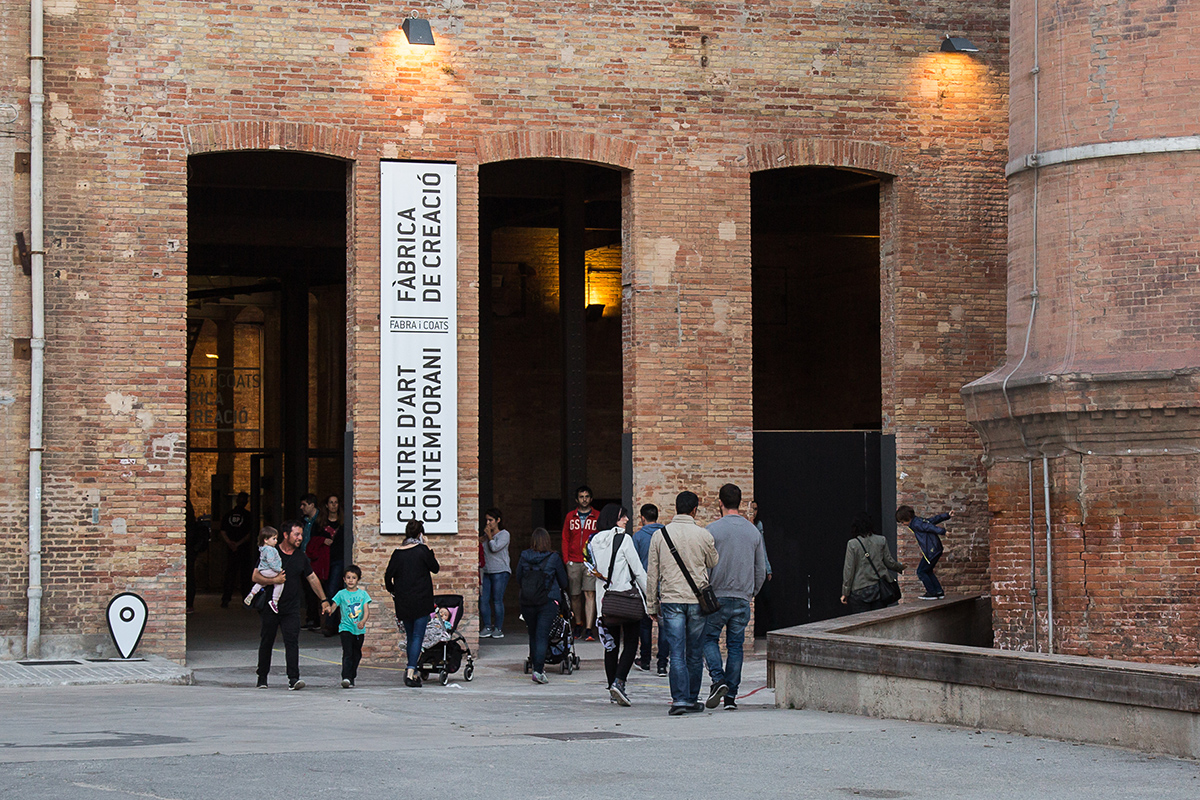
Fabra i Coats-Centre d’Art Contemporani de Barcelona
- Address
- Carrer Sant Adrià, 20, 08030 , Barcelona
- Phone
- +34 93 256 61 55
- Website
- www.barcelona.cat/fabraicoats/centredart/en
- Map
- View map

Matter is what lies beneath change, what anticipates transformation and movement. Matter precedes form and representation, it articulates time and what comes after, making possible what is yet to come. The questioning of matter is common in many processes and debates about current art, often from a thematic viewpoint. However, it is also possible to approach materiality as a method. This exhibition brings together the work of the finalists of the Miquel Casablancas Award 2024 and the three projects developed during 2023 as part of the SAC-FiC residencies. Even though a variety of concerns are considered, methodological affinities can be found among them. Through sculpture, installations and audiovisual pieces, these artworks invite us to explore their construction processes and carry out an archaeology of the substrate they share.
Reflection on the concept of matter is something that has been going on since ancient times, particularly when a thought arose, that, in contrast to the metaphysics of ideas, proclaimed that all reality is based on what is material. Within the political struggles of modernity, historical materiality already emerged as a method for imagining the passage of time in a complex way, discrediting a linear view of history and opting for the conviction that matter is the cause of all transformation, in other words, the fundamental structure of all possibility. Today, focused on the search for other possibilities of life, speculation about a kind of “new materiality” has multiplied, which directly invokes artistic processes whose main focus is matter and its transformation.
Artists: Marc Anglès, Isabel Bonafé, Natalia Domínguez, Mikel Escobales, Albert Gironès, Marina González Guerreiro, Gala Hernández López, Hodei Herreros Rodríguez, Abel Jaramillo, Claudia Rebeca Lorenzo, Lucas Marcos Barquilla, Jara Roset, Laia Ventayol García, Lola Zoido

The list of Western cultural representations surrounding love and passions would be endless: from Greek mythology and its tragedies, through Christian scholasticism, courtly love, the Golden Age, and the romanticism of the 18th century and part of the 19th, to the most popular or alternative cultural expressions of our time, there has been testimony of the ravages caused by some idea of love.
In the realm of the real, we continue to suffer from believers who exterminate the other in the name of love for a God; all the nationalists who continue to throw themselves into mutual destruction for love of some homeland or motherland; adolescents who interpret jealous traits as signs of true love; the mother who kills her children so that they do not suffer; revolutionaries who give their lives or take them for love of some idea of social revolution; or the lover who decides to kill their beloved (or vice versa) upon realizing they are losing their love.
What is the responsibility of culture in all these paradoxes? How many dramatically pre-established situations have we lived in our love stories? What pleasures or phantoms are hidden behind the mask of beliefs surrounding the ideal of love? Could it be that the main cause of social conflicts is not hatred but an excess of blind love? What effects would the de-idealization of love have on social order? And on us?
In the exhibition Words of Love, Núria Güell, through an inaugural action, a video projection, and a closing party with live music, questions the established representations and learned cultural mandates surrounding passionate love and its consequences.
![Albert Serra, 'Els tres porquets [The Three Little Pigs], 2012. Image courtesy Fabra i Coats-Centre d'Art Contemporani de Barcelona.](https://fervent-sinoussi.5-196-224-241.plesk.page/wp-content/uploads/2022/09/albert_serra_web.jpg)
Albert Serra, when he was invited by dOCUMENTA13 in 2012, created Els tres porquets [The Three Little Pigs], a 101-hour long film starred by Goethe, Hitler and Fassbinder. Shot fragmentarily in Kassel to be screened every day for the three months of dOCUMENTA, the work will be displayed as a multi-screen installation at Fabra I Coats.
Through this cinematographic experiment, Serra explores the performativeness of the medium, but also faithfulness towards autobiographical texts and the symbolic construction of history. Set out as a constant flow of discourse, amateur actors literally recite the words attributed to the three charcters in the books Conversations with Goethe by J.P. Eckermann, Hitler’s table talk and a collection of interviews with Rainer Werner Fassbinder. Through his dissertations, the personalities of these three figures, who marked three key moments in the history of Germany and the construction of Europe, take shape.
This is the premiere of Els tres porquets in Spain, which leaves its German context for the first time thanks to this iniviative by Fabra i Coats, which believed it was necessary to be able to display this magnum opus by our most international filmmaker in Catalonia. For this purpose, and with support from the Department of Culture of the Catalan Regional Government and from the Goethe Institute, Fabra i Coats has commissioned and led the gargantuan task of translating and subtitling the 101 hours of the film, which is expected to be screened for two months.
This project has benefitted from the support of the Department of Culture of the Catalan Regional Government and from the Goethe Institute.
Cracking a nut is an insignificant, everyday action. Who would think of entertaining us by cracking nuts? But the fact is that in its very humility this action has in itself the ability to deploy the whole structure of a tiny scene, with its own expectations and dénouement. It doesn’t just summons us with the promise of something to eat, but also manages to focus the attention of everyone there on a single point.
Rather than the often unsuccessful pretensions of more ambitious, elaborate stories, Lúa Coderch places herself where small events like this one discreetly seem to offer us a starting point for a movement of restoration, from which to repair the seams of our common life.
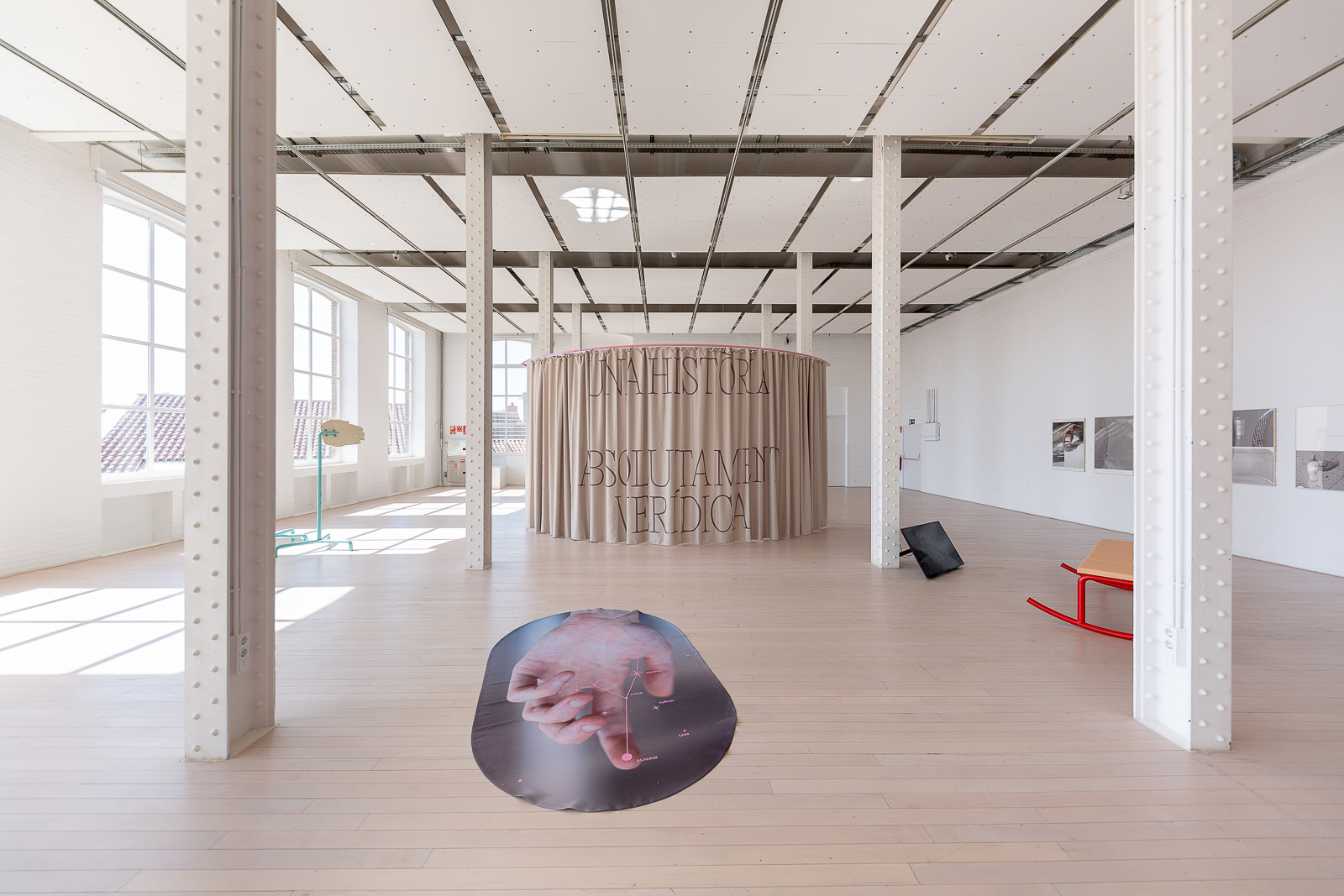
In the Fabra i Coats venue, the exhibition shows a series of devices to capture the attention, including a film-curtain, sculptures that might be furniture and a programme of small-scale actions to share with others, like a set of scenes or small units of meaning that could even make up the starting point of a shared narrative.
With three juxtaposed words, the title disassembles the elements that combined would configure a voice. The tone, recognisable but without semantic content; the tongue, a visceral organ but also a political-linguistic construct, and the mouth, a place of embodied enunciation.
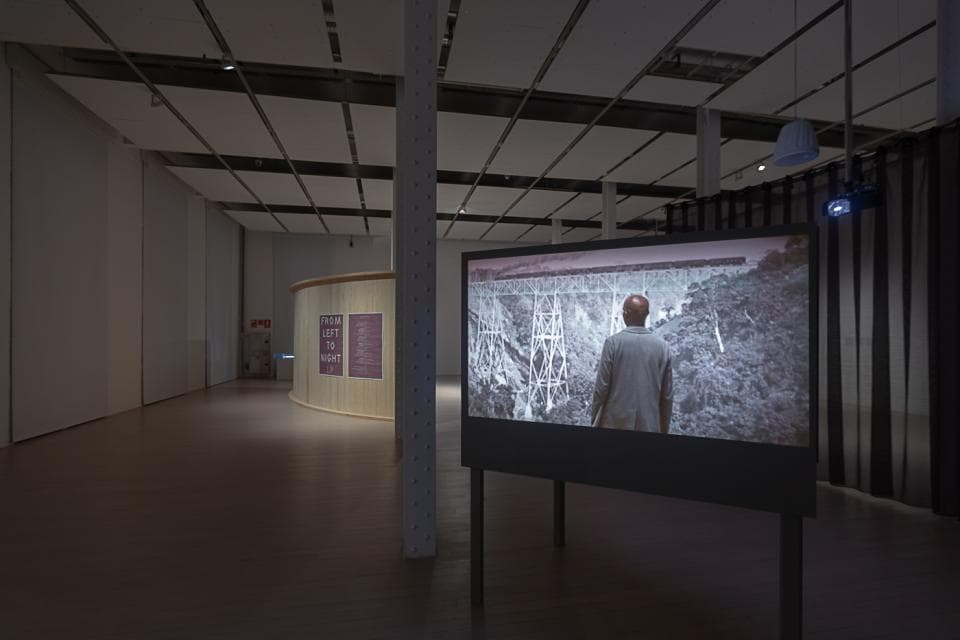
The exhibition focuses on the use of sound and polyphony that runs through the artist’s practice. Not only as something that she uses to shape her films but also as something that shapes her. It looks at the role assigned to other voices, as much as at an artistic trajectory in which the search for one’s own voice involves letting in those of others. Here, the place from which to speak with legitimacy is found by multiplying the voice, by making it alien, in a sort of intentional self-estrangement.
Van Oldenborgh does not direct films, rather she sees them as a place of hospitality to which she invites and mobilises subjects and narratives for a collective elaboration or revision of meaning. At times, messages and texts from the past cut through bodies in the present giving rise to a sense of estrangement, conflict and violence. At times, the participants literally and metaphorically distance themselves from the script, weighing up their capacity to embody it. The processes of dialogued interpretation are ways to make visible and exorcise colonial, ideological, racial and class discursive legacies that would otherwise inadvertently keep on being reproduced.
tone tongue mouth underscores the efficacy of strategies related to speaking, to the encounter and utterings of voices, to the choral construction of narratives and to the non-naturalisation of the place from which we speak. In the artist’s work, there is an obstinate insistence on letting go. On the one hand, in her films, by refusing to direct the voices and bodies and, on the other, in her own agency, by disposing of the univocal monotone speech as an artistic, ethical and political enunciation.
Prologue by Caterina Almirall
Audiovisual reading on the transformation of our emotional relationships after the introduction of new technologies and artificial intelligence. Using a compilation of case studies such as applications, consumer products and service contracts but also films, publicacions and interventions by artists and activists, Núria Gómez Gabriel traces a path through the universe of emotional surveillance.
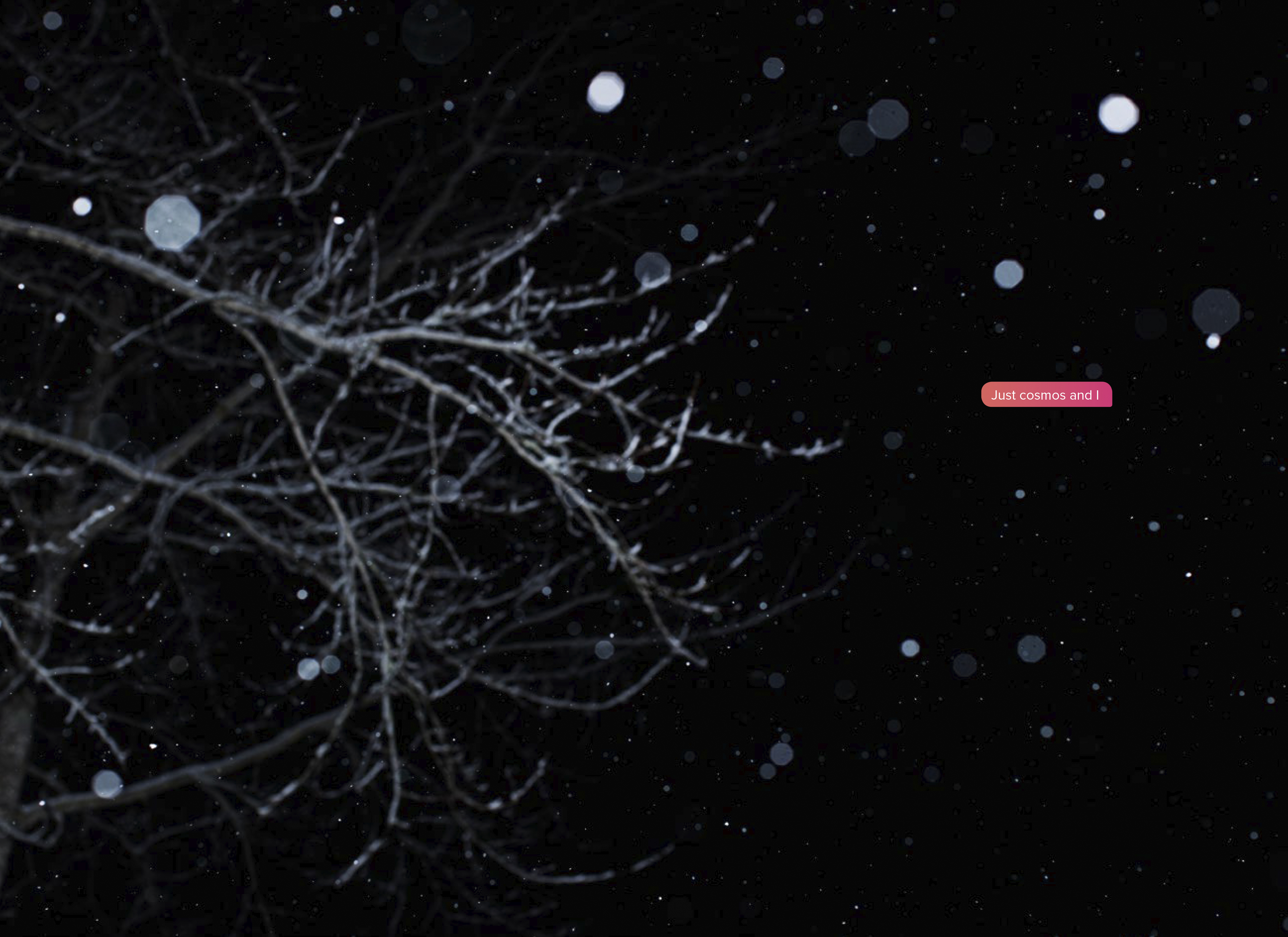
Our love is one of cosmic aberrations. The universe of emotional vigilance is a place of hidden forces, capable of predicting what your future relationship will be in a speculative and rational way or of diagnosing an episode of severe depression ahead of time. With its own rules integrated in its platforms, it represents the combination of legal, moral, aesthetic, technological and commercial effects of the connected digital world. In an ecosystem where the interfaces are increasingly more persuasive and where algorithms play an oracular and preventive role, Who or what determines who or what I am going to fall in love with?
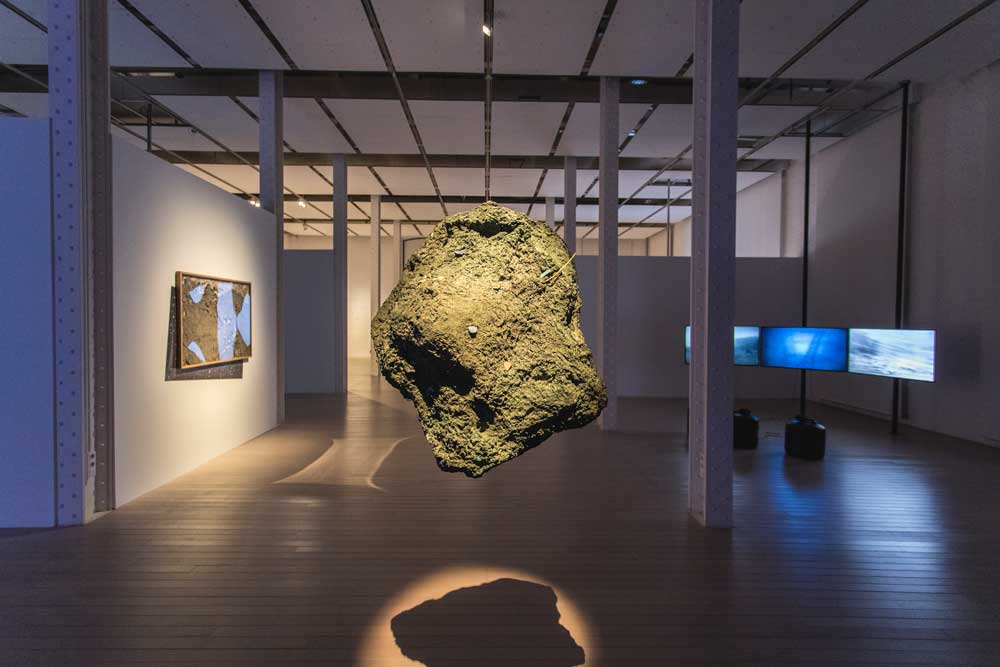
Information leaflet One Day I Stumbled Upon a Meteorite
In the short story “The distance of the moon” (1965), Italo Calvino tells us about the human will in relation to unattainable goals, fictionalizing a universe in which the space that separates us from the satellite also becomes a metaphor for the desires, passions and obsessions on Earth.
To direct the gaze towards the starry sky corresponds to that vertical impulse to which human beings have always responded, an impetus of the body that discloses questions about the origin of the world, the need to find an orientation and the inclination to explore. Likewise, and in different historical eras, this ascending action has embodied the form of the utopian dream, of the fear of invasion, until disclosing the features of a future interstellar colonisation.
From the Space Race era, the possibility of an expansive ‘territorialisation’ of the universe is related today to the uncertainty of the future of life on Earth, thus reducing the seeming distance between the otherness of the cosmos and our daily life. As if the space we inhabit, “infinite, indistinguishable and uniform in all its directions” (Cambridge Dictionary) acquired physical and tangible substance, and forced us to wake up from our self-absorbed walk.
When the already complex debate about the nature of ‘space’ that exploded at the beginning of the Eighteenth century, two main positions were facing: the rationalist, according to which space corresponded to the relationship of distance or proximity between things, and the absolutist that identified it with an omnipresent entity and partly conducible to something divine. Later, Immanuel Kant would talk about space as an abstract concept that human beings have created to make sense of the world. According to contemporary physics, space-time is explained and represented as a container within which we move and flow, an imperceptible system that determines, organises and affects our existence.
By abstaining from the specificity of the scientific discourse and redirecting the debate to a metaphorical context, the ‘spatial gaze’ would then offer a way to narrow the distance between the infinitely large and our daily microcosm, while interrogating those issues that touch us closely, according to a reversed movement that from the cosmos would solicit the body. As if walking down the street we stumbled upon a meteorite.
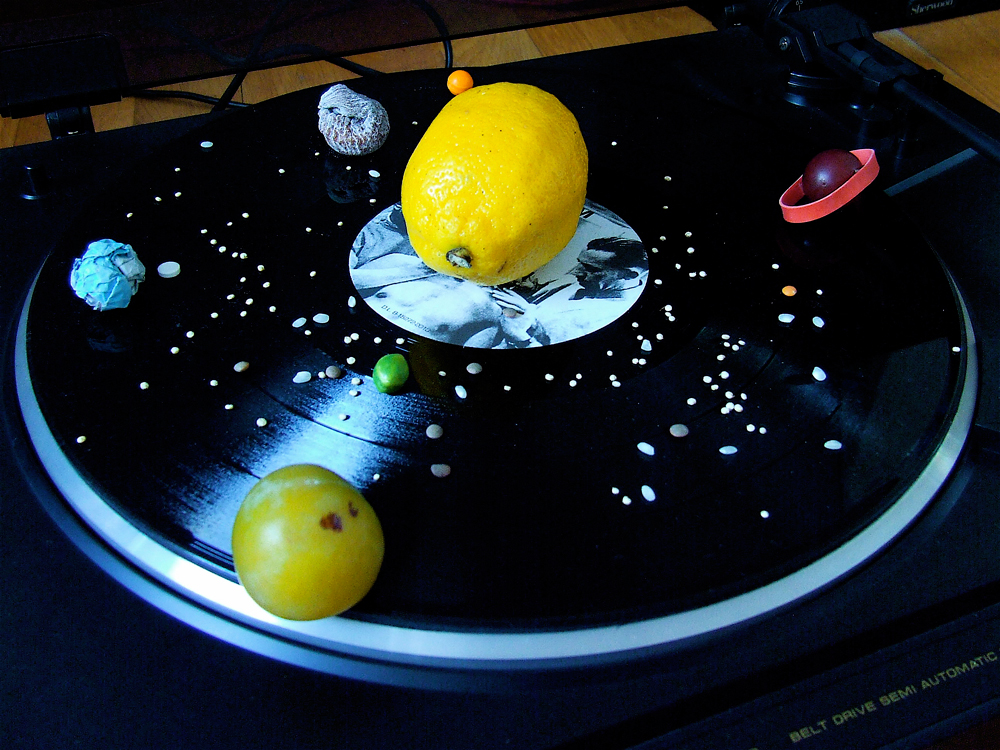
This project, which began as a research project on scientific theories concerning the infinitely large and the infinitely small, is put forward as a glance cast at science “by a rather unscientific mind.” Formulating a number of recurring existential questions, such as “who are we?” “Where are we going?” “What is the universe?” “Is it infinite?” “Where does it end?” “what was there before the Big Bang?”, led Cris Blanco (Madrid) to lay the foundations for ciencia-ficción, a performance, concert, and audio-visual reflection on subject of the cosmos and what lies beyond, in 2012.
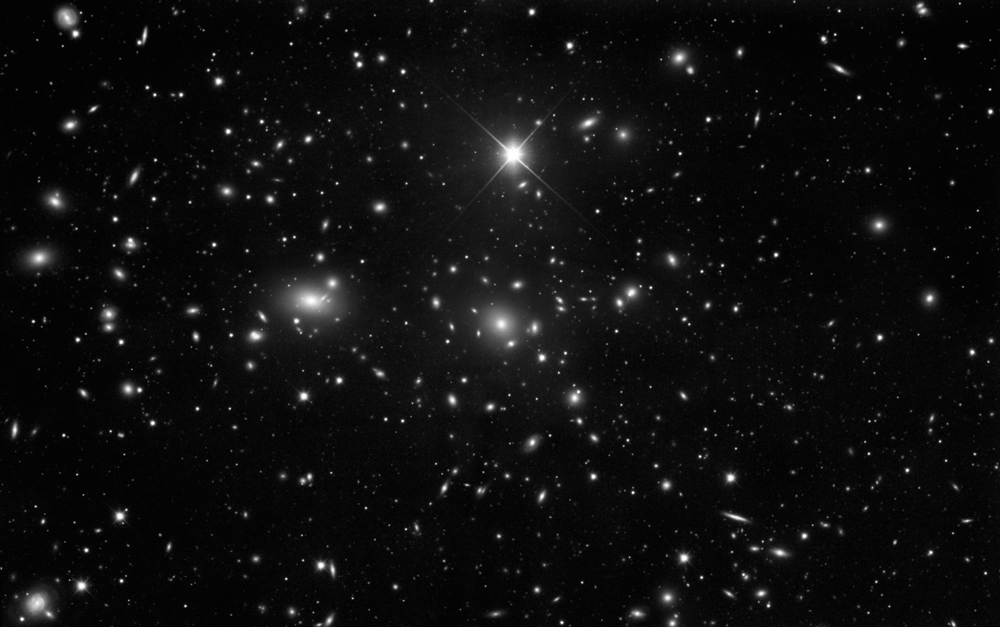
How to Observe a Nocturnal Sky is a performative lecture in which curator Alexandra Laudo considers some astronomical phenomena and outstanding moments in the history of astronomy – and, in particular, of what was historically one of the most prominent observatories in Europe, the former Calton Hill Observatory in Edinburgh- in relation to philosophical reflections on the night, the darkness, and our ways of seeing. Throughout the conference, Laudo also talks about different artistic works that have explored these questions, thus constructing a story that is also a curatorial exercise, a narrated exhibition. The proposal combines references belonging to astronomy, history and visual culture through narrative strategies, blurring the boundaries between curatorial performance, art exhibition, and formal lecture.
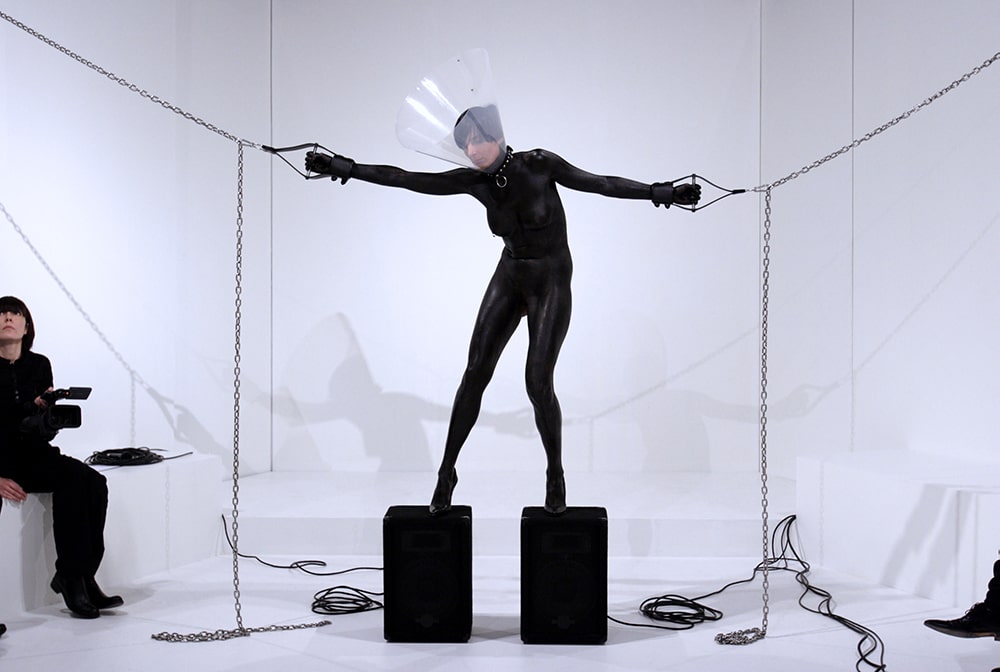
Since the late 1990’s, Joan Morey has produced an expansive body of performances, videos, installations, sound, and graphic works that explore the intersections between theatre, cinema, philosophy, sexuality, and subjectivity. COLLAPSE contains three parts.
The first is presented over two floors at the Contemporary Art Centre of Barcelona – Fabra i Coats. Desiring Machine, Working Machine is a survey of ten major projects from the last fifteen years of the artist’s work.
The second part of COLLAPSE takes place at the Centre d’Art Tecla Sala, in l’Hospitalet de Llobregat (from 23 November 2018 to 13 January 2019) and is the definitive version of the touring exhibition Social Body. The latter has centred on an evolving presentation of the video performance Social Body. Anatomy Lesson, awarded the 2017 Premi de Videocreació by the Xarxa de Centres d’Arts Visuals de Catalunya, Arts Santa Mònica, the Departament de Cultura de la Generalitat de Catalunya, and LOOP Barcelona. Titled Schizophrenic Machine, the third part comprises a major new performance event which will take place in January 2019 at an especially resonant location in Barcelona—which, for the moment, remains deliberately undisclosed.