CosmoCaixa
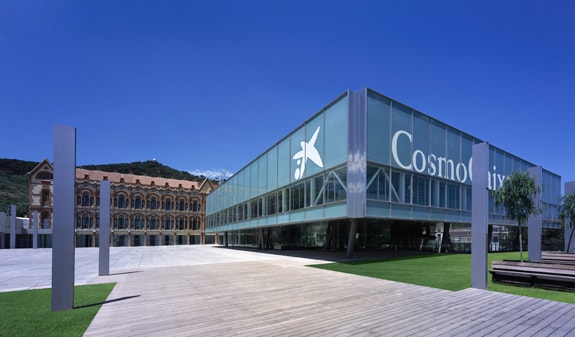
- Address
- Carrer d'Isaac Newton, 26, 08022, Barcelona
- Phone
- +34 932 12 60 50
- Website
- bcnshop.barcelonaturisme.com/shopv3/es/product/325/cosmocaixa-museo-de-la-ciencia.html
- Map
- View map
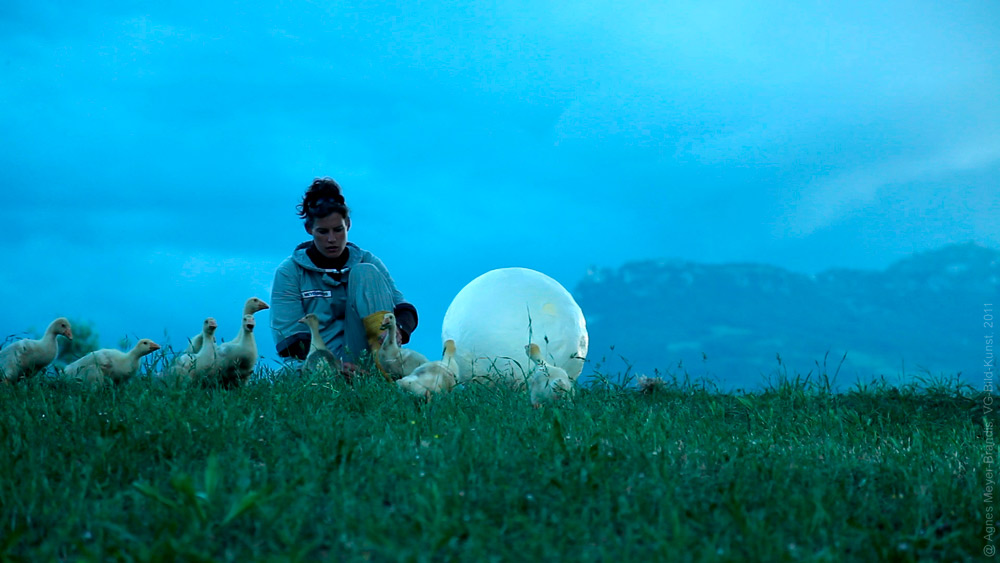
This illustrated conversation between artist Agnes Meyer-Brandis (DE) and curator Ulla Taipale (FI) digs into the process and making-of behind the long-term project and performance with the fantastic Moon Geese. English bishop Francis Godwin (1562–1633) discovered “Moon Geese”, a special migration bird species that instead of traveling to the South, head their yearly flight to the Moon. Meyer-Brandis and Taipale tested the descriptions of Godwin in Siberia during the Expedition to the total solar eclipse in 2008 and after the promising results of this Russian moon flight with local Moon Geese, Meyer-Brandis continued working with her own geese colony on an Italian farm, to train them for future space travels. The audience has a chance to see unedited material from the expedition to Russia, and of the Moon Goose astronaut in Italy, amongst others.
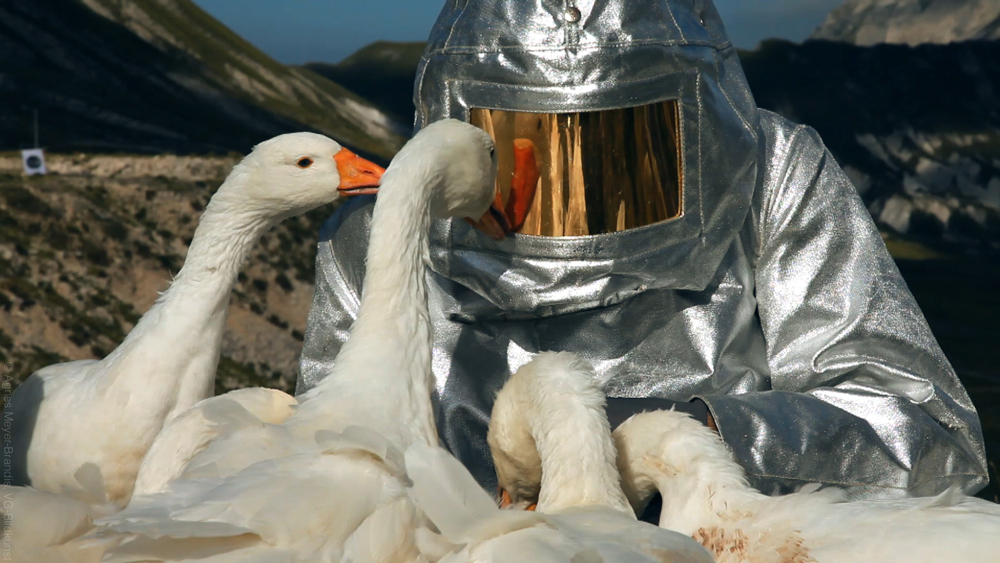
On the occasion of its second collaboration with LOOP, CosmoCaixa hosts a proposal by German artist Agnes Meyer-Brandis, whose work waves scientific facts and fiction with a personal touch of poetic imagination. Resulting from a commission by the ‘Arts Catalyst’ and ‘FACT’ Liverpool in 2011, THE MOON GOOSE ANALOGUE: Lunar Migration Bird Facility (MGA) is a multidisciplinary project that dramatizes the 1638’s novel by Francis Godwin The Man in the Moone, where the protagonist flies to the Earth satellite in a chariot towed by ‘moon geese’. Inspired by the book, Meyer-Brandis raised eleven moon geese from birth, giving them astronauts’ names, imprinting them on herself, and training them to fly in a remote Moon analogue habitat. As illustrated in the project’s documentary film The Moon Goose Colony (MGC), the artist carried out a potential interplanetary journey with the accuracy of scientific research, leaving viewers with a sense of wonder and the fascination for outer space.
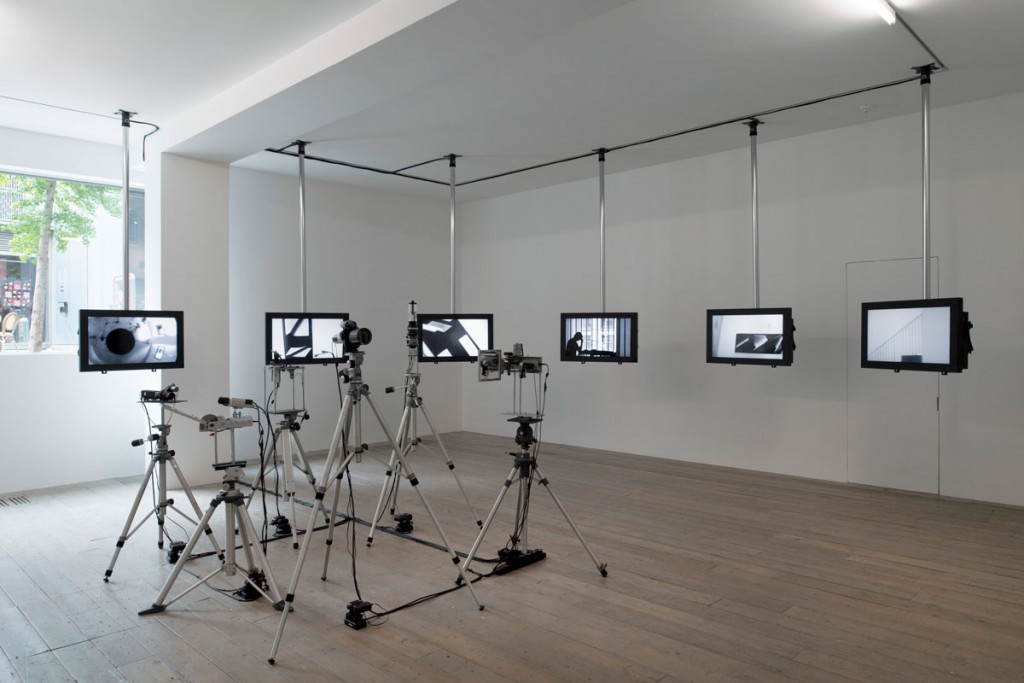
“When a human being operates the camera, the assumption is that the camera is an extension of the eye. You move the camera the way you move the head and the body. In video, unlike photography or film, the view finder is not necessarily an integral part of the camera apparatus. . . . In the late seventies, I began a series of environments titled Machine Vision and Allvision, with a mirrored sphere. Another variation has a motorized moving mirror in front of the camera so that depending on the horizontal or vertical positioning of the mirror, the video monitor displays a continuous pan or tilt either back/forth or up/down. A third variation is a continuous rotation through a turning prism, while still another has a zoom lens in continuing motion, in/out. These automatic motions simulate all possible camera movements freeing the human eye from being the central point of the universe.” — Steina
A mirrored sphere, positioned in the middle of a crossbar reflects the image of surrounding space. Two video cameras, attached to each end of the crossbar are looking in at the mirrored surface. The crossbar — now an assembly of mirrored sphere and two cameras — slowly rotates on the turntable with cameras orbiting the sphere. Since each camera sees half of the reflected space, the whole space becomes observable.
The turntable, which sits on a low pedestal, holds the driving mechanism for the rotation — a slip-ring assembly and a DC motor. The slip-ring assembly provides uninterrupted video signals from, and power to, the cameras. The video signal from two cameras connects to two (or more monitors) arranged in the exhibit space.