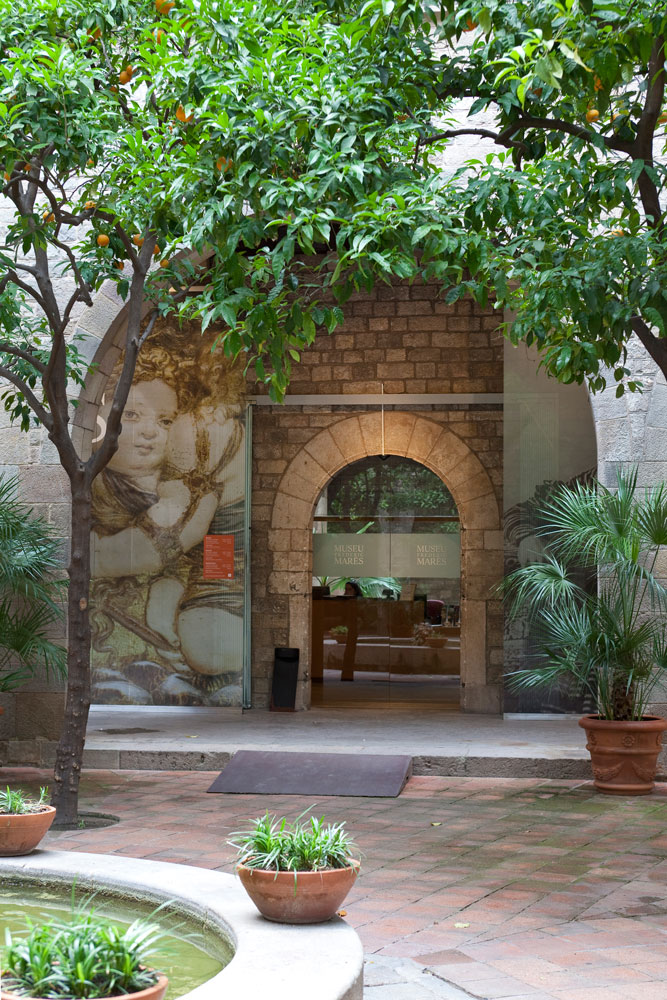
Museu Frederic Marès
- Address
- Plaça Sant Iu, 5, 08002, Barcelona
- Phone
- +34932563500
- Website
- w110.bcn.cat/portal/site/MuseuFredericMares
- Map
- View map
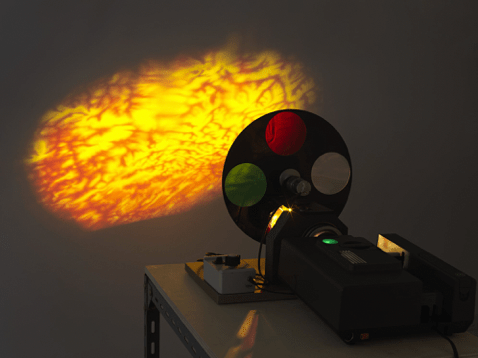
Más allá de lo visual (Beyond the Visual Realm) is an exhibition curated by the Ernesto Ventós Foundation, which offers a convergence of three prominent figures from the world of art and collecting: Frederic Marès, José Val del Omar, and Ernesto Ventós.
Frederic Marès offers us a continent brimming with social and historical significance. Our journey takes us to the Entertainment Hall within the Frederic Marès Museum, where we witness how the scientific and technological breakthroughs of the 19th century reached the masses through leisure and entertainment. Innovation defines the objects in this hall, particularly evident in optical toys like the magic lantern, the polyorama panoptique, and the zoetrope.
Within this Hall, we showcase Óptica Biónica (Bionic Optics) (1974-1982), an installation created by Val del Omar based on one of his experimental techniques: the cyclo-tactile energetic bionic optics. Through this technique, the filmmaker aims to place the image in an unfamiliar and analytical position, harnessing the innate phenomena of human vision to formulate concepts that bridge aesthetics and technology. The artwork is positioned near optical toys, to which it is formally and symbolically connected, creating a dialogue between playfulness and experimentation. These toys embody the author’s most primal calling, as he ingeniously created projections and magic lanterns during his childhood.
Óptica Biónica is a part of the olorVISUAL collection curated by Ernesto Ventós from a singular and exceptional perspective. Ventós championed the idea that art ought to transcend the visual realm and assembled a collection based on the sense of smell. The pieces he procures are not selected for their aesthetics, but for the olfactory memories they evoke in his mind. Continuing his legacy, Óptica Biónica is paired with a distinctly special aromatic essence, blending thyme, chamomile, tea, bay leaf, marjoram, and coriander.
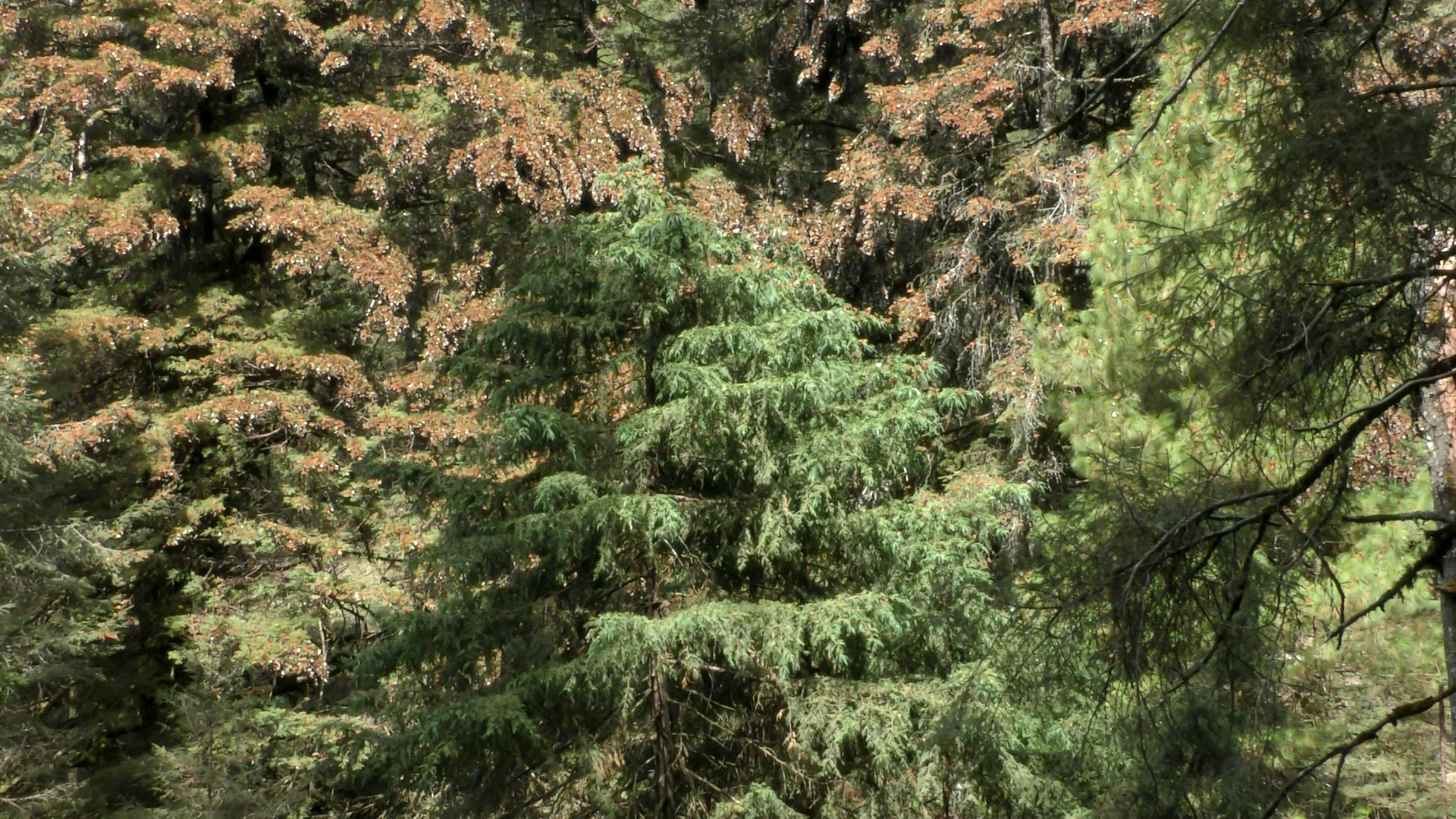
Jennifer Douzenel conceives her videos as pictures that are inscribed in the continuity of the pictorial tradition and where temporality is embodied as a plastic element. Within the framework of the multiple exhibition The bee who forgot the honey, the young French artist presents Monarques, a work in which stands out, as in many of her other videos, the importance of the fixed plane, the framing and a visual texture full of an impressionistic phenomenology.
A poetic 4-minute work whose circular structure captures what Douzenel calls “ephemeral moments of grace”, suspending the narration and the action to focus on what is around, the pure sense of composition and an image that transcends the simple projection frame. In the silent, intimate and almost spiritual context of the arches of the Museu Frederic Marès, the work invites to a contemplation of the useless, which is no more, deep down, than the reflection of the complex arbitrariness of existence.
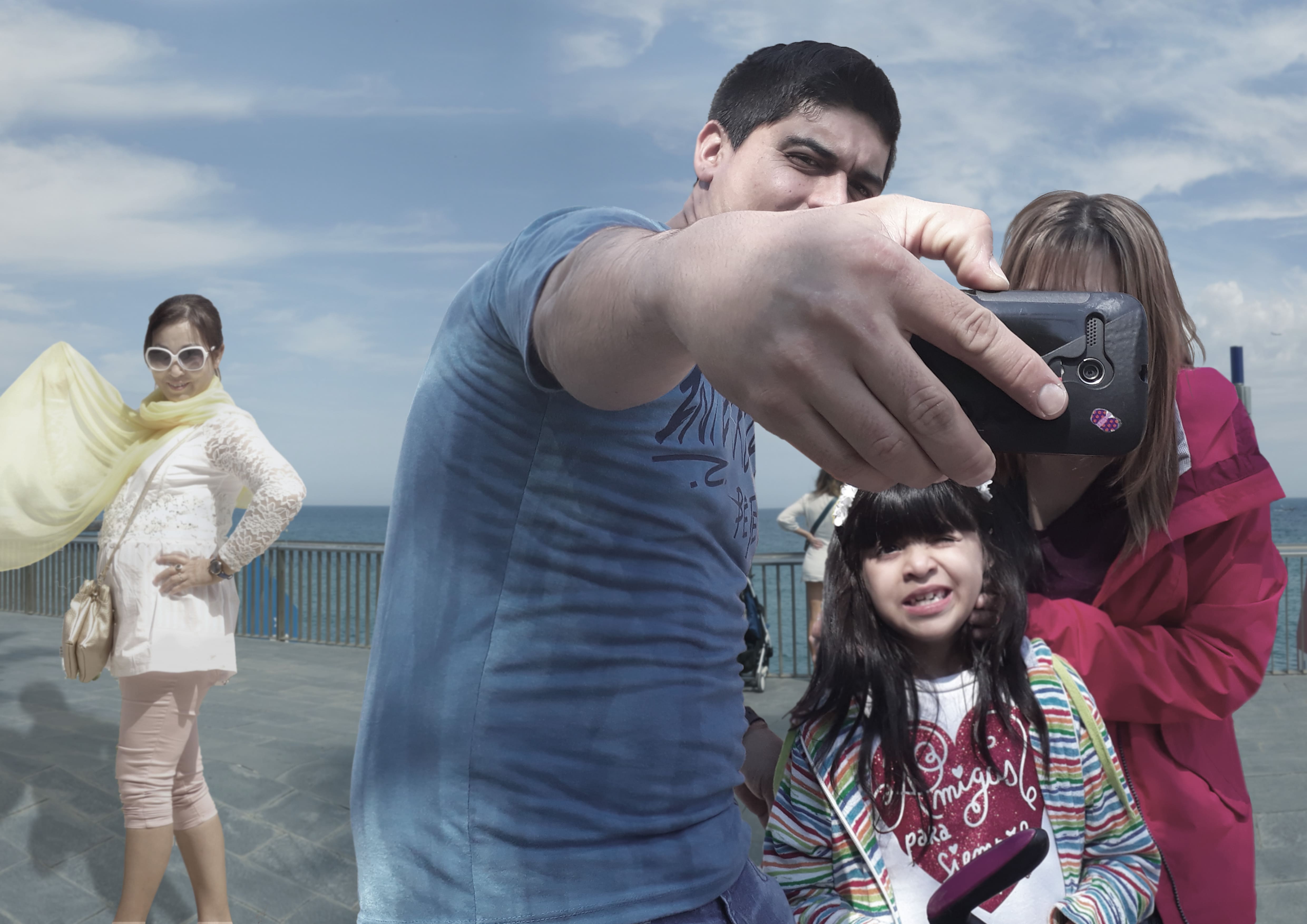
Greetings From is a video filmed along Barcelona’s tourist routes. The Ramblas, the Plaça Reial, several landmark spots and the Tibidado serve as the background for a seemingly endless sequence. Functioning as a sort of report on a typical day in the life of the average tourist, the video almost converts into an encyclopaedia of human expression and entertainment. At the back and unknown to people, the city unfolds.
The video has been made in May 2018, during the artist’s residency at the Istituto Italiano di Cultura di Barcellona. A series of texts on the video are published in ‘Residenze d’artista 2018 – 19′, a publication edited and curated by Maria Rosa Sossai regarding the residency programme promoted by the IIC.
*A production by Raffaela Mariniello and Istituto Italiano di Cultura di Barcellona.
(Single-channel digital video, color, sound, 9’).
Original sounds: Davide Mastropaolo
Coordination: Gennaro Visciano.


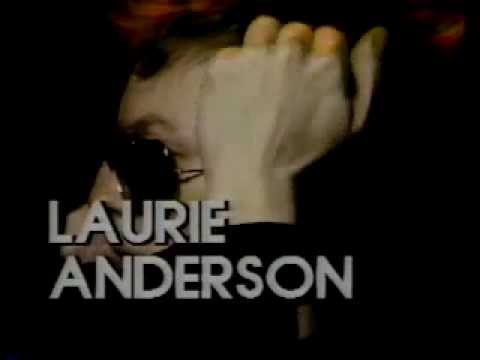
This year, LOOP Festival pays tribute to the experimental video screenings that were organised in the patio of the Museu Marès during the 1984 celebrations of La Mercè. In so doing, the festival recovers some of the videos that evidence the new artistic practices that arose after the advent of television and video recording in the 80s. The pieces re-presented now are `30 Second Spots: TV Commercial` for Artists by American artist Joan Logue (McKeesport, PA, 1942) and `Videoflashs` by Michel Jaffrennou (1944) and Patrick Bousquet (1954). By grouping very short fragments in the form of spots or flashs, both videos invite the viewer to reflect on television as a physical (and perhaps poetic) object and as an advertising tool. In humoristic reference to traditional art forms, the two pieces translate into video-portraits (Logue) or video-sculptures (Jaffrennou/Bousquet).
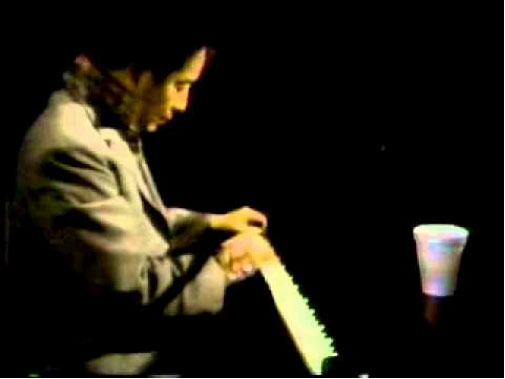
The Muestra de vídeos experimentales, which was first displayed in the courtyard of the Marès Museum during La Mercè in 1984, aimed to present the new artistic practices emerging after the advent of television and video-tape recording.
In this edition of the festival, LOOP has revived some of the videos from the original selection to take another look at the mecum’s use in the eighties, and to experience it again in light of new aesthetic paradigms. The selection may include a projection of 30 second spots: TV commercial for artists and Videoflashs, which were both originally presented in 1982 and focused on the influence of the television medium. Putting together very brief fragments in the form of “spots” or “flashes”, the two videos propose a reflection on television as a physical (and, perhaps, poetic) object and advertising tool. On the other hand, it could also be said that, because of their humorous reference to the traditional artistic media, the two pieces are translated into video-portraits or video-sculptures.
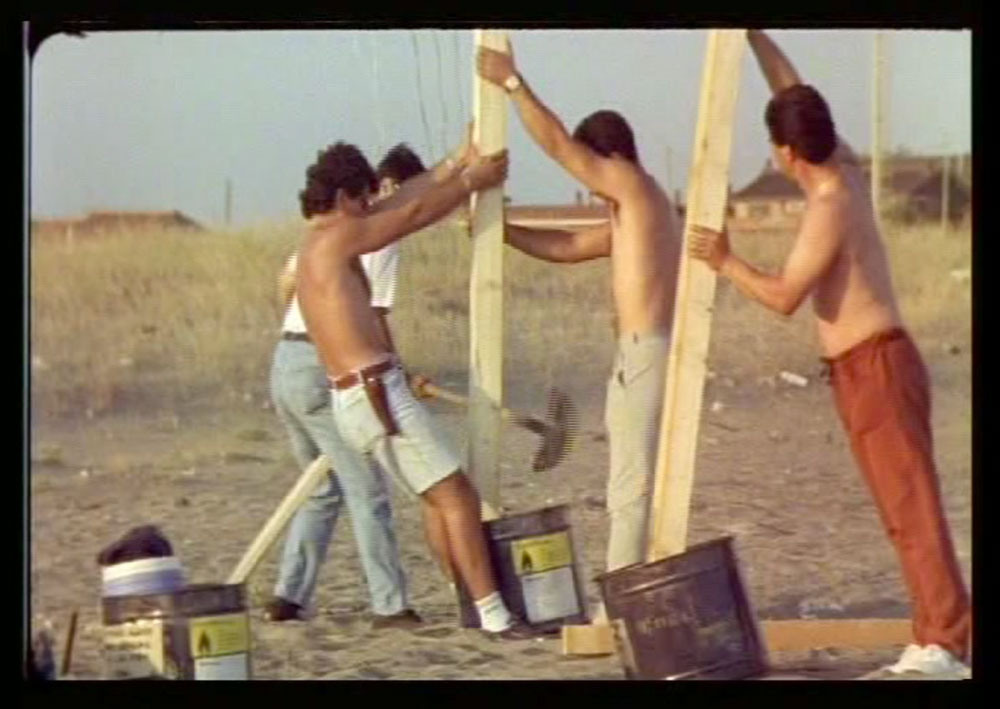
The work of Ceryth Wyn Evans (1958, Llanelli, Great Britain) focuses on how ideas can be communicated through form. His conceptual production includes the use of different media, among which installation, sculpture, photography, film and writing. Evans’s work seeks to break with the existing communication systems, both through the subversion of certain material formats as well as by adopting a purely personal voice.
Firework Text (Pasolini) (1998) shows one of the performative sculptures by the artist, in which the text, supported by a wooden structure, gradually disappears after being lit. The silent film, which was recorded on the same beach where the famous Italian filmmaker was murdered, evokes the sad episode and at the same time reflects analytically on the modalities of storytelling. Evans invites us to think about the meanings of language and perception, and about their manifestation in the exhibition space.