Museu Picasso de Barcelona
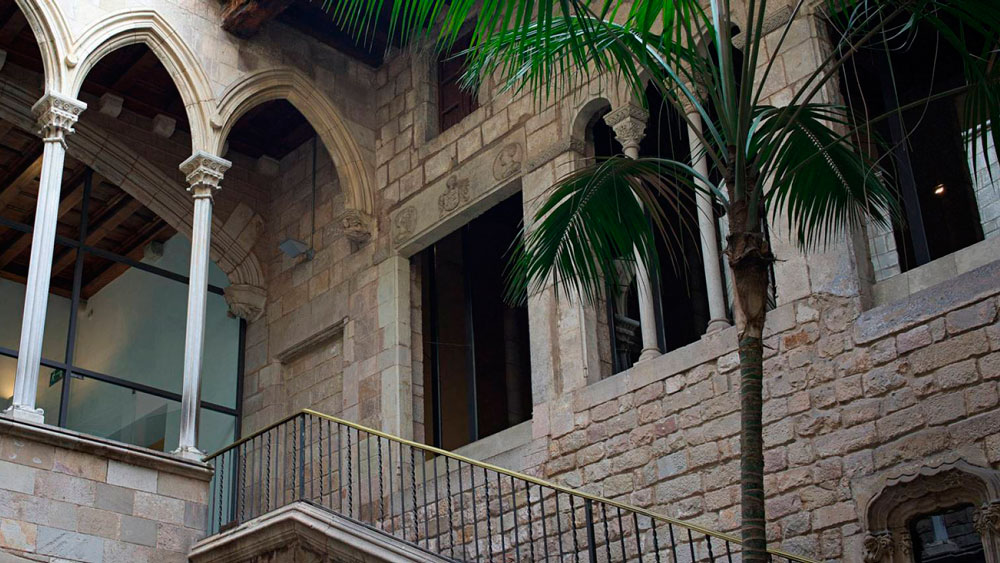
- Address
- Carrer Montcada, 15-23, 08003, Barcelona
- Phone
- +34932563000
- Website
- www.museupicasso.bcn.cat
- Map
- View map
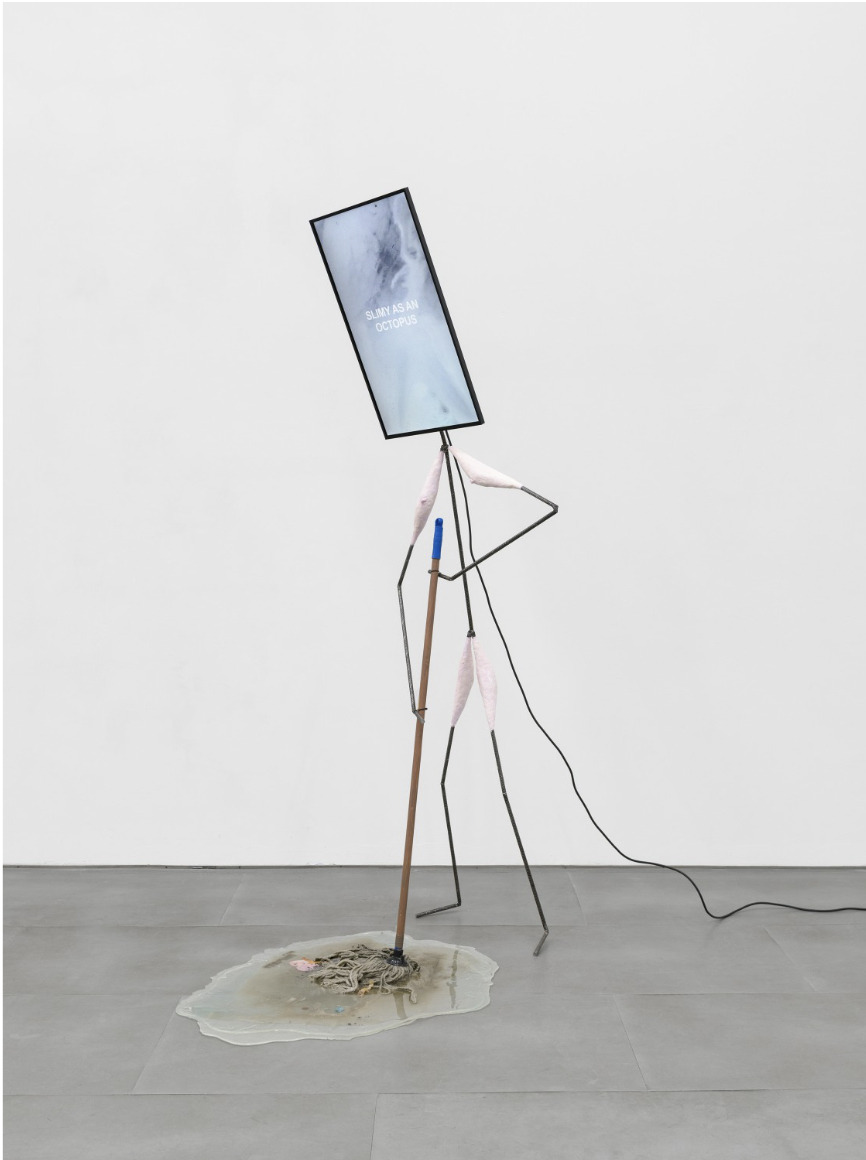
In the work Octopus Head Woman, a video is looped on a screen that acts as the head of a metal figure pushing a mop. It alternates images of an octopus covering the face and legs of a woman with sequences that address the viewer directly, congratulating them, inviting them to vodka, or complaining about their job.
Recognized for her immersive, multisensory, and transmedia installations, with interwoven storylines that blend fiction and reality, Laure Prouvost (Croix-Lille, 1978) is an extraordinary storyteller who envelops the viewer in her surreal narratives and directly engages them in the storytelling, inviting them to imagine themselves in alternative and strange scenarios.
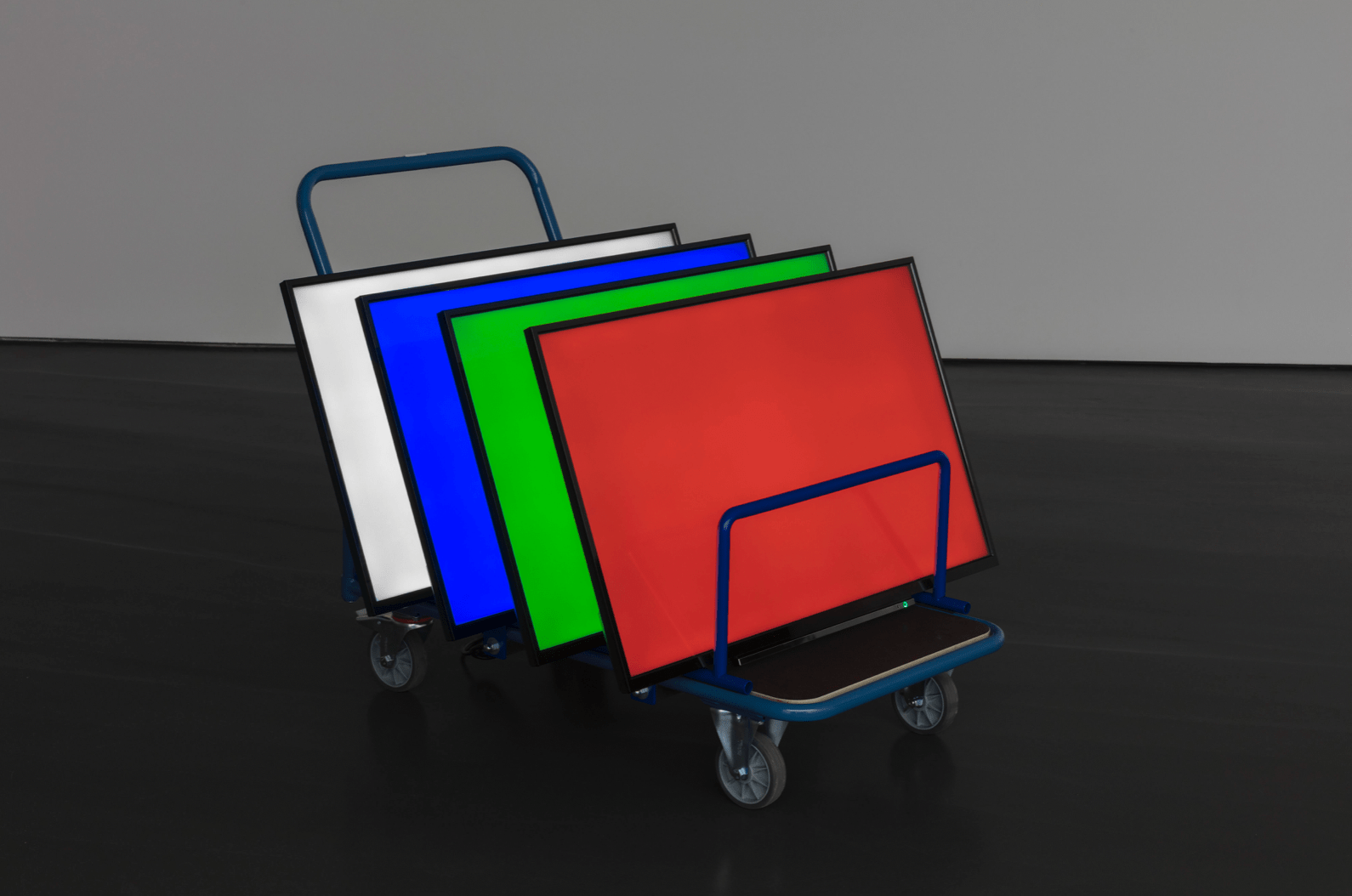
Screen as Display Body consists of four LED screens mounted on a trolley. Each broadcasts a single color: red, blue, green, and white. The work refers to the RGB color model, used for image display in TVs, in which red, green and blue are combined in various ways to reproduce a wide array of colors.
Tao Hui’s immersive multimedia installations bend the boundaries of fiction and reality to address cultural and identity related issues. His works are visceral and provocative, yet enlightening and always imbued with a strong emotional power and a sense of displacement, inviting the viewers to confront themselves with their own cultural history, ways of living and identities.
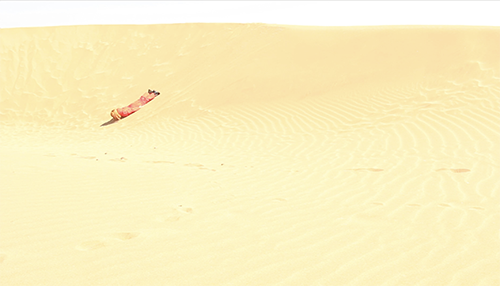
Curious. Disoriented, but present. Actively here. They say that time dictates behaviours, that a place and time determine our relationships. For my part, I think about a time that is always intermediate between something, that is never closed, but rather, which is a hidden closure that gives rise to an accumulation of experiences, of reverberations that come into play.
I also think of an ant which enters someone’s backpack by mistake and suddenly winds up somewhere else, with no earth, far from its anthill, searching and searching along the kitchen floor, guided by its antennae, almost blind and navigating by feel alone. Is this how I would inhabit my time on another planet? Led by my body, by my antennae?
The “Marcial” (Martial) project explores our desire for a possible future. Speculating on the migratory possibility before a world we have injured, Matilde Amigo wondered at recent research on the planet Mars as an inhabitable place. Starting from this premise, the artist launched a “Training programme to inhabit Mars” to learn how to live and form affective bonds on other worlds.
In Believe II, the artist appears to us in an ethereal space whose time and place are unknown to us. Placing the body at the centre, her practice is developed in a dialectic action with the environment, initiating a series of specific gestures and relationships with the singularity of space. Without following a previous choreography, the body appears as an agent of the present.
What relationships will we reproduce in the future? How does our system of individual and collective beliefs contribute to create imaginary worlds and desires? Can we cast doubt on our own beliefs?
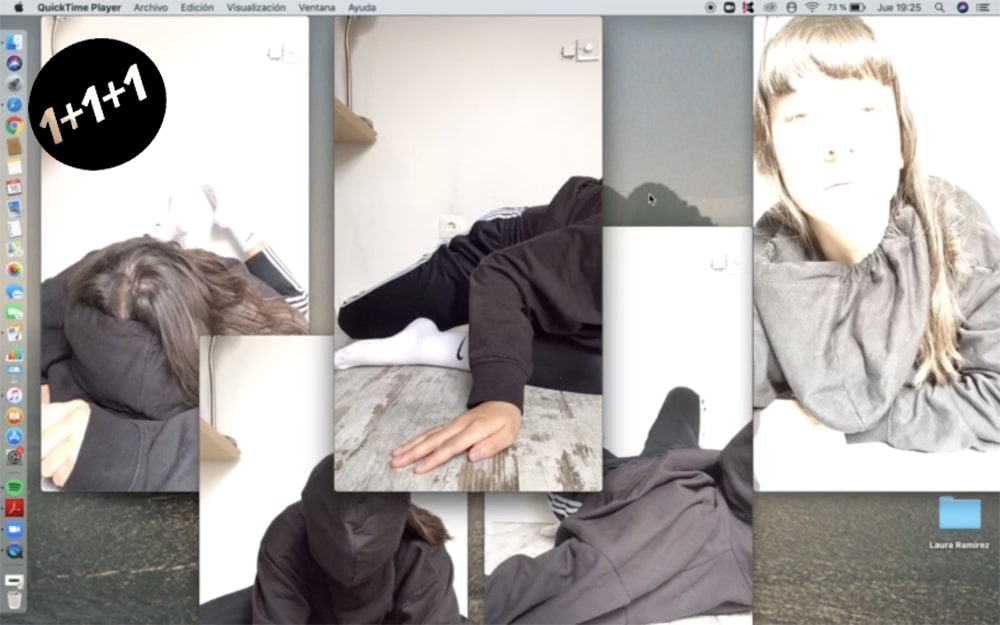
Multiscreen 01 documents the impulse of a body that needs to see itself, to reflect itself, to move, to crawl, to study itself, to recognize. References to live arts and the notion of the fourth wall mesh with image ontology and self-representation in this visual and sound experiment. The creation and development of Multiscreen 01 is a meeting between the gaze and matter: artistic practice confined within digital media, bodies framed by the screen and performed through bytes. Various disciplines converge, mediated by the collective imagination of the digital devices, the scene being an ordinary computer desktop, choreographed by the mouse arrow. The result is a digital performance that is both a visual essay and the instinct of self-representation; it is a game of mirrors between the webcam’s mechanical eye and the viewers visiting the Museu Picasso.
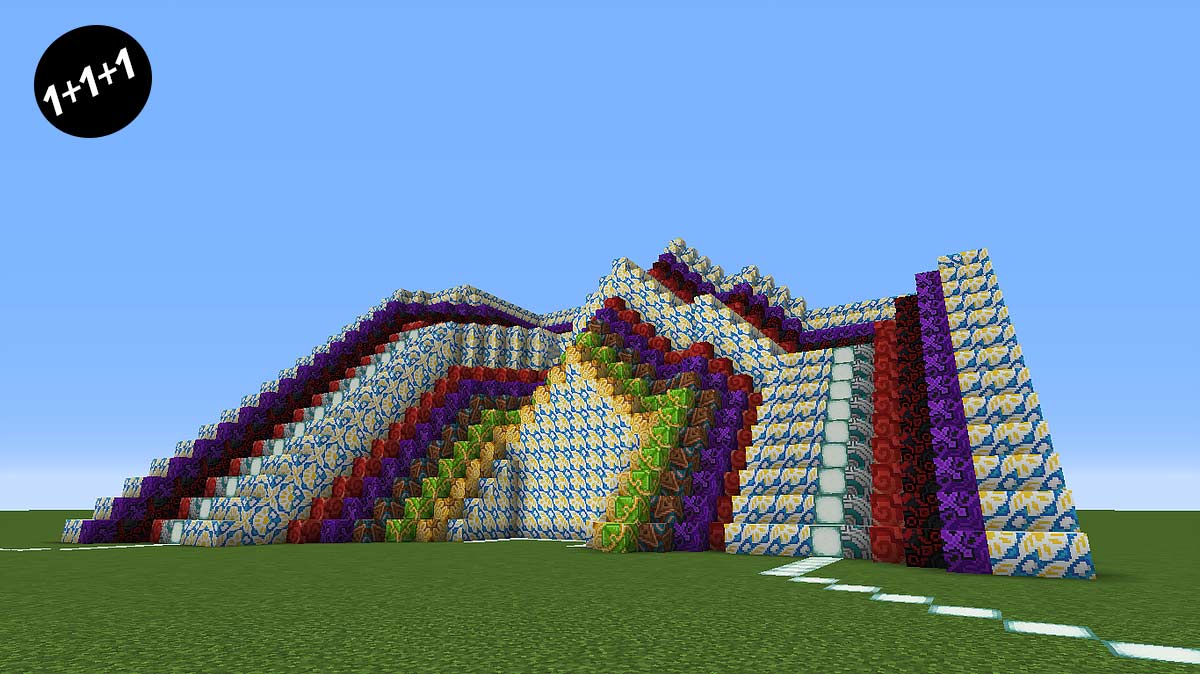
Locus solus. Minecraft version is based on the novel of the same name by Raymond Roussel. It tells the story of the eccentric Martial Canterel who walks his guests through a private garden-museum full of sculptures and sci-fi-like gadgets. For the video presented within the framework of LOOP, Alejandro Palacín uses the logic of Minecraft to reproduce the novel’s plot while pulling from his own sculptural practice. The video game’s virtual space allows the player unlimited cubes with which to build and develop speculative sculptural work that ignore the laws of physics. Proposed as an endless work in progress, after more than three years of construction, this sculpture park has acquired a considerable size–it would take about 45 minutes to see it in its entirety. For LOOP, Alejandro Palacín has created a collective visit to this impossible sculpture park through a series of four micro-capsules in which he acts as a guide.
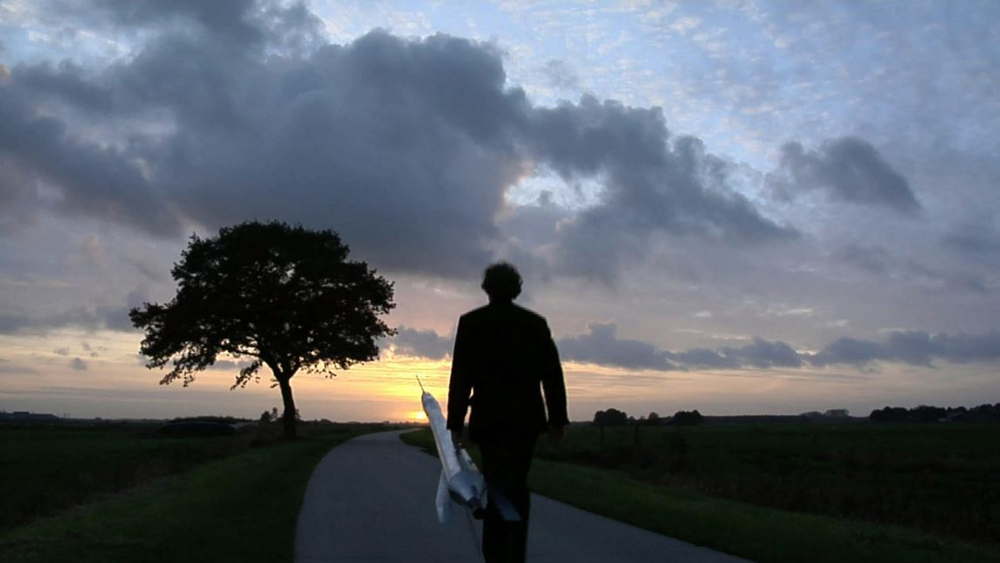
Produced in 2006, Nummer zeven is a key piece in the work of Dutch practitioner Guido van der Werve (Papendrecht, The Netherlands, 1977). Triggered by a childhood memory, the short video deals with the possibility of failure that is inherent to the creative process. Indeed when he was a child, van der Werve used to look at the starry sky and dream to be able to leave the Earth. Now we see him in his study, all busy with the construction of a space rocket with everyday objects. If on one hand the piece questions the fragility of artists, it also exalts their ability to play with everyday circumstances and turn them into extraordinary events. Finally, from a symbolic point of view, the rocket evokes a radical rupture with tradition and the desire to create new imaginaries – all elements that, if we wanted to find a direct connection to the universe of Picasso, would be present in the experiences of the historical avant-gardes and, among them, the cubist imaginary. Nummer zeven is part of LOOP’s curated selection on outer space and its symbolic drifts.
Through the use of an experimental format, Rosa Barba, Mark Lewis, Miranda Pennell, Ben Russell and Salla Tykkä all question the borders between cinema and the visual arts, in this way illustrating the links, similarities and differences between the two fields. Whether technical, formal, syntactical or discursive, those issues that are typical of cinematographic practice ultimately turn into a lively subject to be explored and tested by both the artist and the viewer.

Ben Russell, Black and White Trypps Number Three, 2007
Collection Fonds d’art contemporain de la Ville de Genève (FMAC)
© Ben Russell
BEN RUSSELL (Springfield, USA, 1976)
Black and White Trypps Number Three, 2007
Film 35 mm transferred to video, colour, sound 5.1
11’30’’
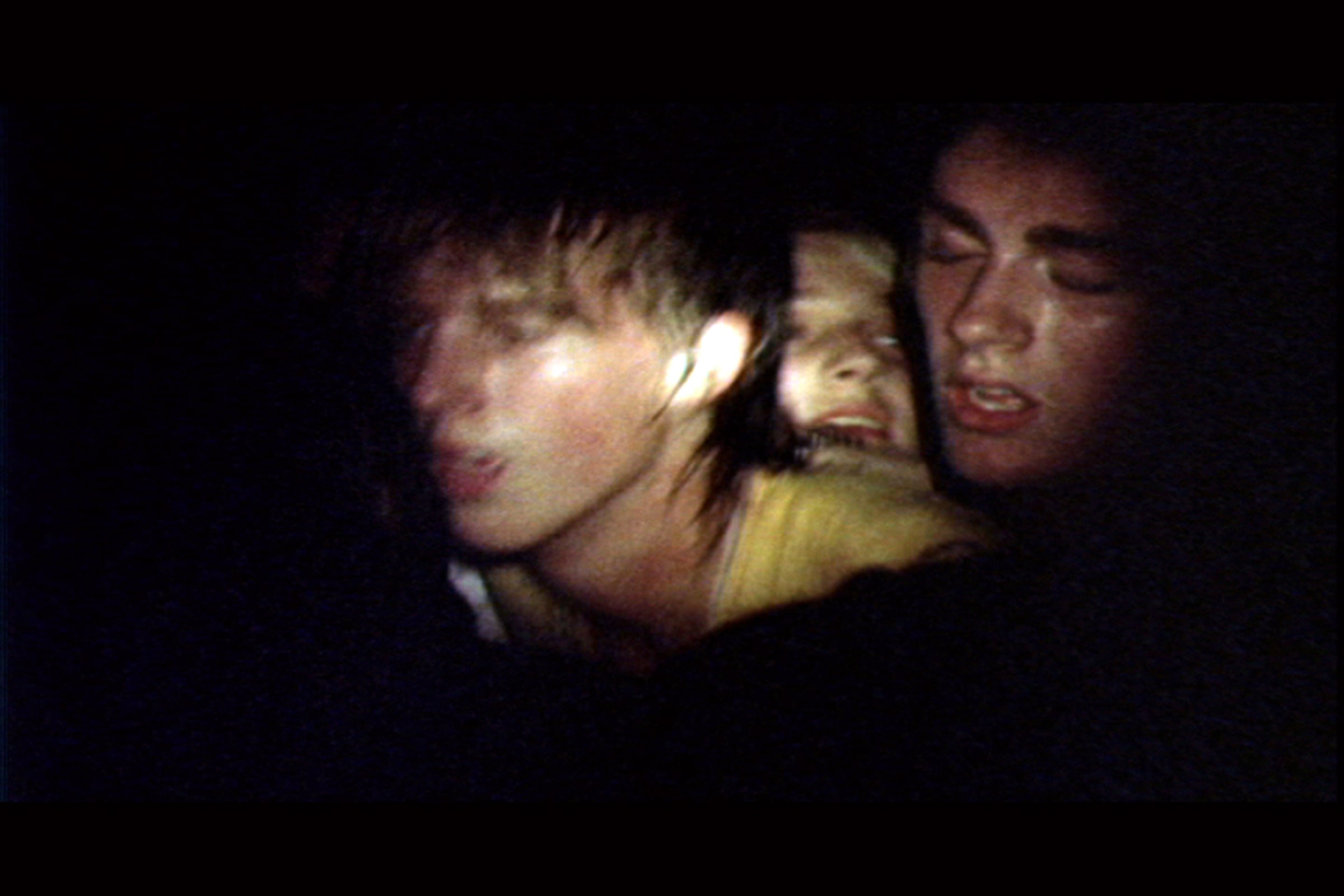
The works of artist, filmmaker and curator Ben Russell mostly focus on ritual and altered states of consciousness, at the crossroads between visual anthropology, the early days of cinema and structural cinema. It is from a historical and semiological perspective that Ben Russell approaches the practice of film; he is interested in the moving image as an experimental object, as an ideal tool of identification and immersion and capable of creating a visceral or even radical acuity, as close as possible to the sensation of time and from space. Between 2005 and 2010 en Russell directed TRYPPS, a series of experimental short films mostly shot on 16mm. Conceived as an ethnographic exploration and evoking a psychedelic and phenomenological experience of the world, the series includes the hallucinatory work Black and White Trypps Number Three, filmed during a concert of the noise band Lightning Bolt in Providence, Rhode Island. Both a collective trip and the portray of an individual state of trance, the experience felt by the audience – framed in a halo of light with Caravaggesque accents –, gradually disintegrates, while the sound stretches and the images slow down, making of the film itself empirical material. [Stéphane Cecconi]

Rosa Barba, Outwardly from Earth’s Center, 2006
Collection Fonds d’art contemporain de la Ville de Genève (FMAC)
© Rosa Barba
ROSA BARBA (Agrigento, Italy, 1972)
Outwardly from Earth’s Center, 2006
Film 16mm transferred to video, colour and stereo sound
23’39’’
Be it video or film, artist Rosa Barba is interested in the very formal features of the medium, which she manipulates in order to reveal its plastic qualities, as in a self-referential process. In Outwardly from Earth’s Center, memory, landscape and fiction merge, implying a precise question: what to do when an island is adrift threatened by extinction? During a residency period on the Swedish island of Gotland, the artist started thinking about a series of possible answers to this threatening premonition, filming shots of great beauty on 16 mm and alternating them with archival footage. Open enough to allow several possible interpretations, the film can be read as an allegory of insularity, a statement on ecology, an absurd account or human satire. [Yves Christen]

Salla Tykkä, Zoo, 2006
Collection Fonds d’art contemporain de la Ville de Genève (FMAC)
© Salla Tykkä
SALLA TYKKÄ (Helsinki, Finland, 1973)
Zoo, 2006
35mm film transferred to HDV video, dolby digital
12’
In her work, Salla Tykkä reviews the legacy of cinema, exploring both its language and its formal and aesthetic qualities. An investigation of the genre of thriller and its codes, in this short film the artist immerses the viewer into a sequence where a woman is seemingly trapped in a zoo. Throughout the whole film, the influence of Hitchcock’s recurring motifs is undeniable: the blonde, chic and rather severe (not to say frigid) female protagonist with a sophisticated hairstyle, that recalls the women liked by the British director; the abundance of psychoanalytic references, such as the presence of water and the juxtaposition and struggle between two realities, – one external and the other internal –, populated by people playing underwater rugby as in an aquatic choreography; and, finally, the anxious soundtrack, that plays an essential role in the construction of the work almost converting into a character itself. To reinforce the increasingly dramatic tension, the film has no dialogue: a recurring feature in the artist’s work, it insists on the primacy of image and sound over speech. Following the woman as she runs through the enclosed space – half park and half zoo –, the artist thus touches upon several themes: the relationship between men and the nature; the reciprocity of the gaze (through the eyes of the woman and the animals, or through the camera lens); the different layers of reality; the daily visions (or drives?) incarnated by the submarine fight. [Yves Christen]

Miranda Pennell, Fisticuffs, 2004
Collection Fonds d’art contemporain de la Ville de Genève (FMAC)
© Miranda Pennell
MIRANDA PENNELL (London, UK, 1963)
Fisticuffs, 2004
16mm film digitised and transferred to video, colour and stereo sound.
11’
After studying contemporary dance in New York and Amsterdam, as well as visual anthropology at Goldsmiths University in London, Miranda Pennell turned to making film and video in 1995. Her films, however, remain strongly influenced by her primary interests, namely performance and choreography, both subject to anthropological scrutiny. Uncertain and even incongruous as they are, the rules that subject the bodies to the space, the environment and the actions generated in this context, resonate in a counterpoint with the calculated game (movement, framing …) of the camera.
Fisticuffs (which could be translated as “fist fighting”) depicts a series of characters in a typical London-pub atmosphere, where the camera follows (or not) a Western-style fight gradually transforms into a ballet as naturalistic as crazy. Between parody of American action films and social painting of a traditional pub scene, the film oscillates between real and surreal in a spirit of “nonsense” typically British. [Stéphane Cecconi]

Mark Lewis, The Pitch, 1998
Collection Fonds d’art contemporain de la Ville de Genève (FMAC)
© Mark Lewis
MARK LEWIS (Hamilton/Canada, 1957)
The Pitch, 1998
Film 35 mm transfered to video Digital Betacam, PAL, colour and stereo sound.
4’
The Fund for Contemporary Art of the City of Geneva (FMAC), created in 1950, was not originally intended to constitute an art collection, but rather to support local artists and decorate buildings as well as public spaces. It was only in the 1970s that the acquisition of so-called ‘mobile’ works, as opposed to works integrated in the architecture, really began.
The core mission of the FMAC is to encourage living artists. It aims to focus particular attention on emerging artists mostly in Geneva, but not exclusively, and to provide an image of art in the process of creation, by taking into account the many tendencies and practises of contemporary art.
Site-specific projects in the public domain steadily carry on the FMAC’s original purpose.
The collection can be browsed online at www.fmac-geneve.ch
Containing over 1’300 audio-visual works by visual artists, filmmakers and writers, the collection of the Media Library of the Contemporary Art Fund of the City of Geneva (FMAC) covers the international production of most of the influential artistic movements since the 1960s. Its international character, the broad range of trends represented and its historical coherence make it the richest collection of its kind in Switzerland and one of the most important in Europe.
The André Iten Fund constitutes the cornerstone of this collection. The successor to Geneva ‘s Centre for Contemporary Images (1985-2008)*, it bears the name of its founder, who passed away in 2008, and testifies to the history and the relations that André Iten built and maintained over decades with and around major artists of video art. With its 200 works, the FMAC’s video collection joins the André Iten Fund and grows in function of the latter and its history. Finally, the Christophe Chazalon Fund, a collection focusing on the polymorphous work of Chris Marker (1921-2012), brings together several hundred pieces, originals or reproductions, including virtually all the films of the French film-maker.
* Founded in 1985 by André Iten, the Centre for Contemporary Images (CIC) was an institution dedicated specifically to new image technologies: video, multimedia, internet, cinema, photography. Two biannual events punctuated its programming and regular monographic exhibitions: the Biennial of Moving Images (BIM) and Version, an event devoted to new media and IT projects. (The historical website of the Centre for Contemporary Images: www.centreimage.ch)
Equipped with individual work stations, the FMAC’s Multimedia Library is destined on the one hand for consultation and research. A second part consists of a modular space that can host different events: programs, exhibitions, projections, performances and events devoted to highlighting these collections and subjects relating to moving images and new media. This second space, more specifically devoted to dissemination and mediation, can also serve as a laboratory and host projects designed by young curators wishing to undertake specific research on video art, its history and practice.
Occupying 150 square metres in the heart of the contemporary art district of Geneva, the FMAC’s Multimedia Library has been open since 2009. Housing both information and archives, it is an indispensable tool for exploring and teaching moving images. The Multimedia Library provides the public free of charge with a resource centre containing a video library of 1’500 works accessible in digital format (DVD), as well as a centre of documentation on video art. It also hosts the archives of Swiss video creation. Consultation is possible on the spot only (no lending or renting out).
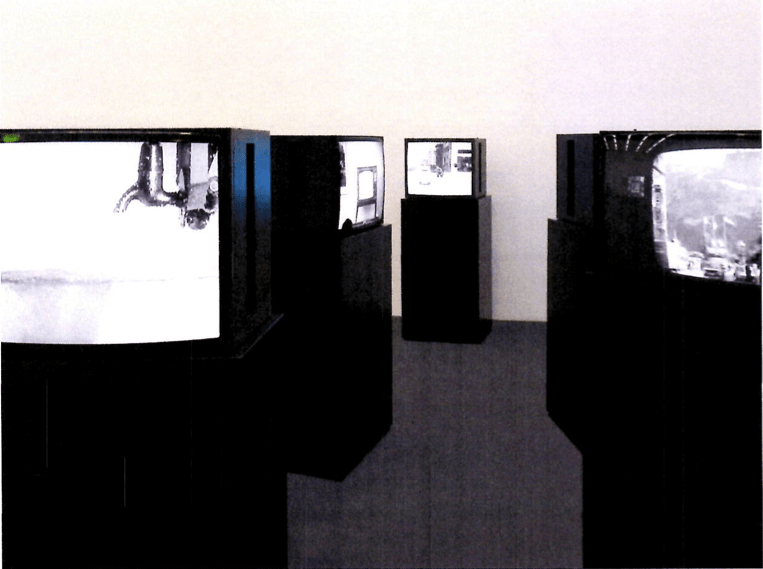
‘TV Interruptions (7 TV Pieces) were my first works for TV, and are a selection from the original ten. Conceived and made specifically for broadcast, they were transmitted by Scottish TV during the Edinburgh Festival in 1971. The idea of inserting them as interruptions to regular programs was crucial and a major influence on their content. That they appeared unannounced, with no titles (two or three times a day for ten days), was essential. These transmissions were a surprise, a mystery. The TV was permanently on but the occupants were oblivious to it, reading newspapers or dozing. When the TV began to fill with water, newspapers dropped, the dozing stopped. When the piece finished, normal activity was resumed. When announcing to shop assistants and engineers in a local TV shop that another was about to appear, they welcomed me in. When it finished, I was obliged to leave quickly by the back door. I took these as positive reactions.’ — David Hall, 1990
A Ningú (To Anybody) shows a selection of unreleased films made by Adolf Alcañiz during the last six years, documenting actions executed by Benet Rossell (Àger, Lleida, 1937) from the intimacy of his private life. Personal metaphors linked either to his home town, Àger, or to his artistic career between Barcelona and Paris, bring us closer to the figure of a vertical artist: from the specific to the common, from the everyday gesture to poetry. The duality of the visual artist and actor invites to a dialogue that is at once material and ephemeral: the ideal conversation takes shape through a hermeneutics of the use of the objects and reminds us of that dismissed scene from Chaplin’s City Light, in which he imagined a series of possible uses of a piece of wood.
Experimental filmmaker from the Sixties, painter, poet, sculptor and playwright, this exhibition pays tribute to the intimate facet of this dedicated artist and, in the words by Jean-Clarence Lamb, to the “spectacle of everyday life.”