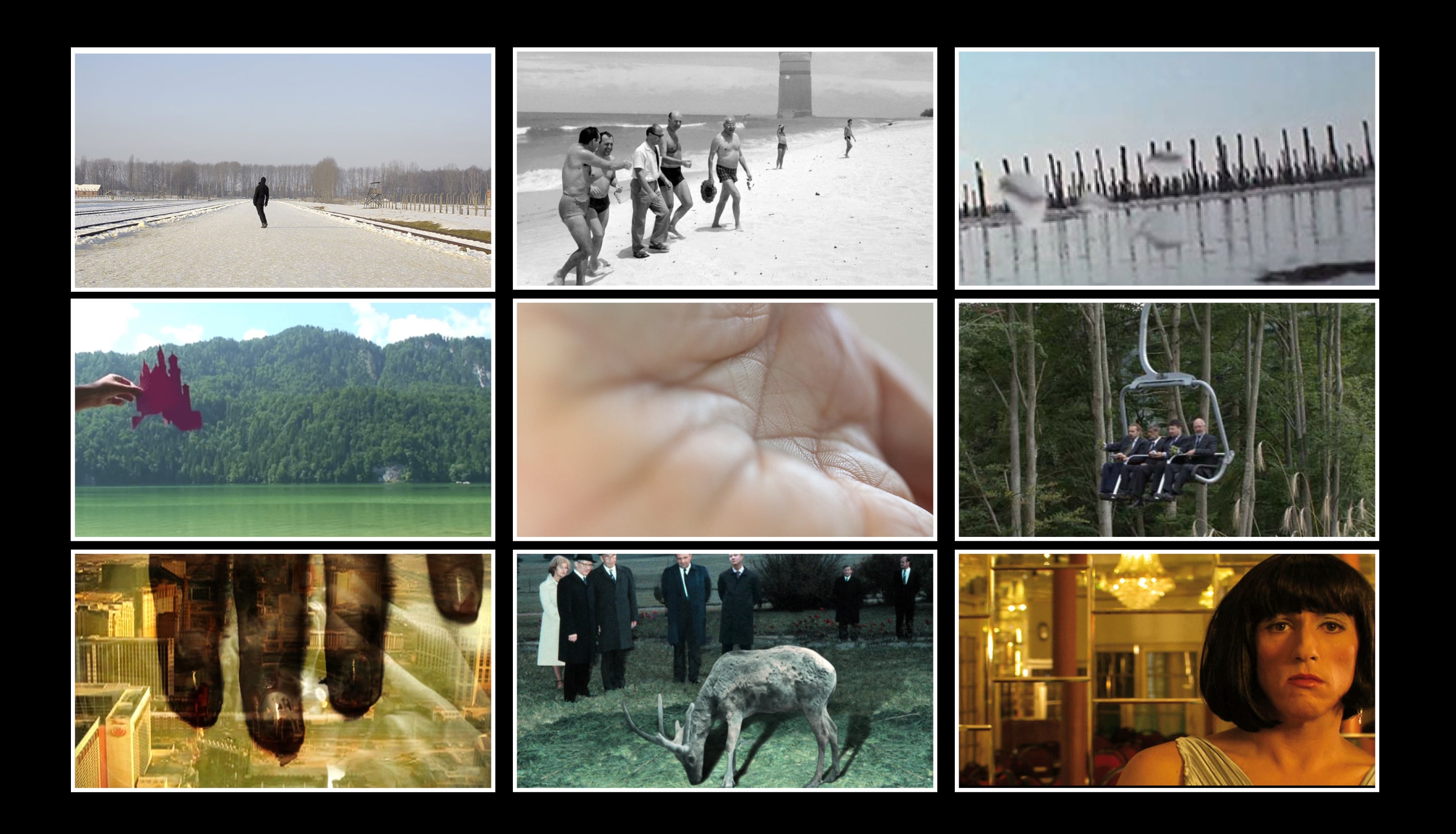
Gabriel Lacomba, #crònicapandèmia T1 cap.0 (2021) presented by Jaume Reus (here)
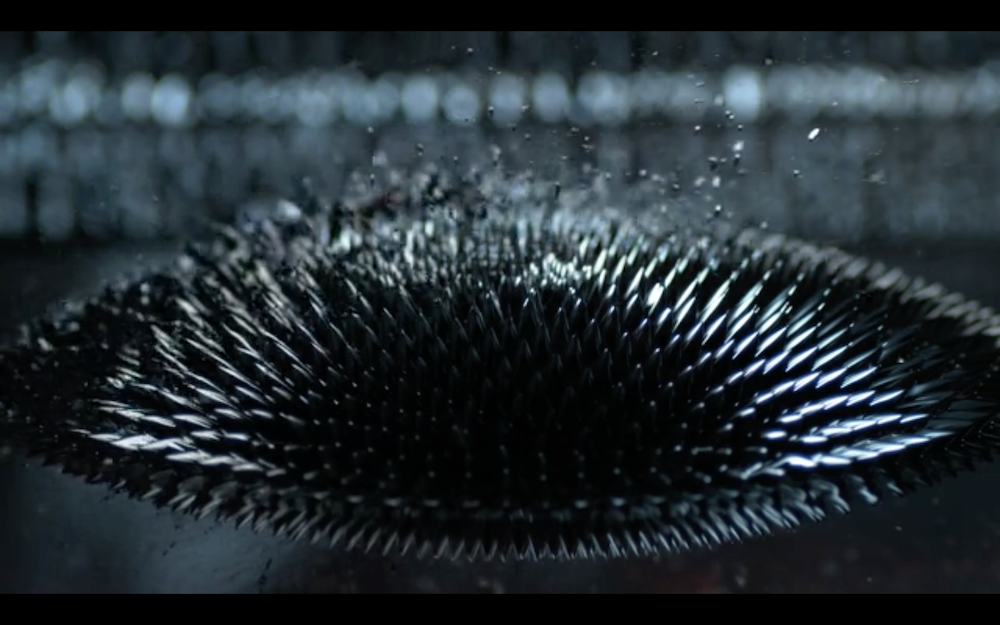
Hicham Berrada, Concordance des temps (Tribute to Jean Epstein) presented by Pascale Cassagnau (here)
Les Fleurs 1, 2, 3
Augures Mathematiques 1,2,3
Prix StudioCollector – a selection of the winning films introduced by Pascale Pronnier (here)
Arash Nassiri, Tehran-Geles, 2015
Shirley Bruno, Tezen, 2016
Ismaël Joffroy Chandoutis, Swatted, 2018
Nicolas Gourault, VO, 2020

On the occasion of LOOP 2020 I was invited to choose a series of moving image artworks from the Julia Stoschek Collection, which features an incredible selection of artists – a testament to how deeply Julia has built this video collection over the years. I am also excited to be working again with Cao Fei, with whom I have maintained a long-term dialogue and carried out many collaborations. The idea of curating a solo presentation was prompted by the fact that the Julia Stoschek’s video collection goes into depth with many artists and their work. I have chosen to select three works from by Cao Fei – RMB City, iMirror by China Tracy and Hip Hop Guangzhou – and then to invite Cao Fei to select three more works from Chinese artists of a younger generation, all created during lockdown.
I first met Cao Fei in the early 2000s with Hou Hanru, before she made the critical and spectacular eight-minute video Cosplayers. At the time, she was studying at the Guangzhou Academy of Fine Arts and was part of a vibrant generation of Chinese artists emerging during East Asia’s rapid urban development in the late twentieth and early twenty-first century. Since this first meeting, Cao Fei’s work has proved prescient and urgent, and the Serpentine has included her in numerous projects, firstly as part of ‘China Power Station: Part 1’, an offsite Serpentine Galleries’ exhibition at Battersea Power Station in 2006, where the artist presented her film, Whose Utopia, and then in 2008, with the installation of RMB City in the gallery’s entrance space, where visitors could access a fictional Chinese city constructed in the online virtual world of Second Life.
Cao Fei’s practice bridges film, digital media, photography, sculpture, performance and installation, all of which capture her fascination with the responses of human behaviour to the rapid technological developments of the last two decades. This engagement begins with her home country of China and the accelerated, at times chaotic, changes that have shaped her generation. From this context, she has explored the broader experience of virtuality and its potential to alter our perception of self and change the ways in which we understand reality. Her work continuously navigates the physical and virtual, the real and the imagined. Through this, she collapses together past, present and future time frames in order to produce new and fantastical realities for the characters that exist within each of her compelling narratives. From the utopic and dystopic potentials of modern-day cities, to the alienating effects of mechanised labour, Cao Fei addresses these far-reaching topics the creation of surreal encounters and with a subtle sense of play. Although each of her worlds appear to teeter on the edge of apocalyptic uncertainty, her characters navigate complex realities with vigour and agency, harnessing the unique possibilities of technology to shape a collective future.
Most recently, we presented Cao Fei first ever UK institutional solo exhibition, Blueprints, at the Serpentine Galleries, which I co-curated with Joseph Constable. The project included the world premiere of ambitious virtual and augmented reality artworks, The Eternal Wave (2020), produced in collaboration with Acute art, and the artist’s latest film, Nova. Both of these works mark the culmination of Cao Fei’s extensive research in Beijing over the last five years, examining the social history and urban transformation of the city’s Jiuxianqiao district where she lives and works. Her feature film Nova was produced out of this research and was presented within an immersive, site-specific installation that also brought together a selection of her previous film works to expand the themes of automation and technology upon which she continuously draws. The exhibition created a layering of virtual, physical and cinematic spaces for the visitor to encounter, leading them through alternative realities and multiple frames of experience.
In addition to selecting works by Cao Fei, this idea to invite her to present the work of emerging artists is inspired by the brilliant show that she curated with Yang Beichen at the Julia Stoschek Collection in Düsseldorf in 2018, titled New Metallurgists – an exhibition that featured sixteen works by eight contemporary artists from China in order to reflect a multiplicity of voices and perspectives. It is exciting to continue this dialogue with Cao Fei and focus on a new generation of artists from China – it has only just begun.
With the collaboration of

The programme presents a series of works from TBA21’s large archives, with past acquisitions and recent commissions. It features the videos by Mario García Torres, Želimir Žilnik, Allora & Calzadilla, Courtney Desiree Morris, and a sound piece by Himali Singh Soin with David Soin Tappeser.
**Scroll till the end of the page for the sound piece by Himali Singh Soin with David Soin Tappeser
“Water is Life. Mní Wičóni” the Native American water activists chanted at the Dakota Access Pipeline protests at Standing Rock, North Dakota, in 2016. When water is analogous to life, it is more than a human right. The protest speaks of the necessity of fresh water for drinking and sanitation, as mandated by both the United Nations General Assembly and the UN Human Rights Council in 2010. It invokes a water affordability crisis that is raging across the planet and aggravated by sanitary regulations brought on by the ongoing pandemic. It also points to the privatisation of water rights, recently imposed in Chile, as well as the contamination of water sources with bacteria and lead. The new and emerging contaminants that travel invisibly with “fresh water” are the vibrant matter written into a history of (de)industrialisation, racialised dispossession, and the effects of racial liberalism’s “illiberal legacies.” These issues make “modern water” politically legible, as well as defining its infrastructures and the fragmented, hegemonic policies of the “hydraulic state.”
Yet the right to water as a human right, as fundamental and indisputable as this need for fresh water is, doesn’t fully encompass the capacious ancestral demands so succinctly captured in the phrase “Water is Life.” In reconceptualising water beyond utilitarian paradigms, the Standing Rock protesters, among many other scholars and water advocates, open a vast field of water relationalities and imaginaries. Water, to them, is first and foremost the source of living and ongoing planetary existence. Living water circulates in a timeless hydrological cycle. It flows through rivers, bodies, seas, and it falls as rain and freezes as ice. It reminds us that all the waters on this planet are somehow connected and that 97% of all water is contained in the oceans. Waters are transfusing bodies, transporting ancestral and elemental wisdom, from ocean to rain to plant, to rock, to human. But water is also a living entity, a spirit, a person, an anima. As such it lives in a place, it entertains reciprocal relations with humans and nonhumans alike. To break water down into its chemical composition or to address it merely as a resource entails an “ontological violence,” dispossessing water of its living essence.
This selection from TBA21’s large archives dives deeply into the liveliness of water and the mighty hydrological cycles that govern this water-rich planet. Spanning the past 15 years of artistic production, they interlace various narratives where water (in the shape of rivers, ice, drinking and ancestral water) is not only restituted from its deadly[1] materiality, but acknowledged as an agency that interacts, witnesses, and holds human worlds. Three works trace the material memory of rivers in the face of environmental hazard and political drama. They span the relocation of mainly Roma refugees in the early 2000s and their return to the shores of the Danube river in Serbia, flooded during the high waters of 2006; the post-Hurricane Katrina waterscape of the Mississippi and the devastations of New Orleans’s Ninth Ward; and finally, the retelling of a forensic episode related to the US invasion of Iraq through three different watery witnesses. The Danube, Mississippi, and Tigris are not only set as the environments that stage human activity, or instrumentalise it as backdrop, but they are intrinsically entangled with the fate, melody, and imaginaries of human and animal lives. Rivers and water sources are not only implicated in an elementary fight, as in several regions in Chile where the lack of water has led to a humanitarian crisis and the forced movement of people, but, also, as a healing element, as a source of spiritual power. A spiritual connection that entangles the riverine with the oceans and with polar icefields, through the deity of Yemanyá and a series of fictional ice archives and meditations on south asian futurism.
______
Mario García Torres, The Way They Looked at Each Other, n.d.
Single-channel video installation (transferred from 16mm film), color, sound, 11 min 15 sec
Commissioned by Thyssen-Bornemisza Art Contemporary
“When you go back, where do you actually go to?”
Using photography and video to meditate on the significance of delay and the im/possibilities of returning to the past, The Way They Looked at Each Other examines an alleged criminal event that took place in 2011, eight years after the 2003 US invasion of Iraq. The video revolves around a forensic investigation led by a Spanish team made up of the judge Santiago Pedraz, court technicians, and a few witnesses in Baghdad. Their intention was to prove the US military personnel guilty of assault, claiming that they shot to death two journalists and wounded three others positioned on the balconies of Baghdad’s Palestine Hotel on August 8, 2003. To illustrate this position of a “lesser perspective,” Mario García Torres engages the material imagination of rivers. The video navigates from Rio Consulado in Mexico City, a river that was piped and covered by a motorway; it cuts to the Danube as it passes through Budapest, Bratislava, and Vienna, and finally it joins the Tigris, as it flows through Turkey, Syria, and Iraq. The river becomes a topographic marker but also a silent viewer of the historical moments. Reflecting the multiplicity, continuity, and currency of the river, the video seems to evoke the status of the (political) event. It arguably doesn’t bring the late witnesses physically closer to the event, but perhaps it allows them to parse intensities and residual forces.
Želimir Žilnik, Soap in Danube Opera, 2006
Single-channel video installation, color, sound, 36 min 34 sec
Commissioned by Thyssen-Bornemisza Art Contemporary
“I liked the idea that the Danube should be the means of communication and site of experience.”
With Soap in Danube Opera, the Serbian filmmaker Želimir Žilnik addresses his immediate surroundings, inviting a group of young participants from the settlements along the shoreline of the Danube between Belgrade and Novi Sad to learn filmmaking and editing through a series of workshops. Parodying the format of soap operas, the participants tell stories, reveal the unspoken rules of their communities as well as their hopes, fears, and desires. They portray their own lives and interactions around the Danube river. The villagers of Kovilj raise cattle on the Danube islands. Marko, an owner of ten horses, around twenty cows, and other cattle is a good friend with Kamer, a Roma who helps him sell the cattle at local fairs. Željko, a young horsebreeder, leads the villagers when they try to save the cattle in the spring of 2006 from the big flood. Life and work close to the Danube connect the Roma people and the villagers, and sometimes make them leave their village and seek happiness on the other bank of the Danube.
Allora & Calzadilla, A Man Screaming is Not a Dancing Bear, 2008
Interactive single-channel video installation, color, sound, 70 min 54 sec
“And above all, my body as well as my soul, beware of assuming the sterile attitude of a spectator, for life is not a spectacle, a sea of miseries is not a proscenium, a man screaming is not a dancing bear…” –Aimé Césaire
A Man Screaming Is Not a Dancing Bear explores issues of ecological witness-bearing and environmental justice within a framework of the traumatized landscape of New Orleans following Hurricane Katrina in August 2005. The film moves between and interlaces three different scenes. Footage of the interior of a flooded house in the Lower Ninth Ward, the predominantly African American neighborhood that was severely damaged by the failed levee system alternates with the camera’s drifting across the lush mangrove wetlands of the lower Mississippi River Delta out of which the city of New Orleans was carved. The haunting aqueous sites are interrupted by the percussive rhythms played by the musician Isaiah McCormick on a set of window blinds, standing outside in front of the destroyed house’s window. The rhythmic drumming on this home-grown instrument subtly recalls the great musical heritage of the Mississippi region, whilst exposing the domestic interior to outdoor light in an inconstant flutter of luminosity, which evokes the sediments and watery traces of recent historical events.
Courtney Desiree Morris, Sopera de Yemayá, 2020
Single-channel video installation, color, sound, 7 min 31 sec
Commissioned by Thyssen-Bornemisza Art Contemporary
Sopera de Yemayá (Yemayá’s soup tureen) is an experimental short film by Courtney Desiree Morris, a social anthropologist and conceptual artist based in California. It explores the relationship between the black female body, nature, and the divine. Guided by the idea that the sacred can be found everywhere, even in the most mundane spaces and practices of daily life, the artist delves into the experiences of female ancestors and elders whose stories are often missing from family histories and official historical narratives. The film draws on the folklore of Yemayá, a deity with roots in the Yoruba religion who is often depicted as a mermaid. Stories about Yemayá were brought to Brazil, Cuba, Haiti, and the U.S. by enslaved Africans as early as the 16th century. The film focuses on the orisha, Yemayá, the Yoruba deity who rules the earth’s oceans and motherhood. “Using my own pregnant body as a vessel, I perform 7 rituals–in sites ranging from my own bathroom and kitchen to rivers and the ocean–that represent the many different facets of Yemaya’s divine energy and the natural sites that she inhabits.”
Patricia Domínguez, La balada de las sirenas secas (The Ballad of the Dry Mermaids), 2020
Single-channel video installation, color, sound, 35 min 24 sec
“Water passes through us all. Our bodies belong to it.”
Combining experimental research on ethnobotany, curative practices, and wellbeing, Patricia Domínguez’s art focuses on the relationships between living species in an increasingly corporate cosmos. Her practice is directly connected to her activism, and she understands art as a field of possibility that can disrupt existing political narratives, challenge interpretation, and propose new ways of approaching problems. First published online on st_age in the form of the interactive publication Gaiaguardianxs (2020), the work emerges from a three-year personal journey of research through conflicts connected to the issue of water in Latin America. The video La balada de las sirenas secas speaks about the privatization of water in Chile, and how fresh water has been diverted to irrigate large-scale corporate avocado plantations in the Petorca region. Since the 1990s, Chile has been plagued by the appropriation of water by the agriculture industry in collusion with politicians. Many people do not have clean water for drinking and basic sanitation, a situation made even more troublesome with the spread of Covid-19. The work is the result of a collaboration with Las viudas del agua (The Widows of the Water) a group of women who are devoting their lives to the fight for access to water resources within their communities.
Himali Singh Soin with David Soin Tappeser, Subcontinentment, 2020
Soundpiece, 10 mins 22 sec
Commissioned by Thyssen-Bornemisya Art Contemporary
“When I finally traveled to both antipodes, they weren’t spaces, but places of loss that needed to quickly be written in order to be preserved in some way.”
Subcontinentment forms part of a series of interconnected works by Himali Singh Soin that comprise fictional mythologies for the poles, told from the nonhuman perspective of an elder that has witnessed the depth of time: the ice. It posits a metaphysics in which the human is humbled and other, alien voices are allowed to speak. Realized as experimental audio soundscape in collaboration with musician David Soin Tappeser, the piece derives from the recently published almanac we are opposite like that, a work that thinks through alienation and intimacy, ecological loss and the loss of home, as it explores the geography and imaginary of the polar regions through a series of dreamlike documents, love letters, poems, and predictions.
Himalis Singh Soin: “Subcontinentment is a manifesto that stems from my fieldwork in the polar circles, where I was confronted with my alienness as a brown body in a landscape commonly used for outer-space simulation experiments. As part of a series of fictional ice archives, south Asian futurism, renamed subcontinentment, anti-chronicles the geopoetic links between the poles and the subcontinent. In transforming the text into a soundscape, David and I began finding correspondences and intersections between my polar recordings and the hyper, denuded aural environment of Delhi under lockdown. Cawing crows, a static in the ether of the polyphonous city, intertwined with screeching skuas, lone reminders of life in the expansive nothingness of the ‘white’ continent.”
[1] Deadly refers to the opposite of living, water seen as stuff or as being placed out of reach.
This programme gathers together a series of works by Argentinian artist Cecilia Bengolea, and it features one video belonging to the collection of the CNAP (National Centre of Plastic Arts, Paris) – Dancehall Weather.
Dancer, performer and video-maker, Argentinian artist-Paris based Cécilia Bengoléa makes the territory of dance and the deconstruction of dominant aesthetics the very material of her work. Alone or in collaboration with a large number of dancers, choreographers, artists such as François Chaignaud – with whom she founded the Vlovajob Pru’s company in 2008 –, Cécilia Bengoléa examines collective dance rituals. The Jamaican culture of Dancehall now globally celebrated, thus, gets revisited with traditional songs from Georgia, exacerbating their political load. The journey through the music and dances of urban communities, as performed in great cities of the world and observed anthropologically, explores all the forms of scholarly parody contained in these popular and anonymous creations. The worlds of “Voguing”, “Twerk”, “Dancehall”, “House”, “Dub Step”, “Hip Hop”, “Bashement”, are explored according to their historical ecologies and respective cultures, with a dancing virtuosity that restores their very community nature (Dancehall Weather, Cnap’s collection). Drawing from the principle of a hybrid or diaphanous body of fluid crystals –as in “Liquid” dancing –, Cécilia Bengoléa presents a metamorphic and animal body, one in constant becoming.
Dub Love, 2017
Video, color, sound, 4 min 23 sec
For the Dub Love project, Cecilia Bengolea collaborated with HIGH ELEMENTS, and Dubplates DJ from the Island of Reunion, to create a sort of optimistic music, defined by a tension between the dub’s characteristic bass sounds and brilliant melodies. Dub is often heard at massive social gatherings in Europe and Jamaica (Nothing Hill Carnival, One Love Rave Festival) through powerful sound systems. Their intense vibrations, their physical impact and their unifying power turned these gatherings into spiritual or even religious events, going far beyond mere entertainment.
Dancehall Weather, 2017
Video, colour and sound, 10 min 28 sec (CNAP’s collection)
Dancehall Weather is an infinite mix of various choreographic collaboration shot between 2014 and 2020 in Kingston, Spanish Town Jamaica. A program of algorithms mixes live videos made in collaboration with Black Eagle, Equinoxx, Kissy McCoy, Erika Miyauichi. This is a ten minutes extrait of the algorithm which mixes six hours of rushes of Cecilia Bengolea and Dancehall Collective archive 2014-2020.
Danse au fond de la mer, 2019
Video, colour and sound, 12 min 52 sec
Danse au fond de la Mer re-enacts the repertory of Utopic dance compositions by François Malkovsky, Paris 1940-1980. A disciple of Isadora Duncan, François Malkovsky followed her steps to create a movement that responds to the industrial revolution and the de-harmonization of human and nature. Malkovsky’s with his repertory, aims to restitute harmony between human and nature again. His short choreographies figurate and animate the elements of the sea nature to sonatas of Schubert, Chopin, Rachmaninov, Debussy. His repertory was re-enacted by Cecilia Bengolea, and dancers Alex Mugler, Suzanne Bodak, François Chaignaud in Kasino in Vienna in 2012. In 2019, Bengolea made a video collage bringing deep-sea life footage to accompany Malcovsky’s repertory.
Shelly Belly inna Real Life, 2020
Video, color, sound, 23 min
Shot in Jamaica between 2015 and 2019 “Shelly Belly inna Real Life” is collaboration of Cecilia Bengolea with the Dancehall scene in Kingston and Bog Walk. It explores the influences of culture and nature within the Caribbean island art community. Narrated through movement and music it follows the language of dancehall from the intricate rhythms of the jungle landscapes to the choreography and steps of the people whose passion practice it follows. Shot by artist and choreographer Cecilia Bengolea it’s uniquely insider view grants unprecedented access to the characters whose vitality and influence has shaped a view of movement and life that reaches from its Jamaican founders to the world beyond.
About Cecilia Bengolea. Bengolea, born 1979 in Argentina, is a multidisciplinary artist using dance as a tool and a medium for radical empathy and emotional exchange. Through collaboration with others – artists, performers, deejays and dancers – Bengolea develops a broad artistry where she sees movement, dance and performance as animated sculpture, where she herself is both object and subject in her own work. Dance may be our most advanced forms of bodily expression. Unlike sport or other related forms of physical communication dance demands that we consider the figure as pure medium devoid of functionality. Adaptive physical intelligence may well be the indirect quest of most dance but, for Cecilia Bengolea, it is the basis of a practice that has been centered around the creation of new bodies of thought. The other mind that is the focus of her attention is less about what Deleuze & Guattari would term the body without organs, than a body without boundaries, a fully eroticized being born of a state of constant rehearsal. The spirit and rhythms that infuse this body move in several directions at once. Often they are found played out in transient or boundaries places such as the side of the road where passing cars choreograph another kind of risk. Sweat and tropical rain further dissolve the boundaries between inside and outside, reminding us perhaps that inner body fluid is an electrical conductor that functions for the body in ways similar to the synapses of the brain – creating new pathways and communication highways redefining sentience.
Bengolea’s work has been shown at the Gwangju Biennial (2014 et 2021), Biennale de Lyon (2015), The Tanks and Tate Modern (2015), Faena Arts Center, Buenos Aires (2015 and 2017) ICA, London (2015), Biennale de Sao Paulo (2016), The Infinite Mix, Hayward Gallery London (2016), Center Pompidou (2010 and 2016), Elevation 1049, Gstaad (2017), Dia Art Foundation (2017), Palais de Tokyo (2015 and 2018), ICA London (2015), Dhaka Art Summit (2018), TBA21, Venice (2018), Desertx (2019), Sferik Tulum (2019), Performa NY (2019) and Fondation Giacometti (2019), Tank Shanghai (2020).
A mechanical wind blows, the branches of a tree sway sinuously, its leaves scatter like migratory birds, the now bear plant warns us: it seemed impossible, but winter has already arrived. The use of a violent force has shrunk the seasonal cycle before our very eyes, anticipating the future artificially.
With a certain poetic rawness, Janis Rafa’s video seems to hide the power of a very current admonition behind the ecstasy of the image: the exploitation of nature has caused irreversible consequences. We are facing a serious ecological crisis that threatens to change the natural dynamics that regulate life on Earth. The action of an oversized economy is a symptom of a certain patriarchal dualism – also echoed in the pairs of images by the Italian duo Masbedo – which is no longer sustainable.
In 1957, the Polish poet Wislawa Szymborska wrote: “time passed like a messenger with urgent news”, and these verses resonate today in all their relevance. With the disruptive force of an unexpected event, the pandemic revealed existing structural problems, confronting us with an urgent imperative: the need to think about symbiotic and more inclusive coexistence systems at a global level.
“Is this what a system collapse looks like? A simulation? A science fiction?”, the eagle that flies over the city in Alyona Larionova’s video seems to ask. These days, it often happens that the paradoxical reality that we are living in the western horizon – that of a hyper-connected and technological humanity that cannot touch – assumes the features of a dystopian film fantasy (or of the best commercial series). And it is exactly when we acquire that seeming distance from what is happening, that we must “stay with the trouble.”
Ultimately, a moment of crisis produces multiple fractures, understood as complex dynamics of separation and rupture between two different physical and temporal states. Like when a volcano erupts – Elena Mazzi and Sara Tirelli explain -, and the explosion creates cracks in the surrounding terrain that make the disruption visible. And it is there, between these fissures, that the possibility of rethinking the future germinates. A call to respond to that “urgent news” of a world in transformation.
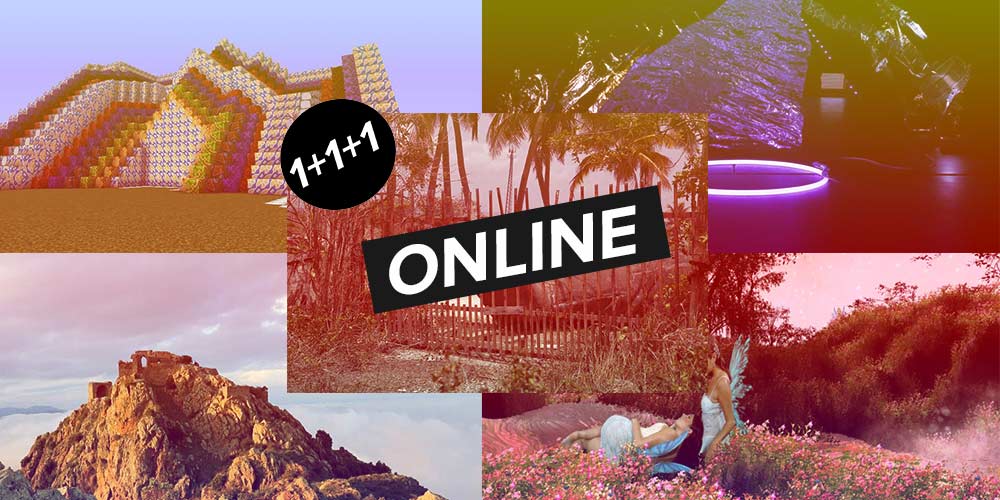
Between November 10th and 22nd, the Picasso Museum, the Centre Cívic Convent de Sant Agustí, the Museu Frederic Marés, and the Real Círculo Artístico will host a video of a local artist presented by a curator linked to the city of Barcelona, in an ideal chain operation aimed at celebrating the vitality of the local artistic framework and all its agents.
Artificialia WunderChapel (2020) by Agustín Ortiz Herrera, presented by Gabriel Virgilio Luciani
El Segundo Viaje (2015-2017) by Irene de Andrés, presented by Blanca del Río
They come from afar (2020) by Anna Dot, presented by Marta Pol Rigau
Locus Solus. Minecraft version by Alejandro Palacín, presented by Gisela Chillida Espinosa
Bolloisla (2020) by blanca arias, presented by edu rubix
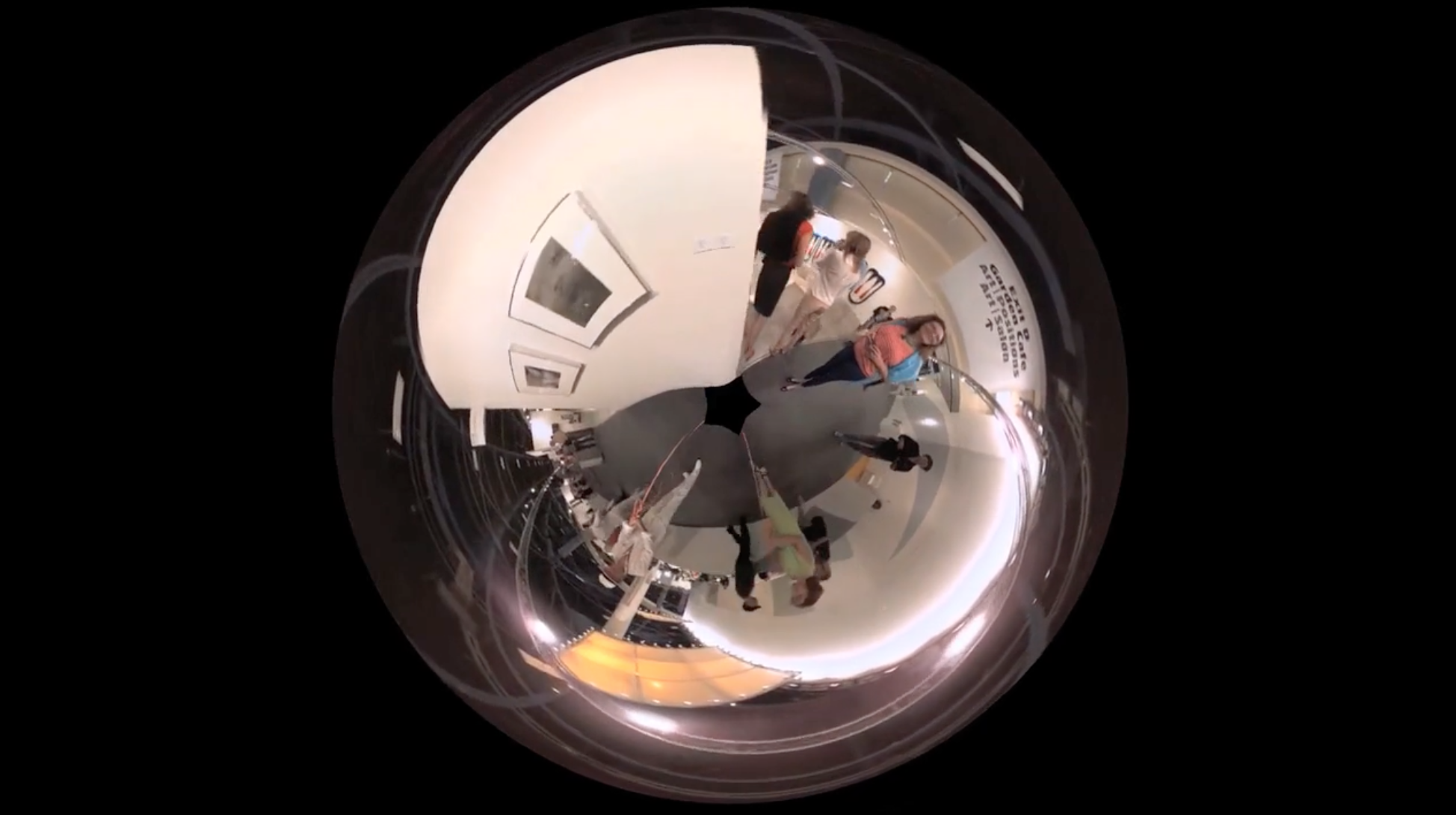
Tondo Artis: the (un)fair ground of contemporary art – a text by Frédéric de Goldschmidt
It all started with the Ladybug, a camera with an enigmatic and sensual name that allows filming in 360 degrees – and seeing as a fly does. Artist Marin Kasimir had assembled a group of 15 friends from the Brussels art world to help him acquire it. As a member of this XV Club, I thought to myself that our Ladybug could capture in a particularly striking way the Rundhof, the inner circular courtyard of the Basel Convention Center, which annually attracts the crème de la crème of the contemporary art world on the occasion of the preview of Art Basel.
Back in 2012, I could never imagine that this very simple idea of wanting to make a return on an investment in equipment –which came to me from my practical experience as an audiovisual producer–, would still preoccupy me eight years later.
At the time, I did not know Marin Kasimir very well, and I wasn’t aware of the fact that he would not be satisfied with one or two of those panoramic images that had made his reputation. From day one, some of the stolen sights and sounds did indeed titillate his curiosity and critical sense.
Art fairs are fly-catchers for collectors, journalists, curators and artists alike. They can’t help but wanting to go, no matter the risk of getting stuck to the sticky ribbon.
FOMO (Fear of Missing Out) is most intense at fairs. Gallery owners want to offer their best pieces, while visitors are afraid of missing the most beautiful party.
Never discouraged, and undoubtedly attracted as much by the quality of the works on display as by the superficiality of some visitors, Marin Kasimir did not stop visiting fairs and filming them. He returned to Basel twice, crossed the Atlantic two more times to attend the American edition in Miami –not to mention the multiple visits to the neighborly Art Brussels.
He explored art fairs during several springs, autumns and winters. Each trip featured the recording of fragments of conversations on the relationship between art and alcohol, art and sex, art and sport and, above all, art and money. During the summer break, he would ride the roller coaster of the Foire du Midi with his two boys, the funfair in the popular district of Brussels.
Tondo Artis: Fair or Unfair? brings together 18 minutes of the artist’s adventures in these high masses: as close as possible to the works, collectors and food plates. The video reproduces the artist’s vision on this great traveling party – one that is both caustic and fascinated.
Tondo Artis is a circular film not only in its format but also in its substance, having been Marin constantly looking for ways to refine the subject. His creative process seemed endless. Since I had agreed to participate in this adventure from the start, he regularly asked me for advice and support, either moral or financial.
A few months after the last contemporary art fair was held, the editing was finally over and I wondered if the film was the testimony of an era and of a phenomenon definitely bygone. Would FOMO have given way to JOMO (Joy of Missing Out)? Fair or Unfair? Now it’s up to the spectators to give their answer.

The city is Bologna, between 2019 and 2020, explored by the perception of a visually impaired boy waiting for the recognition of his Italian citizenship and a kid who suddenly finds herself spending her days at home.
Filmon has lived in Bologna for half of his life, studying political science, playing baseball in a team of visually impaired athletes and moving around the city’s arcades, squares and historic buildings with ease. Filmon does not think of the city as a map seen from above, his city expands from under his feet, widens like a star, always passing through the same points, unwinding in the smallest details of an endless ribbon, a maze of possible pathways recognized by touch and hearing. The urban tangle is domesticated by the physical action of walking, one day with a snappy body and another with a tired body, sitting on the fresh stones of the Public Library in the summer heat, locating a scent of warm lard in the still air of the autumn gouache or following the pungent smell of the detergent that dries along the streets in the spring breeze.
The second half of the film adopts the perspective of Ada, a ten-year-old girl who suddenly passes from the hustle and bustle of games with friends under the arcades of the center, to the silence of an empty house and a locked city in the midst of the pandemic. Ada tells the story of Filmon on the day he becomes an Italian citizen, a country he has never seen with his own eyes, while the city of the future Ada imagines is all different from the one that is about to turn on (reignite) again beyond her balcony.
The film is co-produced by “A-Place: Linking places through networked artistic practices” and LOOP Barcelona, subtitled in English and provided by the audio description in Catalan realized by Narratio, llengua i accessibilitat, SCP.
Co-founded by the Creative Europe Programme of the European Union and the project A-PLACE. Linking places through networked artistic practices.


The various approaches with regard to the genesis of places in the territory of L’Hospitalet have propelled us to try to see the contrasts or synergies that might result from staging together their respective methodologies and conclusions. Those approaches can be summed up into three main categories: the technical, the historical and the artistic. From those points of departure, we hope to weave a more complex and extended picture of an urban and social landscape that is stressed in many ways and remains a puzzling challenge to all those that try to activate and act upon it.
Part 1
Part 2
Part 3
The event will be conducted in Spanish and Catalan
With the support of:
The Creative Europe programme of the European Union

A-PLACE. Linking places through networked

LOOP Barcelona
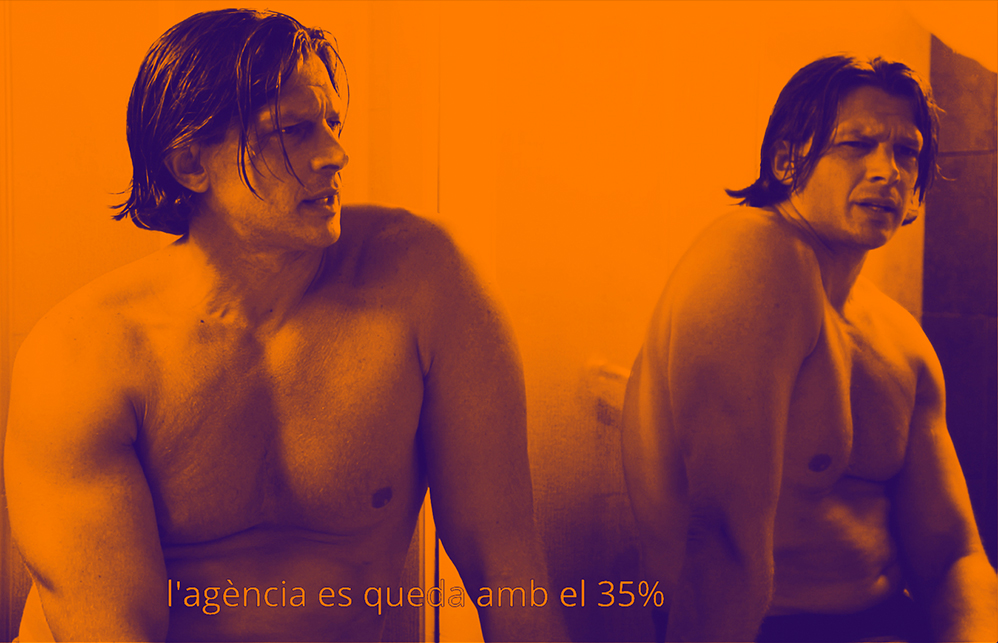
Rosa Brugat has delved into the opposite field of the other, in the masculine gender, to glimpse what happens on the other side, in the field of male prostitution, a kind of taboo that is not talked about and which reveals a completely different behavior of women in relation to desire, sex, pleasure and that, despite the apparent freedom and tolerance of today’s world, paid male prostitution remains a minority, an almost hidden luxury and to put it plainly, to be still even frowned upon Rosa Brugat has created the documentary € 100 an Hour, which talks about the male business. In February 2020 he presented it at the Cinema Retiro in Sitges and on June 30 at the Cinema Truffaut in Girona. Esteban, a male gigolo of Argentine origin, the cameraman, Andrea Resmini, Alexandra Planas as the client and Rosa Brugat as the nun took part.
El Temps de les arts – Pilar Parcerisas
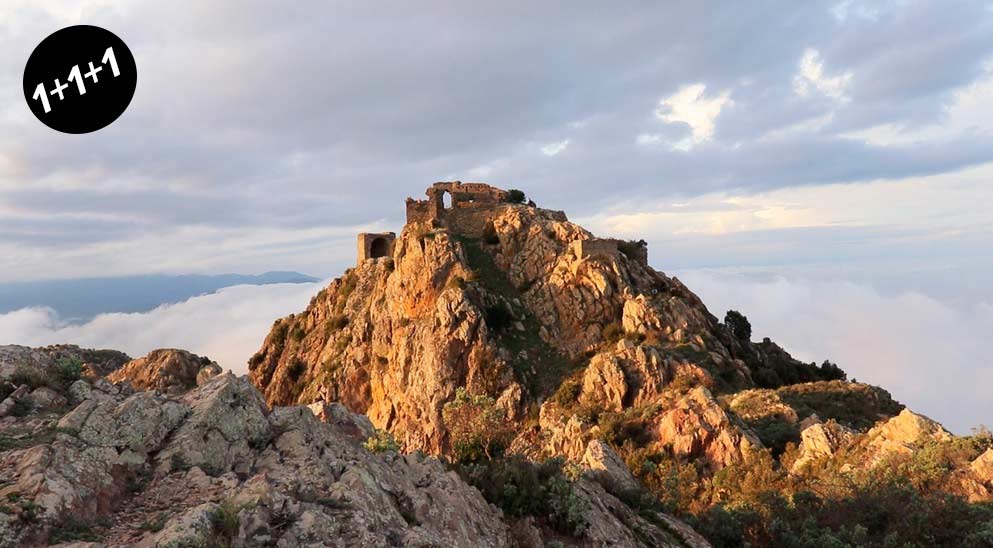
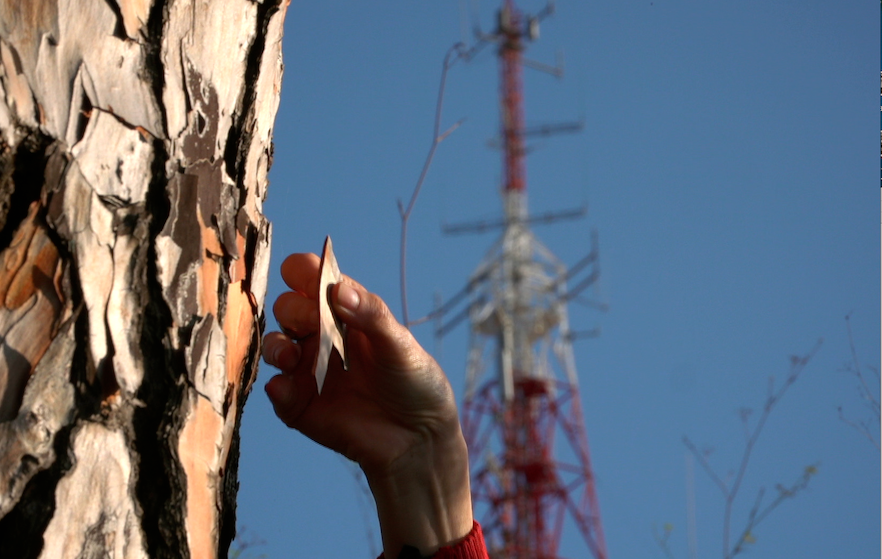
The village Vall de Santa Creu is crossed by many paths that allow us to cross the mountains of Rodes from a side to the other quite easily. With all this in mind, They Come from Afar is a walk initats at Palau Saverdera with destination to Vall de Santa Creu.
The route pass across many points that evidence the antiquity of these paths such as the group of dolmens of Fontasia, Sant Onofre church, Mas Ventós, Santa Helena church, Sant Pere de Rodes monastery and the stone huds that can be found around Coll Perer.
For centuries humans have been using these paths, crossing the mountains in all directions. But it’s been not only us. Also the birds cross them through their paths in the sky. This video piece begins from an initial parallelism between land and air routes.
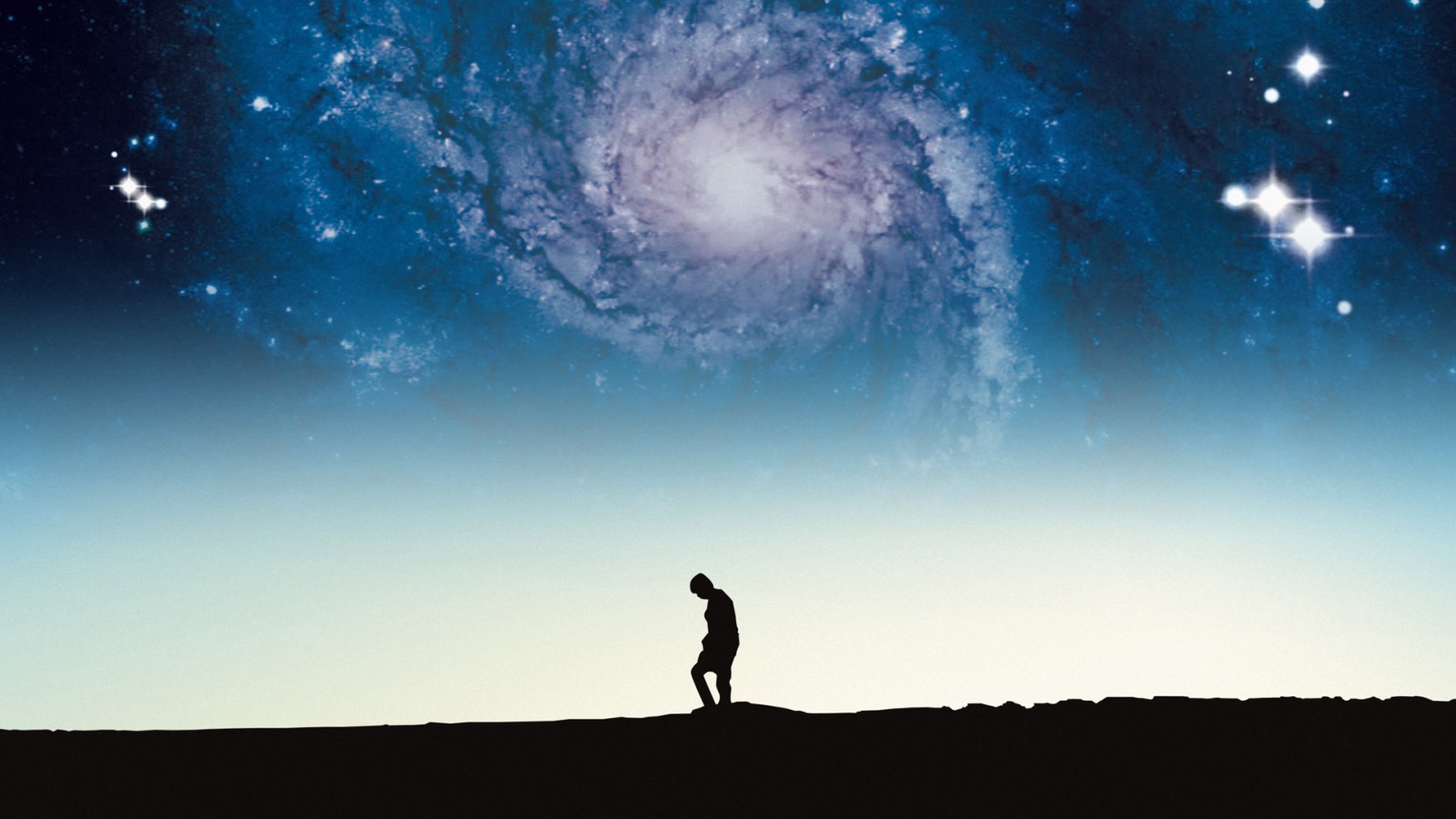
Nostalgia de la Luz (2010) is a film about the distance between heaven and earth, between the light of the cosmos and human beings, and the mysterious travels back and forth that bound them. In Chile, at an altitude of three thousand meters, astronomers from around the world gather in the Atacama Desert to observe the stars. Up there, the transparency of the sky allows you to see the borders of the universe. Below, the extreme dryness of the earth preserves the human remains intact: mummies, explorers, adventurers, natives, miners and the bones of the political prisoners of the dictatorship. As the astronomers search for extraterrestrial life, a group of women remove the stones, looking for their missing relatives.
The film places us somewhere between the beginning and the end, beyond the present. The gaze travels between the earth and the sky, between life-before-life and life-after-death. It tells us about the possibility of perceiving the traces of a previous life, where no one sees anything: the desert or the darkness of the universe.
As part of the project Becoming Immortal and Then Dying, presented by curator Caterina Almirall at La Capella, the film explores two different searches that happen in the same place, the desert, and that share the need to solve the question of origin, the need to remember. In a way the desert is a space that preserves the traces of the past, being simultaneously a vast museum to decipher and a necropolis.
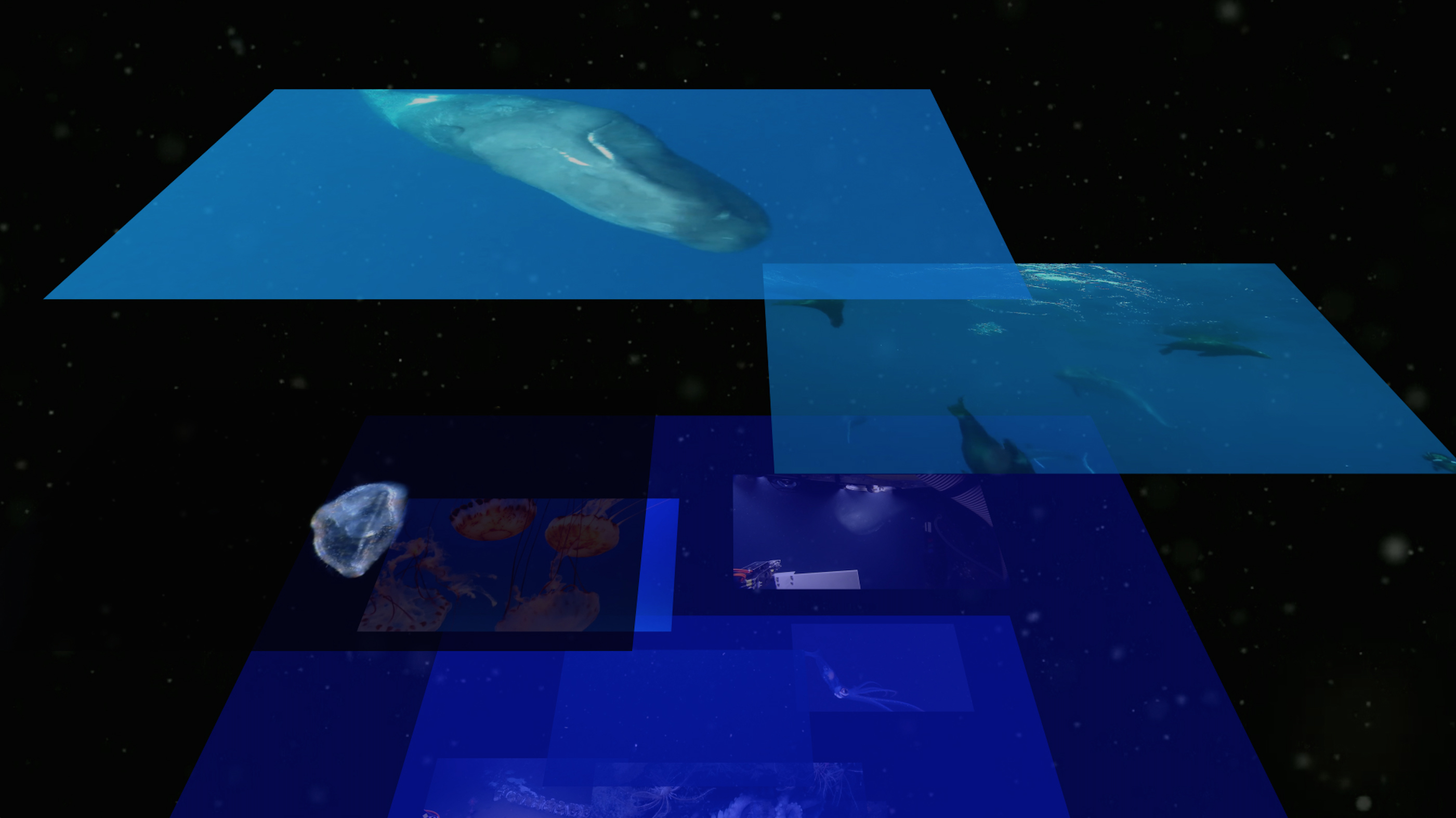
For its first collaboration with LOOP, TBA21–Academy presents the Inhabitants’ web series in the making What Is Deep Sea Mining? (2018-ongoing), as a curated online proposal on VIDEOCLOOP, the festival’s platform for the streaming of artists’ film and video. A project formed by artists Mariana Silva and Pedro Neves Marques, Inhabitants attempts to reinvent the modalities and aesthetics of factual investigation and documentary-making. The name of the duo echoes a straightforward geopolitical standpoint, while it pays tribute to Armenian filmmaker Artavazd Peleshyan’s homonymous short film, which depicts epic moments of animal migrations and stampedes. The series of episodes was commissioned by TBA21–Academy and made in collaboration with Lisbon-based curator Margarida Mendes. It pursues and highlights Inhabitants’ ecological and environmental agenda by looking at the topic of deep sea mining, a new frontier of resource extraction at the bottom of the ocean, set to begin in the next few years.